
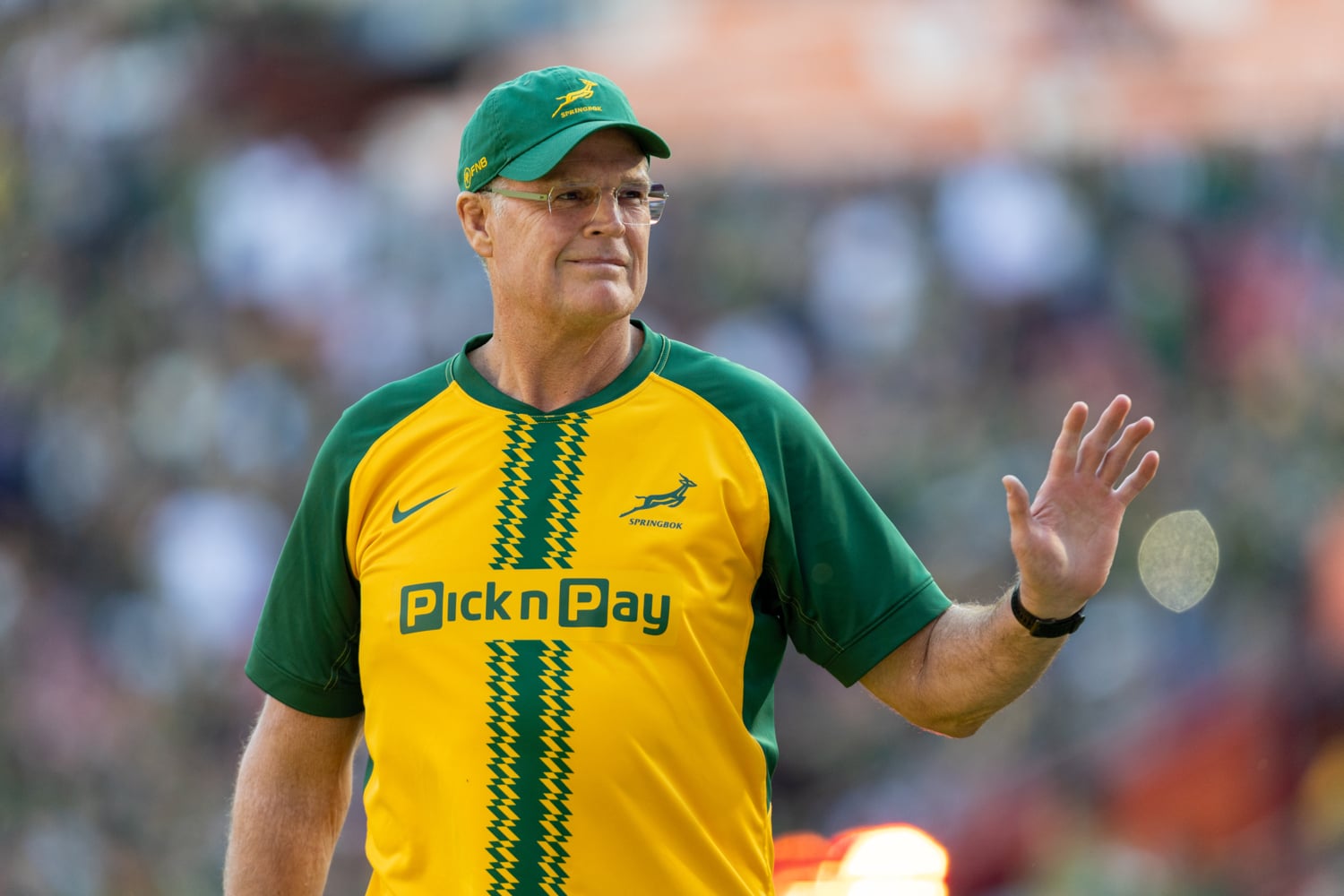
The Bok boss is spoiled for choice for the Test match in Perth next Sunday
The Springboks will now turn their attention to a one-off Test against the Wallabies in Perth next Sunday, and the central selection question is which combination coach Rassie Erasmus will trust for a physically demanding away assignment so soon after an intense series against New Zealand.
Managing workload after four brutal All Blacks Tests
The majority of the Springbok squad that travelled to Baltimore for last Saturday’s fourth Test against the All Blacks – a match the Boks won to take that series 3-1 – are not likely to feature against the Wallabies. Several front-line players have just come through four successive high-stakes encounters in what was billed as part of rugby’s oldest and most intense international rivalry.
Among those heavily used were Jesse Kriel, Damian de Allende, Jasper Wiese, Pieter-Steph du Toit, Eben Etzebeth, Ruan Nortje and Malcolm Marx. They started all four Tests, with some featuring for the full 80 minutes each time. Others, including Sacha Feinberg-Mngomezulu, Siya Kolisi, Wilco Louw, Thomas du Toit and Ox Nche, also logged substantial minutes, even if the front-rowers did not finish every game.
With that level of load on his core group, Erasmus has strong incentive to freshen up his squad. Rotation is no longer just a tactical preference for elite Test sides but a necessity, particularly for a team like South Africa whose game model is built on set-piece dominance, collision intensity and defensive line speed. Forwards in particular face strict player welfare protocols under the global framework overseen by World Rugby, and top unions manage minutes closely across the calendar.
Franchise demands and calendar pressure
Complicating Erasmus’s planning is the reality that many of his squad members will be required by their United Rugby Championship (URC) franchises over the next few days as teams build towards the start of the next URC season, which is scheduled to get under way next Friday, 25 September – just two days before the Boks’ Test in Perth.
That dual commitment highlights a familiar tension in the modern game: national unions want their best players in camp as long as possible, while club and franchise coaches need those same players in pre-season structures, especially for key positions like flyhalf, scrumhalf and tight-five forwards. For South African rugby, which now has URC teams competing week in, week out in the northern hemisphere structure, that balance has become a core strategic consideration.
Nations Championship on the horizon
Selection for Perth will also be shaped by the second part of the inaugural Nations Championship season, which takes place in Europe in November. The Springboks are scheduled to play:
- Italy – 7 November
- France – 14 November
- Ireland – 21 November
- A “finals game” – 28 November
Those fixtures, under the global Test window structure overseen by World Rugby, form the backbone of South Africa’s northern tour and will likely be treated as a key barometer of depth and adaptability against three distinct European styles before a final cross-pool encounter.
Given that schedule, it would be no surprise if Erasmus opts for a matchday-23 in Perth that looks very different from the combinations used for the bulk of the four Tests against the All Blacks. The Perth Test now doubles as both a stand-alone challenge in Australia and a selection trial for the November block.
Next men up: fringe Boks in line for Wallabies Test
Several players who were in the mix for the first two Tests against New Zealand, but less involved as the series evolved, could come back into focus for Perth. Jan-Hendrik Wessels, Zachary Porthen, Paul de Villiers, Marco van Staden and Cobus Wiese are all candidates to feature against Les Kiss’ Wallabies.
They are part of a wider selection pool that keeps South Africa competitive across an expanded international schedule. In particular, back-rowers like Van Staden and De Villiers offer continuity in the breakdown and defensive work-rate that underpins the Springbok identity, while young front-rowers such as Wessels and Porthen are being groomed for the long-term scrum succession plan.
Backline reshuffle and playmaking options
Beyond the pack, there is every expectation that the Perth Test could see a reshaped backline and fresh playmaking axis. Among those firmly in the selection basket are Aphelele Fassi, Edwill van der Merwe, Canan Moodie, Handré Pollard, Herschel Jantjies, Elrigh Louw, Ben-Jason Dixon, Ntuthuko Mchunu, Carlu Sadie, Boan Venter and Johan Grobbelaar. Also under consideration are Andre-Hugo Venter, Evan Roos, Quan Horn and potentially Vusi Moyo, Batho Hlekani and Haashim Pead.
For a one-off Test, the choice of flyhalf and halfback combination will be particularly closely watched. Pollard provides tactical kicking and game management, while a scrumhalf like Jantjies offers a different tempo from the base. Out wide, players such as Moodie and Van der Merwe bring finishing ability and aerial presence, with Fassi and Horn offering versatile options at fullback.
Opportunities for under-used All Blacks series squad members
There will also likely be room on the flight to Western Australia for players who did not see extensive minutes over the course of the New Zealand series but remain central to the broader Springbok project. That group includes Damian Willemse, Ethan Hooker, Kurt-Lee Arendse, Manie Libbok, Morné van den Berg, Cameron Hanekom, Deon Fourie, Lood de Jager and several props.
For these players, Perth offers more than just game time: it is a chance to restate their claims for Nations Championship involvement and, in some cases, to reaffirm their roles in a squad that has evolved through multiple World Cup cycles. Willemse’s versatility across the backline, Arendse’s counter-attacking threat, and De Jager’s line-out experience are clear examples of specialist skills that can reshape a Test match.
Injury watch and unresolved selection calls
Not every variable is in Erasmus’s control. The current injury status of Franco Mostert and Grant Williams has not been confirmed, and it is also unclear whether Vincent Tshituka, Jaco Williams and Embrose Papier will be considered for Perth.
Until those medical and selection calls are finalised, the precise balance between established Test regulars and emerging options remains open. For the coaching staff, that uncertainty reinforces the importance of a broad, integrated squad where players transitioning between Springbok duty and franchise rugby understand the systems and expectations in both environments.
Balancing legacy and evolution
Erasmus has no shortage of options. He is expected to name his lineup for the one-off match early next week, with the bulk of the Bok squad that travelled to the United States believed to still be in the Baltimore-New York area and set to fly directly to Australia later this week.
Beyond the immediate selection intrigue, the fixture in Perth sits within a broader strategic cycle for South African rugby. The Springboks, governed by the South African Rugby Union, must juggle their obligations across a crowded calendar, protect player welfare, and at the same time keep evolving tactically to stay ahead of major rivals in both the southern and northern hemispheres.
How Erasmus uses this Wallabies Test – who he rests, who he elevates, and which combinations he tests – will offer an early indication of how the world champions intend to manage the transition from an All Blacks-dominated block into a Nations Championship campaign that will again test their depth, resilience and adaptability at the very top level of the game.