
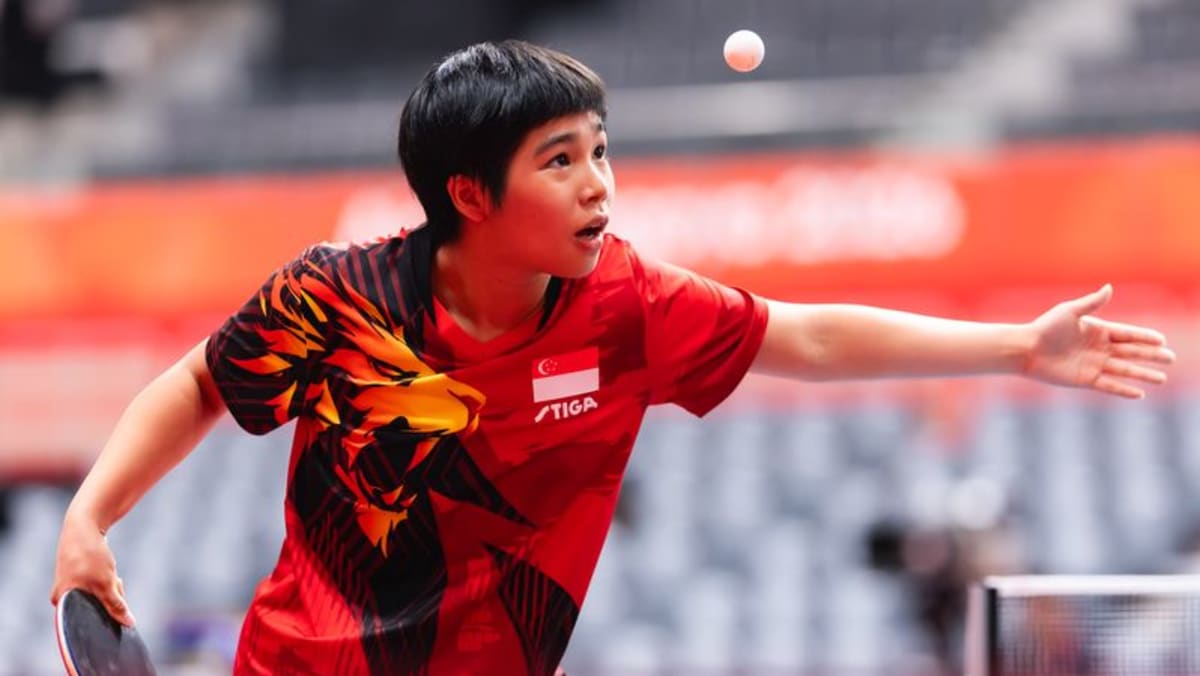
Singapore stun higher-ranked Hong Kong to reach Asian Games women’s team quarterfinals
TOKYO: Singapore’s women’s table tennis team produced a notable upset on Tuesday (Sep 22), overturning the rankings to defeat Hong Kong in a round-of-16 clash at the Asian Games and advance to the quarterfinals.
Hong Kong came into the tie as the ninth-ranked team in the event, with Singapore listed 15th. On paper, every individual match-up favoured Hong Kong: none of Singapore’s three players fielded was ranked above her opposite number.
Underdogs overturn the rankings
Singapore’s line-up featured Ser Lin Qian (world No. 83), Tan Zhao Yun (No. 109) and 15-year-old debutant Loy Ming Ying (No. 125). World No. 48 Zeng Jian, Singapore’s highest-ranked player, did not feature in the tie.
The match was played at Sky Hall Toyota, where nerves showed early on Singapore’s side. In the opening singles, Loy pushed world No. 63 Su Tsz Tung to a deciding game but slipped to a 2-3 defeat as Hong Kong claimed the early advantage.
Tan then delivered the first major swing of the tie, edging past world No. 35 Doo Hoi Kem 3-2 to level the contest and establish Singapore’s belief that the rankings gap could be bridged on the day.
Momentum swings in a five-rubber contest
Hong Kong restored their lead when world No. 81 Ng Wing Lam prevailed 3-2 over Ser in another tight singles, leaving Singapore needing to win the remaining two matches to stay alive.
Tan responded with a commanding performance in her second appearance of the tie, sweeping Su 3-0 to pull Singapore level once more and shift the pressure firmly onto Hong Kong.
That set up a decisive final rubber for Loy, still only 15 and making her Asian Games debut. Having lost narrowly in the opening match, she responded with an assured 3-1 victory to complete the comeback and send Singapore into the last eight.
Match facts
- Event: Women’s team, table tennis – Asian Games, round of 16
- Venue: Sky Hall Toyota, Japan
- Team rankings: Hong Kong No. 9; Singapore No. 15
- Singapore players fielded:
- Ser Lin Qian – world No. 83
- Tan Zhao Yun – world No. 109
- Loy Ming Ying – world No. 125 (15 years old, Asian Games debutant)
- Did not play: Zeng Jian – world No. 48
- Pre-match group records:
- Hong Kong – three wins from three in the group stage
- Singapore – two wins, one loss
Significance in the Asian Games structure
The Asian Games are the continent’s flagship multi-sport event, staged under the authority of the Olympic Council of Asia, and sit just below the Olympic Games in competitive stature for many national programmes. Table tennis has long been one of the strongest and most competitive sports at the Games, reflecting Asia’s global dominance in the discipline.
Within that context, a team ranked 15th eliminating a top-10 side that had topped its group unbeaten is a substantial result. It alters the balance of the women’s team draw and underlines that lower-ranked delegations can still make deep runs if they manage selection, form and match play effectively.
Impact on Singapore and Hong Kong
For Singapore, the win validates investment in a broader squad beyond its highest-ranked player. With Zeng Jian not fielded, the result shows depth in the women’s programme and highlights the value of emerging athletes like Loy gaining exposure in high-stakes matches.
Individually, Tan’s two victories over higher-ranked Hong Kong opponents reinforce her case for continued selection in key team ties and may influence future line-ups in regional and global events sanctioned by the International Table Tennis Federation.
For Hong Kong, exiting to a lower-ranked team after a perfect group stage suggests a missed opportunity in a draw where every round can affect broader programme assessments and resource allocation at national level. In a sport where continental performances often feed into decisions on long-term planning, such results can prompt technical reviews and adjustments, even without immediate ranking consequences listed here.
Next up: quarterfinal test against South Korea
Singapore’s reward is a quarterfinal meeting later on Tuesday with world No. 4 South Korea, one of the established powers in Asian women’s table tennis. The step up in opposition is significant: on rankings alone, South Korea enter as clear favourites.
For Singapore, the tie offers another opportunity to test its younger players in a knockout environment against elite opponents. Progress to the last eight already represents a strong return against seeding; any further advance would strengthen the team’s standing within Asia’s crowded competitive landscape and provide additional evidence that its next generation can compete with traditional powers.