
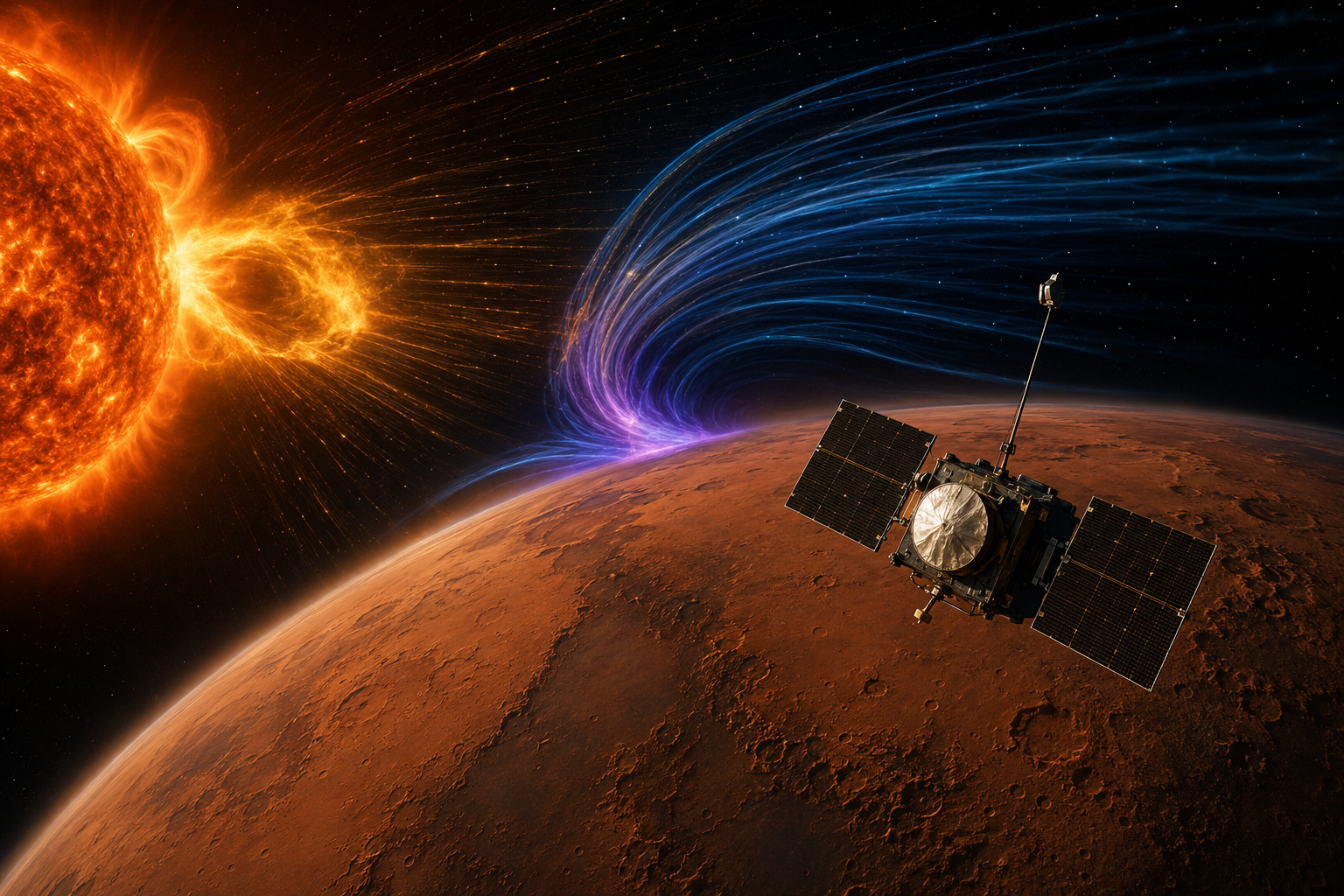
Mars has long been viewed as a vulnerable outpost in the solar system, lacking the robust global magnetic shield that protects Earth from the relentless onslaught of solar radiation. This exposure makes the planet a primary case study for understanding how space weather erodes atmospheres and impacts planetary surfaces. However, new data from NASA’s MAVEN spacecraft reveals that Mars possesses a more dynamic defense mechanism than previously understood, capable of actively manipulating incoming plasma during extreme solar events.
During a severe solar storm in December 2023, MAVEN captured the first direct evidence of the Zwan-Wolf effect occurring within the ionosphere of an unmagnetized planet. Historically, this phenomenon-where plasma is squeezed away from a stagnation region-was associated with Earth’s powerful magnetosphere. The discovery proves that Mars can induce a similar response through its ionosphere, effectively shoving plasma aside to create temporary density depletions and reshaping how scientists think about atmospheric protection on “unshielded” worlds.
The Physics Behind Plasma Dynamics on an Unmagnetized World
The Zwan-Wolf effect is driven by electromagnetic forces rather than physical collisions. Christopher Fowler, a planetary scientist at West Virginia University, explains the distinction between fluid dynamics on Earth and plasma behavior in the vacuum of space: “When solar wind, the continuous flow of plasma emitted by the sun, encounters bodies such as planets and comets, it is deflected around them, much like the flow of water in a stream is deflected around a rock,” he said, noting that this effect has typically been studied close to planets with intrinsic magnetic fields such as Earth and Jupiter.
Fowler notes that the comparison to water is limited: “Because the water in that stream is relatively dense, physical collisions between water molecules bumping into each other and the rock determine how the water is diverted. In contrast, the environment in space is so tenuous that solar wind particles do not bump into each other. Instead, electromagnetic forces control how particles are deflected around these bodies.” In other words, invisible magnetic and electric fields act as the real “obstacle,” sculpting the flow of charged particles around a planet.
On Mars, this happens via an induced magnetosphere. As solar wind drapes magnetic field lines around the planet’s dayside, it creates pressure gradients that can briefly behave like a magnetic shield. During the December 9, 2023, interplanetary coronal mass ejection (ICME), these gradients were amplified, allowing MAVEN to detect magnetic structures moving downward through the ionosphere. This process results in a sharp increase in magnetic field strength-roughly 50 nanotesla-accompanied by a 30% to 40% drop in ion density, a clear signature that plasma is being squeezed away from the region in front of the planet.
“The squeezing helps move the solar wind plasma around the planet, and it makes the plasma less dense in front of the planet,” Fowler said. “By finding this effect in the atmosphere of Mars, we are discovering new ways in which our sun can interact with and affect planets in our solar system. It’s amazing to think that an eruption on the sun can disturb the atmosphere of Mars 142 million miles away.” For mission designers, those disturbances are no longer an abstract concept but a measurable, recurring stress on spacecraft systems.
Infrastructure Risks and Space Weather Forecasting
Understanding these plasma rearrangements is not merely a theoretical exercise; it is a requirement for the survival of hardware and humans in deep space. As national space agencies and commercial operators plan for crewed missions and permanent robotic assets in Mars orbit and on the surface, the ability to forecast “invisible” plasma processes becomes critical. The discovery that the Zwan-Wolf effect can operate below normal detection limits suggests that current space weather models may underestimate the volatility of the Martian ionosphere during solar maximums, when the Sun is most active and regulatory thresholds for radiation exposure and spacecraft safety are most likely to be tested.
The following table outlines the primary technical risks associated with these atmospheric disturbances for future Martian infrastructure, from navigation constellations in low orbit to power and data links serving scientific bases on the ground:
| Risk Factor | System Impact | Mitigation Requirement |
|---|---|---|
| Plasma Depletion | Disruption of satellite-to-surface communication links and intermittent loss of positioning signals | Multi-band redundancy, adaptive signal processing, and failover procedures baked into communications standards |
| Ion Heating | Increased degradation of spacecraft thermal shielding and sensor noise in critical avionics | Advanced radiation-hardened materials and design rules harmonized with human spaceflight safety norms |
| Magnetic Compression | Induced currents in long-range electrical conduits, power grids and tethered systems | Galvanic isolation, surge protection systems, and infrastructure codes that assume extreme space weather scenarios |
| Atmospheric Rearrangement | Unpredictable orbital decay for Low Mars Orbit (LMO) assets and higher fuel demands for station-keeping | Autonomous station-keeping propulsion and operational rules that allow rapid orbit adjustments during storms |
Detection Limits, Solar Amplification and Governance of Risk
One of the most significant takeaways from the MAVEN data is the role of “lucky timing.” The Zwan-Wolf effect likely occurs on Mars during quiet solar periods, but its signature is too faint for current instrumentation to resolve. The December 2023 storm acted as a natural amplifier, pushing the phenomenon into a detectable range and giving policymakers and engineers a rare, high-contrast look at a process that may normally sit below design margins and safety guidelines.
“We think this effect could occur in the Martian atmosphere all the time, but it’s usually such a small effect that our instruments aren’t sensitive enough to detect it,” Fowler said. “The solar storm really hit Mars hard and disturbed the entire space environment around the planet. This seems to have amplified the Zwan-Wolf effect so that we could observe it during this time period. We got lucky, being in the right place at the right time with MAVEN to see this.” For agencies that must certify spacecraft and habitats under codified radiation and spaceflight standards overseen by bodies such as the United Nations Outer Space Treaty, that “luck” is an early warning that future rules may need to account for more subtle, cumulative plasma effects as Mars traffic grows.
Implications for the Broader Solar System
The discovery expands the known behavior of non-magnetized bodies. Because the induced magnetosphere is a common feature of worlds lacking an internal dynamo, the Zwan-Wolf effect likely manifests on Venus, Titan, and various comets. This suggests a universal mechanism for how the MAVEN mission’s targets and similar bodies manage solar wind pressure, and a common playbook for how future orbiters and landers in those environments might encounter sudden, localized changes in plasma density and magnetic field strength.
While the researchers noted that the observed ion heating was modest and unlikely to drive significant atmospheric escape, the ability of space weather to rearrange plasma inside an ionosphere remains a critical variable. For future robotic and human exploration, the “invisible” architecture of a planet’s ionosphere will be just as important as its surface topography in determining the safety and viability of long-term habitation. As Mars inches closer to becoming a destination for sovereign and commercial crews, findings like these are likely to move quickly from specialist journals into the risk registers, design baselines and diplomatic conversations that will determine how humankind shares and safeguards another world.