
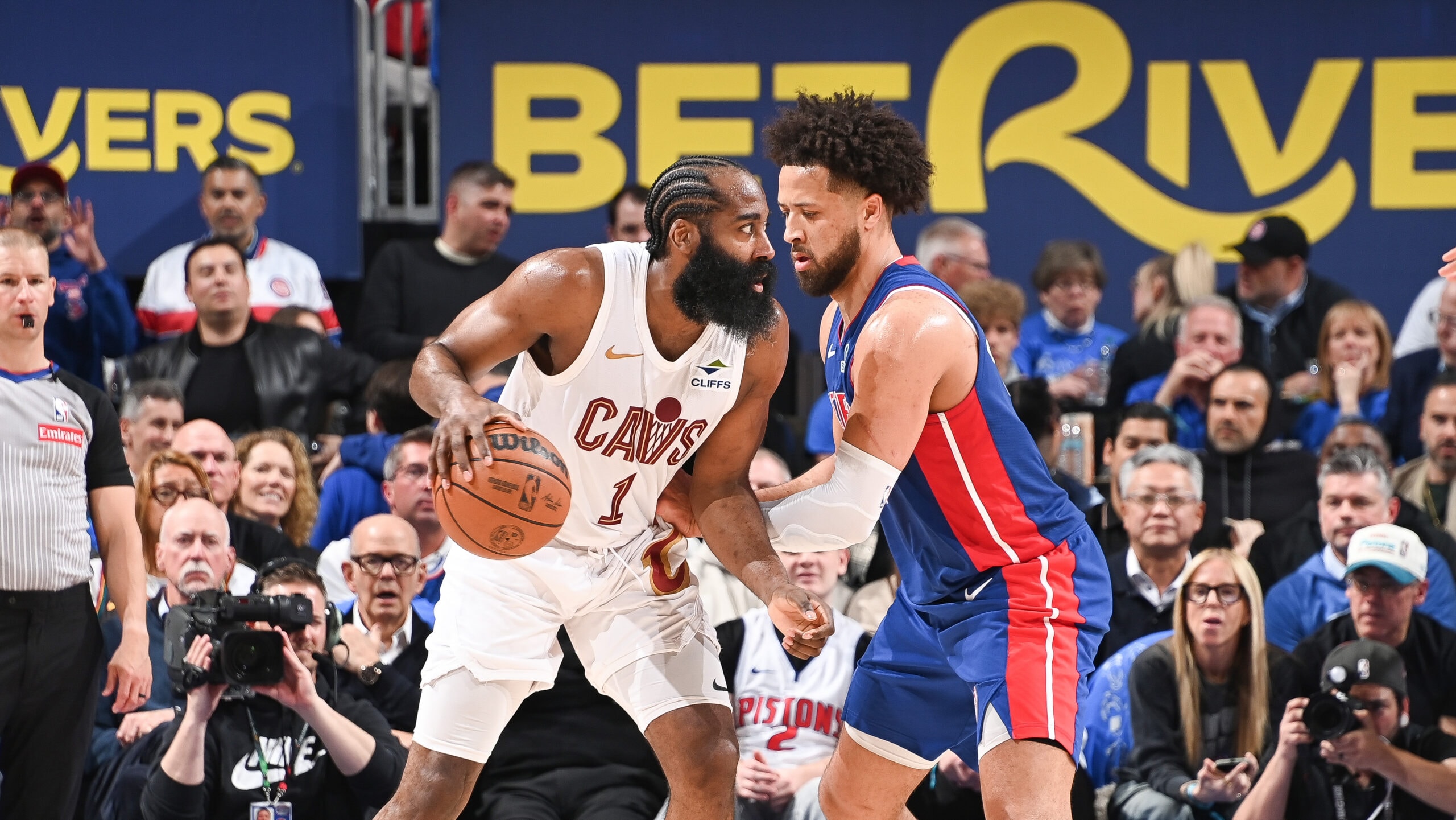
James Harden and the Cavaliers look to advance to the Eastern Conference Finals with a Game 6 win against Jalen Duren and the Pistons. (Photo by Gregory Shamus/Getty Images)
The NBA playoffs reach a critical juncture this Friday with a doubleheader of Game 6 matchups on Prime Video. Both the Cleveland Cavaliers and the San Antonio Spurs enter their respective contests with a significant statistical advantage; historically, teams that win Game 5 when a series is tied 2-2 go on to win the series 81.7% of the time, underscoring how quickly best-of-seven series can tilt under the league’s collective bargaining and playoff-format framework.
Cleveland’s Path to the Conference Finals
The Cleveland Cavaliers host the Detroit Pistons at Rocket Mortgage FieldHouse, aiming to extend their unbeaten home record in the 2026 playoffs. A victory tonight would secure a second-round series win and mark the first career Eastern Conference Finals appearance for Donovan Mitchell in his nine seasons in the league – a milestone with implications for Cleveland’s long-term roster-building and salary-cap planning under league rules.
Detroit arrives in Cleveland following a narrow 117-113 overtime loss on Wednesday in Game 5, a contest in which the Pistons surrendered a nine-point lead in the final minutes. While Cade Cunningham delivered a game-high 39 points in that defeat, the Pistons require broader offensive support to extend the series and protect the competitive credibility of a young core that has been rebuilt through the draft and recent trades.
A key tactical battle will center on Cunningham and Dean Wade, whom Cleveland employs as the primary initial defender to disrupt the MVP candidate’s rhythm before help rotates from the weak side. The Cavaliers have also used Harden and Mitchell selectively on Cunningham to change looks and force the ball out of his hands.
Cleveland’s depth has proven decisive, with Max Strus contributing 20 points and six three-pointers in Game 5, supported by five assists from Dennis Schröder in a stabilizing role off the bench. The Cavaliers’ starting rotation remains anchored by Mitchell’s 30.6 points per game and the interior presence of Evan Mobley and Jarrett Allen, whose rim protection and rebounding have allowed Cleveland to control tempo and late-game possessions.
Cavaliers projected starting lineup & 2025-26 season averages:
- PG: James Harden (21.0 ppg, 4.8 rpg, 6.8 apg)
- SG: Donovan Mitchell (30.6 ppg, 5.8 rpg, 2.8 apg)
- SF: Dean Wade (3.2 ppg, 4.0 rpg)
- PF: Evan Mobley (14.4 ppg, 6.8 rpg, 5.2 apg, 3.0 bpg)
- C: Jarrett Allen (13.4 ppg, 5.8 rpg, 1.6 bpg)
Pistons projected starting lineup & 2025-26 season averages:
- PG: Cade Cunningham (26.6 ppg, 5.2 rpg, 8.4 apg)
- SG: Daniss Jenkins (9.8 ppg, 3.8 rpg, 3.2 apg)
- SF: Ausar Thompson (8.0 ppg, 6.6 rpg, 3.6 apg)
- PF: Tobias Harris (18.2 ppg, 6.8 rpg, 1.4 spg)
- C: Jalen Duren (9.4 ppg, 6.6 rpg, 1.0 spg)
Detroit’s rotation may see further shifts in the frontcourt. Paul Reed has emerged as a high-efficiency option, recording 10+ points in three consecutive games on 15-for-20 shooting, and playing over Jalen Duren during the fourth quarter and overtime of Game 5. How head coach Monty Williams balances Reed’s floor spacing and mobility with Duren’s size and rebounding will be a central strategic decision in a win-or-go-home scenario.
For both franchises, the stakes extend beyond the box score: a berth in the conference finals unlocks additional national broadcast exposure and revenue, strengthens each front office’s case for its current roster-construction strategy, and influences the leverage of star players and agents in upcoming off-season negotiations.
Minnesota’s Defensive Crisis Against San Antonio
In the second game of the evening, the Minnesota Timberwolves host the San Antonio Spurs in their own Game 6, trailing 3-2 in the series. Minnesota enters attempting to recover from a dominant 126-97 loss on Tuesday, a defeat that puts them on the brink of elimination and raises fresh questions about a roster built – and heavily paid – around size and half-court defense.
The disparity in interior scoring has been the defining factor of the series. In Game 5, the Spurs outscored the Timberwolves 68-36 in the paint, a gap that Minnesota must close to force a Game 7 on Sunday. San Antonio has consistently leveraged high ball-screen usage and off-ball motion to pull Minnesota’s bigs away from the rim, opening lanes for drives and cuts.
The burden falls heavily on Anthony Edwards, who struggled in the previous outing, shooting 6-for-13 for 20 points across 39 minutes of play. Minnesota needs both a more aggressive Edwards and cleaner defensive rotations around him; otherwise, San Antonio’s balanced attack and disciplined spacing – hallmarks of the organization’s longstanding institutional philosophy – are likely to decide the series.
Beyond this series, the outcome may help shape how both front offices interpret the league’s current competitive environment: whether size and rim protection can still anchor a deep playoff run, or whether more switchable, perimeter-oriented lineups become a necessity in future roster and draft decisions.
Injury Report and Availability
Personnel availability will play a role in tonight’s tactical adjustments, particularly for the Detroit Pistons, who regain key perimeter scoring and spacing options. Health management is governed by team medical staffs working within league-wide player health and safety protocols, but in high-leverage playoff moments, those decisions quickly become basketball ones as well.
| Team | Player | Status | Injury |
|---|---|---|---|
| Detroit Pistons | Duncan Robinson | Available (6th man) | Lower back |
| Detroit Pistons | Kevin Huerter | Available | Adductor |
| Detroit Pistons | Caris LeVert | Available | Heel |
| Minnesota Timberwolves | Terrence Shannon Jr. | Questionable | Head contusion |
For Detroit, the return of Robinson and Huerter gives Williams the option to field multiple plus shooters around Cunningham and Harris, potentially stretching Cleveland’s defense and forcing the Cavaliers to choose between staying big at the rim or matching up on the perimeter. For Minnesota, Shannon’s availability adds a measure of athleticism and on-ball defense the Timberwolves have missed in stretches; if cleared, he could see situational minutes against San Antonio’s secondary scorers.
As both Game 6s unfold, the decisions made on rotations, matchups and late-game execution will reverberate well beyond Friday night, informing how these organizations navigate the constraints and opportunities of the league’s governing system – from contract extensions and luxury-tax thresholds to future playoff seeding in a Western and Eastern Conference that only grows more competitive.