
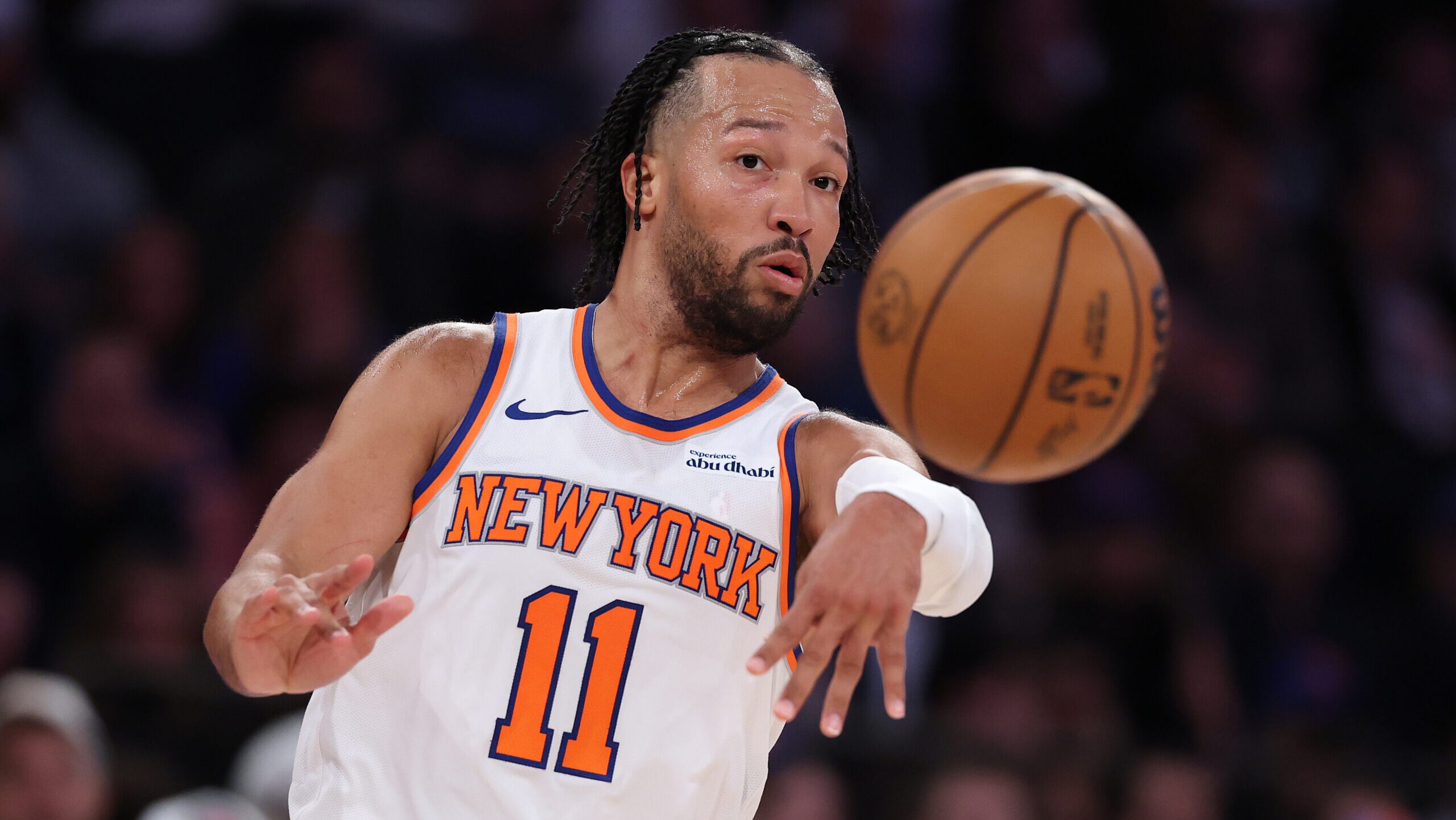
Cleveland defeats New York, 115-107, to improve to 6-6 while the Knicks fall to 6-5.
Champions Searching for Rhythm: Knicks Sit at 6-5 After Home Loss to Cavaliers
NEW YORK – The New York Knicks are 6-5 after a loss at home to the Cleveland Cavaliers on Wednesday, a 115-107 defeat that underlined how thin the margin has been early in their title defense.
It’s a mediocre start for the defending NBA champions when set against the context of the opposition they have faced so far. Through Wednesday, their schedule ranks as the league’s ninth-easiest in terms of cumulative opponent winning percentage (.460), and only one of their six victories has come against a team with a winning record (Detroit).
For a team that just produced one of the most dominant championship runs in recent NBA history, the standings in mid-November are not decisive on their own. The Knicks were 7-4 after 11 games last season, so this year’s 6-5 mark leaves them just a single result behind that benchmark.
But the early schedule still matters. Results in October and November shape seeding, tiebreakers and travel demands in April and May, especially in a conference where home-court advantage and rest days can decide best-of-seven series. New York steadied themselves with a four-game winning streak before the Cavs’ visit, yet Wednesday’s loss highlighted both ongoing offensive issues and the structural strengths that continue to underpin their profile as contenders.
What follows is a deeper look at the data through Wednesday, Nov. 11 – where the Knicks have slipped, where they have stabilised and which trends will matter most when the calendar turns toward the postseason and the in-season Emirates NBA Cup intensifies.
Offense: Production Up, Efficiency Pockets Lag Behind
The Knicks opened their title defence with a three-game stretch in which they scored just 103.4 points per 100 possessions, a run that would have ranked as their second-worst three-game offensive segment across all of last season. Since then, the overall scoring has climbed, but several core pieces of the attack are still misfiring in ways that directly affect late-game execution and half-court reliability.
Mikal Bridges off to a slow start
Among 169 players with at least 75 field goal attempts so far, Mikal Bridges ranks 168th in true shooting percentage (40.2%). His shot profile, usually one of the most stable elements in any offense he plays in, has dipped sharply:
- 47% shooting in the paint, a career low.
- 2-for-13 (15%) from mid-range, another career low.
- 26% from beyond the arc, also a career low to this point.
He has attempted just four free throws in 268 minutes, and his minutes have been cut back significantly of late. For a wing who is often tasked with attacking closeouts and punishing smaller defenders, the lack of rim pressure and foul drawing reduces the diversity of New York’s offense and increases the usage burden on Jalen Brunson and Karl-Anthony Towns.
Jalen Brunson’s struggles in the paint
The Knicks’ biggest offensive drop has come inside. Their field goal percentage in the paint has fallen from 58.3% (11th in the league last season) to 51.7% (30th) this season – the steepest decline in the NBA.
That slide has multiple contributors. Bridges has been part of the problem, and Andre Drummond has shot 20-for-47 (43.5%) in the paint in his new role as back-up center, replacing Mitchell Robinson, who finished 72.3% in the paint last season.
But the most surprising number belongs to Brunson. The All-Star guard is converting just 41.8% of his attempts in the paint, the second-worst mark among 105 players with at least 50 field goal attempts inside, and down sharply from 54.9% over his first four seasons with the Knicks.
There are early signs of a correction: Brunson has gone 16-for-30 (53.3%) in the paint over the last four games. If that trend stabilises, it would restore an essential part of New York’s late-game playbook, where Brunson’s craft and footwork have traditionally forced defences to collapse, opening corner three-point looks and weak-side cuts.
Late-clock execution has regressed
The Knicks have long been comfortable operating late in the shot clock, playing through isolations and high pick-and-rolls that shrink the margin for error but leverage their star talent. This season, that approach has been far less efficient.
They currently post an effective field goal percentage of 41.5% in the final seven seconds of the shot clock, the league’s fifth-worst mark and down significantly from 51.2% last season.
| Season | eFG% | Rank | %FGA | Rank |
|---|---|---|---|---|
| 2022-23 | 50.0% | 4 | 21.7% | 3 |
| 2023-24 | 47.2% | 18 | 24.5% | 1 |
| 2024-25 | 49.9% | 2 | 21.9% | 5 |
| 2025-26 | 51.2% | 2 | 21.6% | 4 |
| 2026-27 | 41.5% | 26 | 22.8% | 4 |
eFG% = (FGM + (0.5 * 3PM)) / FGA
%FGA = Percentage of total field goal attempts
Coach Mike Brown was asked on Wednesday whether his team was playing with enough purpose offensively.
“Not yet,” he replied. “At times, yes. But we’re not always in a good flow right now, which is fine, because there are other ways to win a basketball game while we’re trying to work on that.”
In the context of the 82-game regular season, that comment underlines the balance Brown must strike: sustaining a system good enough to bank wins now, while also refining late-clock sets, spacing and usage patterns that tend to decide playoff series where scouting is more detailed and pace slows.
Karl-Anthony Towns Anchoring the Half-Court from the High Post
Amid the offensive volatility, Karl-Anthony Towns has emerged as New York’s most stable and efficient hub. He has scored more points than the 20.9 per game he is averaging this season, and a true shooting percentage of 65.9% would make this the most efficient campaign of his career.
While Brunson has struggled around the rim, Towns is finishing at a career-best level. He is 57-for-87 (65.5%) in the paint, significantly ahead of his previous marks and reflective of a role that combines post scoring with perimeter playmaking.
Towns is averaging 44.1 high-post touches per 100 possessions, the seventh-highest rate in the league and his highest figure in three seasons with the Knicks. When one of those touches leads directly to a shot, turnover or trip to the free throw line, New York is scoring 1.26 points per chance, ranking third among 92 players with at least 100 such direct high-post touches.
That combination of efficiency and volume offers Brown flexibility in how he arranges his rotation. High-post usage allows the Knicks to:
- Run offense through Towns against bigger frontcourts without overloading Brunson’s on-ball responsibilities.
- Open cutting and screening angles for role players who benefit from movement-based touches rather than static spot-ups.
- Maintain half-court structure even when second units stagger around Towns rather than a traditional point guard.
He has been aggressive driving against opposing centers, using his mobility to turn face-ups into paint touches, and he has consistently found team-mates on the move from those alignments.
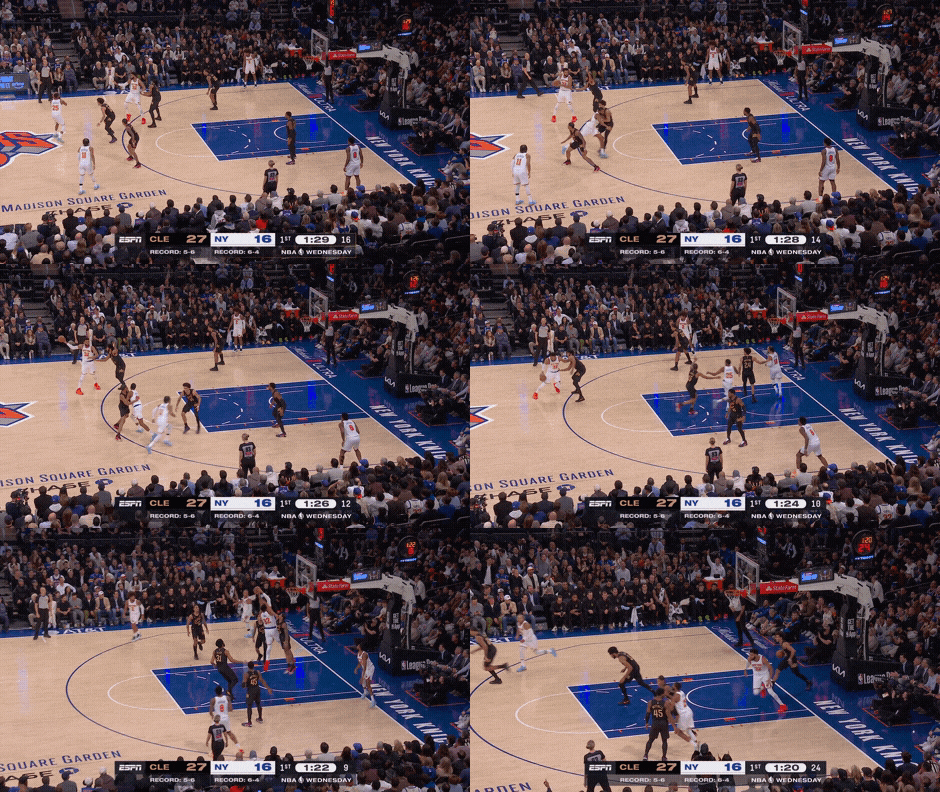
And he’s been dropping dimes to teammates on the move:
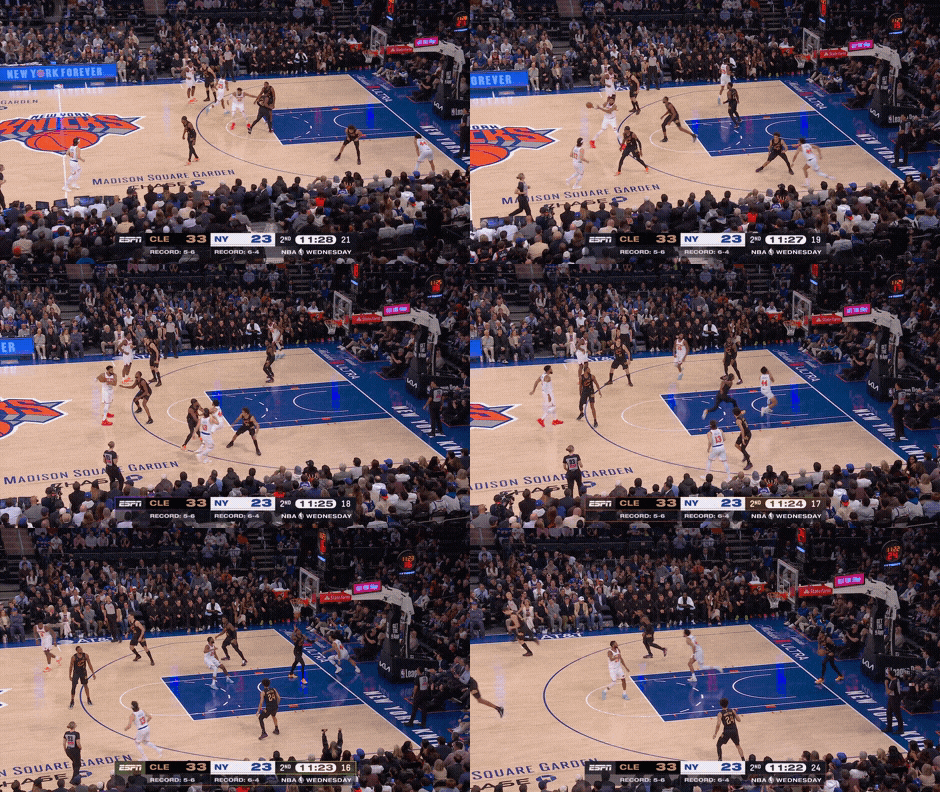
Turnovers remain a weakness for Towns, especially when he is asked to initiate so many possessions, but the upside of his high-post creation has been central to keeping New York’s overall offensive rating inside the league’s top 10 despite individual shooting slumps.
Rebounding Edge Keeps the Knicks in the Possession Battle
Even with Towns’ giveaways and a defence that does not generate many steals or forced errors, New York has protected its possession differential – a key marker for sustained success across an 82-game schedule and into playoff series where each extra shot attempt can swing a game.
The Knicks do not force many turnovers on the defensive end, yet they still rank fourth in the “possession game,” with 4.0 more shot opportunities per contest than their opponents. The primary reason: they have been the best rebounding team in the league so far this season.
They lead the NBA in offensive rebounding percentage (37.9%) and rank second in defensive rebounding percentage (72.6%). That dominance has translated to the scoreboard, with New York outscoring opponents by 7.4 points per game on second-chance opportunities.
Andre Drummond has not replicated Mitchell Robinson’s finishing or rim protection, but he has broadly matched Robinson’s work on the glass. More significantly, Towns has improved his own rebounding numbers every season in New York, recording a career-high mark in rebounding percentage in each campaign.
He is currently just ahead of Drummond for the highest defensive rebounding percentage (33.1%) among 323 players averaging at least 10 minutes per game.
For a team eyeing another deep postseason run, that combination of offensive rebounding and secure defensive rebounding provides a buffer when the shooting fluctuates. It also supports Brown’s willingness to persist with certain lineups while he tries to reset the offensive rhythm, knowing his team will usually win the volume of attempts even if the efficiency is temporarily below par.
Paint Protection Remains a Defensive Cornerstone
The offensive paint struggles have a mirror image on the defensive end, where New York remains one of the league’s most disciplined and effective units around the basket.
The Knicks are one of three teams – alongside the Boston Celtics and Oklahoma City Thunder – that rank in the top five both in opponent field goal percentage in the paint (53.6%, fourth) and in limiting the share of opponent shots that come at the rim (41%, third).
League-wide, teams have taken 43.1% of their shots from beyond the three-point line, which would represent the highest rate in the 48 seasons since the three-point line was introduced. Even in that context, the most efficient scoring area remains the restricted area and short paint, so protecting the rim continues to be the first defensive priority for serious contenders.
For the second consecutive season, the Knicks rank in the top four in opponent points in the paint per 100 possessions, reinforcing that their interior defence is not a one-year outlier but an embedded structural strength.
Lowest opponent FG% in the paint
| Team | FG% | %FGA | Rank | PITP/100 | Rank |
|---|---|---|---|---|---|
| Oklahoma City | 49.8% | 41% | 2 | 36.6 | 2 |
| Boston | 51.8% | 40% | 1 | 36.1 | 1 |
| San Antonio | 52.6% | 49% | 26 | 46.2 | 16 |
| New York | 53.6% | 41% | 3 | 39.7 | 3 |
| Detroit | 54.3% | 46% | 12 | 43.5 | 5 |
%FGA = Percentage of total opponent FGA
PITP/100 = Points allowed in the paint per 100 possessions
For international audiences, this kind of interior dominance is often a key differentiator when the game slows in playoff series or cup knockout rounds. It limits easy baskets, forces opposition offences into a higher volume of contested threes and mid-range attempts, and reduces the strain on individual perimeter defenders who might otherwise be overextended.
Stronger Underlying Profile Than the 6-5 Record Suggests
When the individual issues in the paint and in clutch execution are set alongside the broader analytics, the Knicks’ underlying profile still aligns with that of a serious contender.
Despite their shooting problems around the rim, they rank 10th in offensive rating. Even after conceding heavily against Cleveland, they stand seventh in defensive rating. Within the Eastern Conference, they are one of only two teams currently ranking in the top 10 on both ends of the floor.
The Knicks and the Houston Rockets are also the only teams yet to lose a game that was not within five points in the final five minutes. Their clutch metrics themselves have been poor, but the overall point differential – plus-6.8 per game, ninth in the league – is marginally better than at the same stage last season, when they were 7-4 with a plus-6.7 differential.
Statistically, that point differential corresponds more closely to the record of an 8-3 team than a 6-5 one. Over a full regular season, such discrepancies tend to narrow, which is why front offices and coaching staffs place significant weight on net rating and possession-based metrics when evaluating whether to alter rotation patterns or personnel.
Road Trip, Emirates NBA Cup and the Next Phase of the Season
New York now embark on a four-game road trip that opens with an Emirates NBA Cup fixture in Indiana on Friday (7 p.m. ET, Prime). The in-season competition, integrated into the regular calendar, adds a parallel trophy pathway that can affect a club’s commercial and sporting profile even before the traditional postseason begins.
The Knicks are the only team to have reached the Cup quarterfinals in each of the competition’s first three years, but they lost their first East Group B game this year in Philadelphia against the 76ers. That context increases the importance of every remaining group-stage fixture, with point differential and head-to-head results part of the tie-breaking structure as teams look to secure progression.
For a defending champion already navigating the physical and tactical demands of a long title defence, a strong Cup run has several implications:
- Additional high-intensity games against quality opposition before the All-Star break, useful for stress-testing late-clock sets and high-post actions built around Brunson and Towns.
- Potentially increased media and commercial exposure, as Cup fixtures gain more weight in the broader global calendar.
- A further test of roster depth, particularly in the frontcourt, where Drummond and Towns must carry heavy rebounding and rim-protection responsibilities.
In the broader context of the regular season, the upcoming road swing and Cup schedule offer an early checkpoint. If Brunson’s finishing continues to recover, Bridges finds rhythm, and Brown’s staff can sharpen the late-clock offense without sacrificing defensive structure, the underlying metrics suggest New York remain well placed to secure a strong seed and a manageable playoff path – even if the first 11 games have lacked the fluency expected of reigning champions.
* * *
This analysis is produced for GlobalHeadlinez Sports, providing international readers with context on competition format, analytics trends and the evolving landscape of top-level professional basketball.