
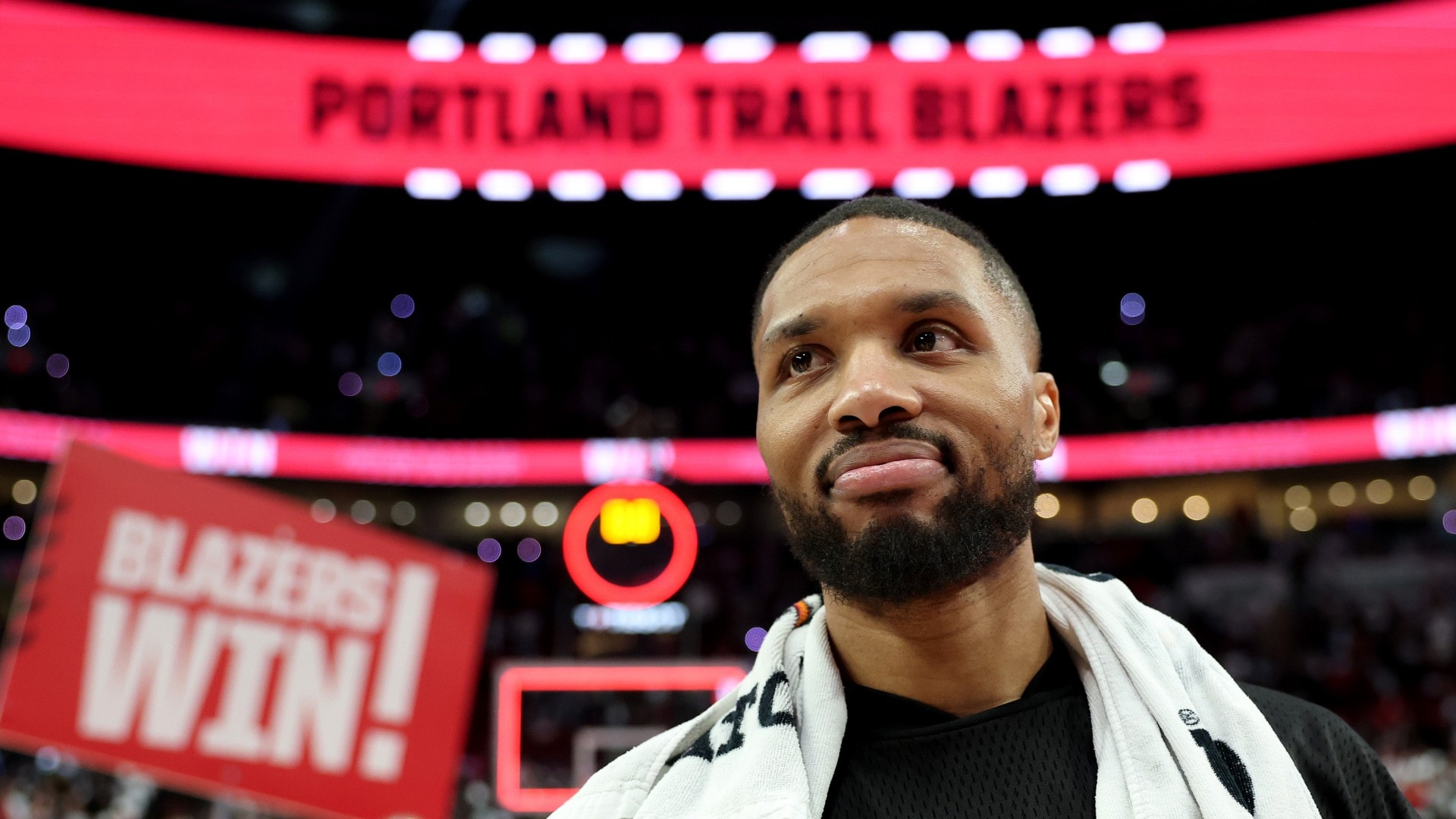
Damian Lillard’s Portland Return Is Rewriting What a Franchise Icon Can Be
Damian Lillard is averaging 20.6 points per game since returning to Portland.
There were 1,309 days and 256 Portland Trail Blazers games between the time Damian Lillard left the franchise and when he returned, and in retrospect, the player and team should’ve counted every one of them.
His final game before departing was March 22, 2023, a win at Utah. Lillard finished with 30 points and 12 assists, then sat the final 10 games of that season with calf tightness. Portland dropped nine of those contests, including a 56-point loss to Golden State that underlined both his frustration and how dependent the Blazers had become on his presence.
Until then, Lillard had started every game he played for Portland, 830 straight including the postseason. That level of availability shaped not only the Blazers’ identity but also their roster planning.
The calculation shifted in the summer of 2023, when Portland used the No. 3 overall pick in the NBA Draft on point guard Scoot Henderson and projected him as the long‑term leader of the backcourt. By the autumn, Lillard was effectively the point guard of the past: he requested a move and was traded to the Milwaukee Bucks, ending an 11‑year first chapter in the Pacific Northwest.
His return in a Blazers uniform came last month in a 41-point home win over the Phoenix Suns. Lillard scored 25 points, but the box score could not capture the significance of the evening. The defining image was the prolonged ovation inside Moda Center, a full‑arena embrace that felt as much like a civic reunion as a sporting occasion.
The city, for various and obvious reasons, needed Dame. And Dame, for various and obvious reasons, needed Portland.
After more than two years apart, it shows.
“I have a lot of joy,” he said.
From the night he was drafted in 2012, the connection between player, city and franchise has been unusually tight. At 36 and coming off a year’s inactivity following left Achilles tendon surgery, he is no longer quite the same deep‑range supernova who routinely pulled up from 30 feet, but the threat is still there. So is the renewed noise around the only major men’s professional team in a city defined by its basketball culture.
Lillard is averaging 20.6 points per game in his second Portland stint, and the Blazers are winning again with his influence at the core. In a league where player movement is baked into the collective bargaining landscape, the sight of a long‑time star returning and immediately slotting back into the competitive frame gives this story league‑wide resonance.
“It’s all a journey … that’s what we spend our entire lives working towards, getting to continue to push on this journey,” he said.
The mechanics of how he left are no longer the focus inside the arena. What matters now is that the reunion feels both emotionally permanent and competitively relevant.
“The grass isn’t always greener but you have to learn that,” said former Blazers coach Terry Stotts, who spent more seasons on Portland’s bench with Lillard than any other coach. “He missed the comforts and continuity of his life in Portland. It was the realization that home is home.”
Community, Continuity and a Different Kind of Franchise Player
Relationships between high‑profile athletes and the cities they represent are often framed as lifelong bonds. In practice, they are usually conditional arrangements governed by salary‑cap realities, performance curves and front‑office strategy.
Lillard and Portland have pushed back against that pattern. Their connection is partly about his résumé – he is a nine-time All-Star – but equally about how his public persona mirrors the city’s self‑image.
Portland behaves like a small market even as it competes on a global NBA stage. The Blazers are treated locally less as a corporate product and more as neighbors. Lillard, despite his stature, has consistently behaved in ways that make it easy for residents to see him as one of their own. While many teammates have typically left town in the offseason for larger markets and warmer climates, the Oakland‑born guard has described Portland as “home.”
That word is not just sentiment. It is reflected in the infrastructure he has helped put in place around the city’s schools.
Molly Ouche, principal at Parkrose High School, saw that first‑hand in 2017 when she approached Lillard to help re‑energize her student body. He agreed to visit the school and used that appearance to launch what would become a multi‑school youth initiative.
“This isn’t going to last, maybe just a year,” she remembers thinking about his cooperation. “He’ll come and go. It’s not sustainable.”
Nearly a decade later, the project is still running. It has expanded to two other Portland high schools and a middle school. The RESPECT program encourages, identifies and rewards respectful behavior from students, built on three core values: Show Up, Work Hard and Be Kind. The NBA’s own structures around community engagement give that kind of initiative a formal backdrop, but Lillard’s presence is what gives it local credibility.
“He has made regular appearances in different capacities,” Ouche said. “He has done whole school assemblies and small groups with our leadership kids. Every spring we have senior commitment day. He came last year and just kind of hung out, took a million pictures. He gave a short speech but it wasn’t about his career. It was about celebrating them.”
During the pandemic, when in‑person visits were impossible, Lillard shifted to video, asking a simple operational question: “How do we make this work?”
For teenagers who have grown up with the NBA as a global entertainment product, a direct message from a star can be transformative. Lillard regularly salutes individual students with social‑media shout‑outs; within school communities, those acknowledgments carry weight that no poster campaign can replicate.
“One student had just lost her grandmother and father and said she was so happy Dame took the time to do that,” Ouche said.
His impact extends beyond structured programming. Around the city, there are stories of Lillard quietly supporting local businesses or individuals, often unannounced and without publicizing the interaction. During his time with Milwaukee, he still returned to Portland in the offseason to run his camp – a small but telling indicator that his professional relocation did not come with an emotional one. Initially, he handed out Bucks gear at those sessions. Over subsequent summers, the visual identity of the camp shifted again as his career did.
“I don’t know if he knows the depth of his impact or hears the stories about him that I get to hear,” Ouche said. “There’s just something in him that keeps him committed to this community. I’m sure it fills his cup or else he wouldn’t be giving as much.”
The reciprocity of that relationship is clear. Lillard draws energy from a fan base that has rarely turned on him, even in moments of upheaval, while the city benefits from the stability of a star who is visible in everyday civic life.
“Everyone loves him,” Ouche said, “and he hasn’t given anyone any reason not to.”
In franchise history terms, that distinguishes him from the two other players who broadly sit in the same tier of Blazer mythology: Bill Walton and Clyde Drexler.
Walton, the former league MVP and centerpiece of Portland’s only championship team, exited on acrimonious terms after accusing the club’s medical staff of mishandling his foot issues. Drexler, who led the Blazers to multiple deep playoff runs, eventually engineered his way to his hometown Houston Rockets in pursuit of a title alongside Hakeem Olajuwon. Neither Walton nor Drexler ultimately re‑established Portland as their primary base.
“I believe he’s the greatest Blazer ever and it’s more than just the points, it’s what he does for the city,” said Stotts. “He’s ingrained in the fabric of the city. Portland appreciates that. Nobody begrudged him when he left to go to Milwaukee and they embraced him when he came back. He’s very open about his feelings for the city and what that means to him.”
That level of civic integration has competitive implications. In a league built on the standard player contract and free agency structures of the NBA’s governance framework, franchises in smaller markets often struggle to convince top‑end talent to commit long term. Lillard’s decision to return – and to re‑invest publicly in the city – becomes part of Portland’s broader argument that it can be a career destination, not merely a developmental stop.
Milwaukee Detour and the Value of Discomfort
The most significant physical setback of Lillard’s career – the left Achilles injury he suffered during the 2024‑25 season with the Bucks – carried structural consequences well beyond the injury report.
He required a full year to recover. For Milwaukee, a franchise constructed around Giannis Antetokounmpo’s prime contention window, that absence necessitated a recalibration. By cutting Lillard loose before last season, the Bucks made a hard salary‑cap decision and, in effect, returned him to Portland.
“I thought it was a necessary experience,” Lillard said of his Milwaukee stint. “It was an experience that I needed.”
Yet he never fully settled. His children remained in Portland. On the floor, while his understanding with Antetokounmpo was respectful, it was not always seamless, and Milwaukee did not progress beyond the first round of the playoffs during his time there – although the Bucks did win the 2024 Emirates NBA Cup.
By all accounts, the moment that crystallised his feelings came not in Wisconsin but back in Oregon, during Milwaukee’s first visit to Portland post‑trade. The sellout Moda Center crowd delivered a sustained ovation through his introduction and tribute video, and the noise in the building had the feel of something closer to a civic rally than a routine regular‑season engagement.
“It was probably the most moving experience you could have at an NBA game,” said Ouche. “The love for Dame, you could feel it. Incredible to be there, incredible to see.”
For the Blazers, that evening doubled as an institutional reminder. In the modern NBA, where the balance of power between players and front offices is constantly negotiated, the reaction underscored just how central Lillard remained to the franchise’s identity even while wearing another jersey.
Playoff Legend: The Shots That Defined a Generation
What played out in that tribute was rooted in specific on‑court moments. Lillard’s relationship with Portland fans is not built solely on symbolism; it is also grounded in the kind of playoff resume that reshapes a franchise’s timeline.
Twice, he has ended first‑round series at the buzzer in ways that have entered the wider NBA canon.
In 2014, Portland trailed the Houston Rockets by two points in Game 6 with eight‑tenths of a second remaining. Lillard cut off a screen, demanded the inbounds pass with a clap of his hands and released a catch‑and‑shoot three that dropped as the horn sounded, sending the Blazers through and detonating an eruption in the arena.
Lillard’s game-winning 3-pointer in Game 6 pushes Portland past Houston in the first round of the 2014 playoffs.
In 2018, with the series against the Oklahoma City Thunder tied to his legacy as much as the standings, Lillard walked the ball into the frontcourt in the closing seconds of Game 5, sized up Paul George and launched a 37‑footer. The shot dropped, he waved the Thunder off the floor and disappeared under a pile of celebrating teammates.
Lillard on his game winner vs. OKC.
“What was cool about that shot against OKC was the clock was counting down and you didn’t know what would happen, but the anticipation of what was going to happen was building, because the ball was in his hands,” said Stotts. “To do that twice in your career is amazing.”
Those sequences elevated Lillard from All‑Star to appointment viewing. The deep shooting range, the visible self‑belief and the familiar motion of him tapping his wrist to signal “Dame Time” combined into a distinctive personal brand.
“I know what I bring to a team,” he said. “I’m a big shot-maker.”
For an international audience, those moments also contextualise why his return has sporting consequences beyond Portland. In a league driven by playoff currency, the presence of a guard with a track record of deciding postseason games changes how opponents script late‑game defensive schemes and how television partners package marquee match‑ups.
A Rebuilt Blazers Core and Renewed Competitive Ambition
Lillard’s homecoming is not a nostalgic gesture for a rebuilding side. It lands at a time when the Blazers have already begun to climb out of their longest drought of the era.
The team snapped a six‑year absence from the postseason last spring. Since then, the front office has added not only Lillard but also Ja Morant, who arrived looking for a reset, as well as retooled around a core that now features Deni Avdija as an All‑Star and leading scorer. With Jrue Holiday also in the backcourt, Portland fields four players with All‑Star experience: Avdija, Morant, Holiday and Lillard.
This is not the 33‑win roster he walked away from in 2023. The talent distribution is broader, and the hierarchy less dependent on one individual’s usage rate. For Lillard, that matters late in his career, both in terms of workload and in the sustainability of any playoff push.
“It’s just a matter of playing for each other, doing the right things, playing the right way,” he said. “If our mentality is right, we can really be a tough time for everybody. We can be a dangerous team.”
Functionally, the presence of multiple primary ball‑handlers allows coach and front office to manage minutes differently, particularly in dense parts of the schedule. The NBA’s calendar, with back‑to‑backs and extensive travel, usually asks veteran guards to balance high‑usage nights with stretches of off‑ball play. Lillard’s willingness to let others initiate while still leveraging his gravity as a shooter fits that trend.
He enters this phase after a full rehabilitation year that doubled as the longest physical reset of his career. The rhythm has not fully returned; his own assessment is that his shooting efficiency still needs sharpening. Yet the danger remains obvious enough that leaving the league’s fifth all‑time three‑point scorer unmarked is an organisational risk.
New York saw that firsthand when he buried a game‑tying three in the final seconds last Saturday after the Knicks’ defence gambled. In a league defined by scouting and data‑driven decision‑making, those kinds of reminders tend to travel quickly.
His first 30‑point game since March 2025 arrived last week as well, with a 33‑point performance against his former team, the Bucks. The match‑up carried obvious narrative weight but, as far as Lillard was concerned, this was less about revenge than numbers: the kind of output you expect from a guard closing in on 23,000 career points.
“I think the thing I’m most happy with or most excited about is I know that I’m not completely back all the way connected,” he said. “I’ve been able to be as productive as I have without fully getting all the way back in form. I know there’s more to come.”
For the Blazers, that assessment is central to medium‑term planning. A fully re‑integrated Lillard alongside younger All‑Stars gives Portland a pathway to sustained playoff relevance in a Western Conference that has regularly shifted under the pressure of superstar movement and collective bargaining changes.
Home, Legacy and the Broader Meaning of Lillard’s Second Act
The larger story of Lillard’s return is not just that a former face of the franchise came back. It is that, following major surgery and a high‑profile move to a contender built around another global star, he chose to reset where his legacy began.
Within the NBA’s global ecosystem – with its draft‑and‑salary‑cap rules, luxury‑tax lines and player‑option decisions feeding into every transaction – that choice carries a message to other elite players who began their careers outside the largest American markets. It suggests that leaving for a title push elsewhere need not end a relationship with an original fan base, and that coming back can be more than a ceremonial final stop.
The institutional upside for Portland is clear. A city that once watched key figures leave and never truly return now has its most modern icon back on court, back in the community and back in the national television window. For a franchise whose commercial and competitive fortunes are closely tied to one building and one regional market, that alignment matters.
The personal dimension is simpler. In this anticipated return season, with the schedule circling the American holiday calendar, Lillard has arrived at a conclusion that resonates well beyond sport: after detours, injuries and shifts in competitive context, the place that makes the most sense for him – professionally and personally – is the one where his NBA story began.
Damian Lillard is whole again. The Blazers are relevant again. And in Portland, where basketball and community are rarely separated, the sense this year is that the franchise and its defining guard have rediscovered the same answer: the best place to be on Thanksgiving is home.