
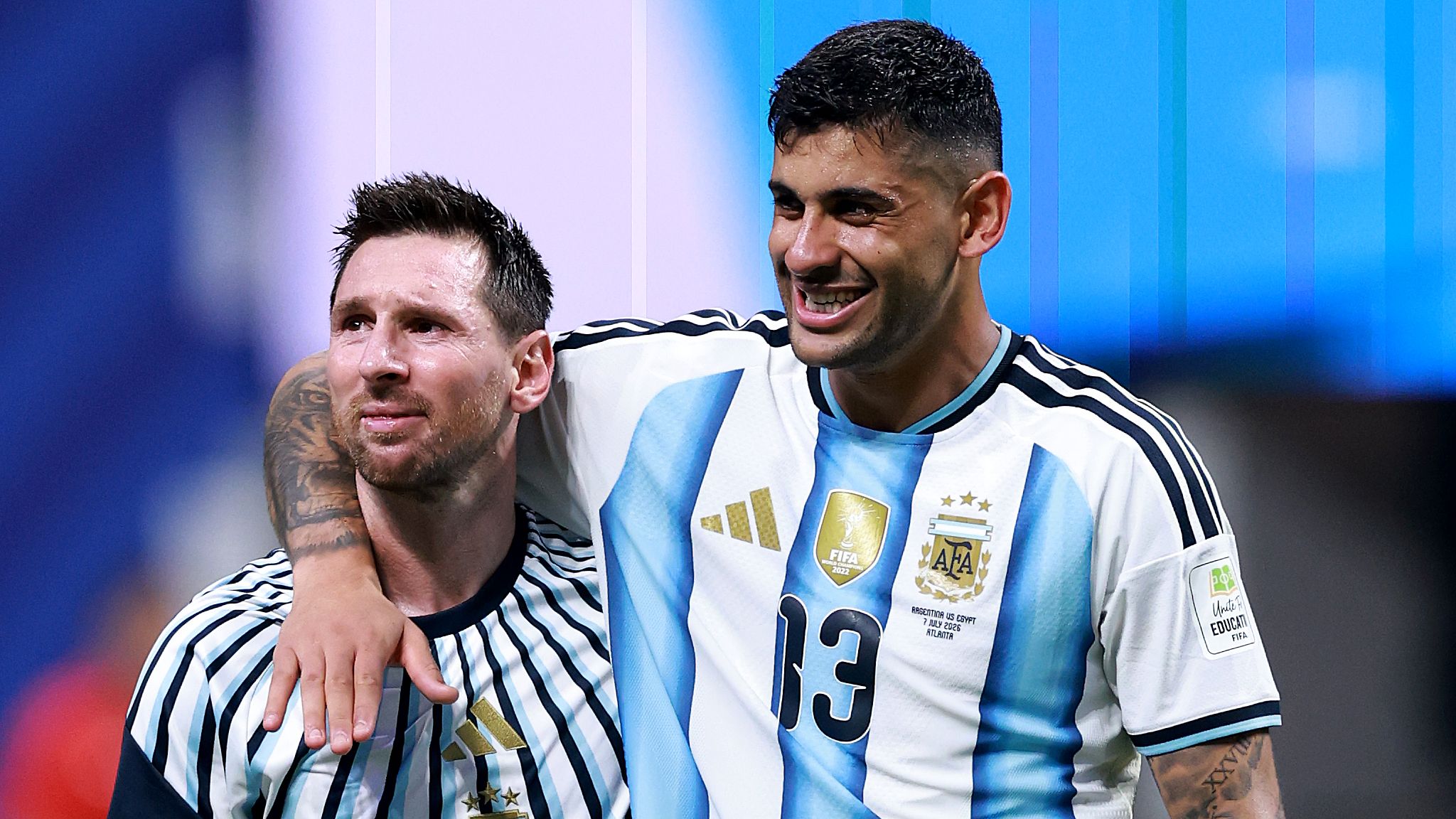
Romero and Simeone Praise Messi as Ballon d’Or Debate Shifts Toward Football’s Future
An unshakeable admiration for the legendary playmaker underpins the conviction that no contemporary rival can match his sustained excellence. That perspective fuels the argument that individual voting criteria will change drastically once the veteran officially hangs up his boots. Reiterating the talisman’s singular status at the summit of the game, Romero declared: “There is nobody else like Messi. I keep saying it.”
Lamenting how promotional appeal could decide future winners, the centre-back continued: “Surely, once Messi decides to call time on his career, we’ll have to see who they give the Ballon d’Or to. To whichever player has the most marketing power, because that is pretty much what it comes down to.”
Similar backing for the forward came from Atletico manager Diego Simeone last week. Assessing who merits the Ballon d’Or, he noted: “Messi, without a shadow of a doubt. After the World Cup he had, at his age, without any doubt, Messi.”
Messi’s Place in an Award Dominated by Individual Brilliance
Romero’s comments tap into a long-running discussion around Lionel Messi’s position in the modern game and his relationship with the Ballon d’Or, the annual award organized under the authority of world football’s governing framework overseen by FIFA. While the prize is formally a distinction for individual performance, the defender’s remarks highlight how one player’s influence has come to shape expectations of what “the best” looks like in elite football.
Messi’s sustained excellence at club and international level has repeatedly placed him at the centre of Ballon d’Or debates. For players, coaches and voters, his presence has effectively set the benchmark for attacking contribution, decision‑making in decisive matches and consistency across domestic and international calendars.
From Performance to Profile? Concerns Over a Post‑Messi Era
Romero’s fear that “marketing power” could become decisive once Messi retires crystallises a wider anxiety within the game: that commercial reach might increasingly compete with pure footballing merit when awards are handed out. In an era of global broadcasting, digital audiences and commercial partnerships, star profiles often extend far beyond the pitch.
For current professionals, this matters in concrete ways. Individual honours can influence:
- contract negotiations and image‑rights valuations
- national‑team status in tightly contested positions
- club hierarchy perceptions when assembling squads around key figures
If future Ballon d’Or voting is perceived to be swayed by commercial appeal rather than footballing output, it risks altering how players and clubs approach branding, media exposure and even competition scheduling for marquee names.
Simeone’s World Cup Reference and the Weight of Major Tournaments
Diego Simeone’s assertion that Messi is the outstanding Ballon d’Or candidate “after the World Cup he had” underscores the central role major international tournaments continue to play in shaping the award’s narrative. World Cups, continental championships and global club competitions are widely viewed as the ultimate testing ground for elite players under pressure.
When a senior coach at a leading European club frames his assessment around World Cup impact and age, he is implicitly reinforcing two long‑standing criteria for Ballon d’Or voters: decisive influence on the biggest stage, and the ability to maintain that level deep into a career. Messi’s performances at international level have therefore become a reference point not only for fans but also for peers and managers evaluating what constitutes an award‑winning season.
For national teams, that standard shapes selection debates. A player capable of delivering at that level strengthens the case for building tactical systems around him, even late in his career, while younger talents are judged against a bar that has been elevated by such World Cup campaigns.
Implications for the Next Generation of Contenders
Both Romero’s and Simeone’s perspectives look beyond Messi himself and toward the structural questions facing the sport. Once a player of his stature is no longer active, voters will be presented with a more fragmented field of candidates whose claims may derive from different competitions, positions and styles.
In that context, clubs and agents are likely to place growing emphasis on visibility in high‑profile tournaments governed under the broader international match calendar, as well as on a player’s ability to carry branding and leadership responsibilities. Outstanding seasons in domestic leagues or continental club competitions may still be decisive, but the balance between on‑field performance and off‑field profile could become even more scrutinised.
For emerging stars, the message is clear: technical quality and decisive contributions remain the foundation of any Ballon d’Or case, yet the environment around the award is evolving. The transition away from an era defined by a single, dominant figure will test how firmly football’s institutions and stakeholders can keep individual recognition aligned with what happens on the pitch.
A Debate That Reaches Beyond One Player
Ultimately, the endorsements from Romero and Simeone are more than tributes to one of the game’s greatest playmakers. They reopen a broader discussion about how global football chooses its standard‑bearers, how much weight is given to World Cup campaigns and whether the sport can insulate its most prestigious individual honour from the growing pull of commercial influence.
As long as Messi remains active, the comparison point remains unusually clear. Once he steps away, the criteria that Romero and Simeone are now challenging will be tested in full view of players, clubs and supporters worldwide, in a landscape where both sporting integrity and market forces are in constant negotiation. For award organisers, voters and governing structures, maintaining trust in that process will be as important as the trophy itself.