
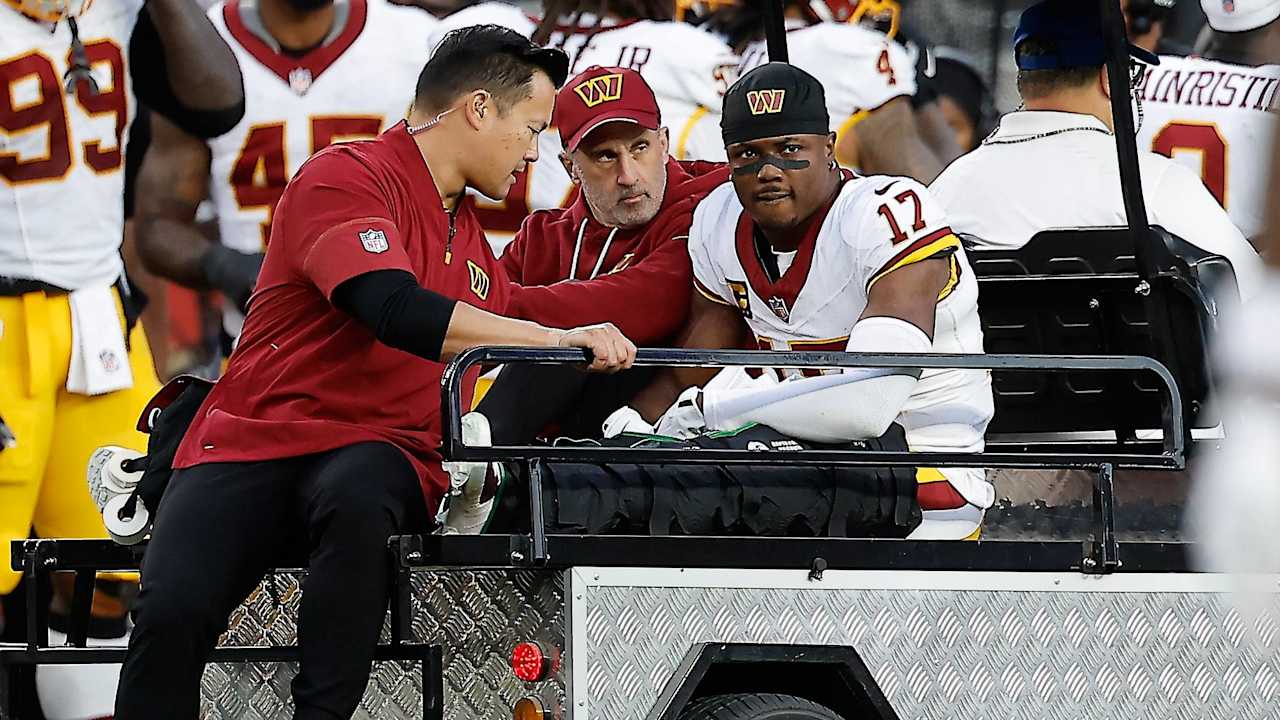
Commanders Face Offensive Reset After McLaurin Injury as Diggs Steps Into No. 1 Role
Washington’s already fragile offense has been thrust into full-scale transition. With Terry McLaurin carted off with a left knee injury and placed in an air cast after an early 27-yard reception against San Francisco, the Commanders now move forward expecting Stefon Diggs to become rookie quarterback Jayden Daniels’ primary receiving option, while multiple depth pieces are pushed into significantly expanded duties.
McLaurin Blow Leaves Diggs as Daniels’ Focal Point
McLaurin’s injury came late in the first quarter, shortly after he had helped Washington’s opening drive with a 27-yard catch. Matched up with 49ers cornerback Deommodore Lenoir on a passing play, the wide receiver crumpled to the turf and immediately clutched his left knee. Medical staff quickly applied an air cast before McLaurin was carted off the field.
The 29-year-old, described in the club’s record as a five-time 1,000-yard receiver and two-time Pro Bowler, closes his season on 15 receptions for 230 yards and one touchdown. With that production now lost, Washington’s passing game will be reshaped around Diggs, whose route versatility and experience give Daniels a clear top target on the perimeter and in the intermediate zones.
Behind Diggs, Washington will be forced to redistribute targets among wide receivers Dyami Brown, rookie Antonio Williams and Treylon Burks, each of whom moves into a more prominent role in the rotation. Their ability to handle more snaps and a broader route tree will directly influence how quickly the offense can stabilize without McLaurin.
Running Game Hit as Croskey-Merritt Moves to Injured Reserve
The reshuffle at receiver comes on the same day Washington placed lead running back Jacory Croskey-Merritt on injured reserve. Losing the team’s primary ball carrier removes a key outlet for a young quarterback and further concentrates pressure on the passing game to sustain drives.
In practical terms, Daniels will be operating behind a backfield and receiving corps that no longer resembles what Washington planned at the start of the campaign. With the ground game compromised and McLaurin sidelined, opponents can devote more defensive resources to Diggs and challenge Brown, Williams and Burks to consistently win their matchups.
NFC East Context: Struggling, but Still in Touch
All of this unfolds as Washington endures a three-game winless run and sits at the bottom of the NFC East. Yet, the broader divisional picture offers a narrow margin of opportunity. Over the last two weeks, none of the four NFC East teams have recorded a victory.
The standings over that period show:
- New York Giants: 3-2-1
- Philadelphia Eagles: 2-4
- Dallas Cowboys: 2-4
- Washington Commanders: trailing the pack
In most seasons, a three-game slide would all but end hopes of competing for the division. But with every rival also stalling, Washington remains within reach of the pack under the NFL’s divisional structure, in which the top team in each four-club grouping earns an automatic playoff berth under the rules administered by the NFL’s competition framework. The Commanders’ ability to adapt on offense will therefore have a direct impact on whether this window remains open.
Pressure Point for a Rookie Quarterback
For Daniels, the timing and nature of these injuries raise the stakes of his development. Rookie quarterbacks typically rely heavily on experienced receivers and a stable ground game to manage pressure, protection checks and timing routes. The loss of both McLaurin and Croskey-Merritt means the first-year passer must accelerate his rapport with Diggs while simultaneously integrating Brown, Williams and Burks into more complex roles.
This shift also tests Washington’s roster construction and coaching staff. On a practical level, the offensive staff must recalibrate its game plans: route combinations that previously isolated McLaurin on key downs will now lean toward Diggs, with complementary concepts designed to give Brown and Burks manageable responsibilities and to bring Williams along without overexposing him.
Offensive Identity in Flux
Washington’s recent performances underline how narrow the margin for error has become. Winless over three consecutive games, the team is searching for rhythm and identity with the ball. The twin setbacks in the backfield and at receiver threaten to erode what continuity remained, but they also clarify how the attack is likely to be structured in the short term:
- Diggs as the primary read on critical downs and in red-zone concepts
- Brown and Burks handling an increased share of outside and intermediate routes
- Williams being integrated gradually as a complementary option
- A reconfigured rushing committee attempting to offset the loss of Croskey-Merritt
In the context of a division where no team has recently found consistent form, even marginal improvements in how Washington absorbs these absences could have outsized implications. If Diggs and the supporting cast can provide Daniels with enough reliability to sustain drives and reduce turnovers, the Commanders can remain competitive in a tightly bunched NFC East despite being at their thinnest offensively.