

Behind Closed Doors: How Politics, Media and Governance Framed Ireland’s Israel Fixture
Ireland’s UEFA Nations League meeting with Israel in Debrecen was billed as a football match. In practice, it became a collision point between sport, public broadcasting, protest politics and even press-box identity, offering a revealing snapshot of how modern international fixtures are contested well beyond the pitch.
A Nations League match played in a vacuum
The politically charged tie was staged in a near-empty neutral stadium in Debrecen, Hungary, with no home crowd to shape the atmosphere and with Ireland going on to win 3-0. Many had insisted in advance that they would not tune in, but the television data showed a different story.
On RTÉ’s main channel, the stripped-back broadcast format – no on-site crowd noise, no pundits in-stadium, no local commentary – drew an average audience of 478,000, peaking at 573,000 viewers, with more than 230,000 additional viewers following via RTÉ Player.
Those numbers comfortably surpassed the audience for Ireland’s defeat to Kosovo the previous Thursday, which averaged 383,000 viewers and peaked at 486,000. Yet, even with a three-goal win and the backdrop of intense debate, both matches sat a long way short of the viewing peaks around Ireland’s World Cup play-off campaign in March, when the defeat to Czechia and the preceding victories over Hungary and Portugal all drew audiences around the one‑million mark.
For the Football Association of Ireland, the Nations League is not just another friendly cycle. The competition, run under the umbrella of UEFA, feeds into seeding, future qualifying draws and competitive rhythm between major tournaments. From that perspective, the figures show that even a low-atmosphere neutral-site match can still command significant national attention, underpinning the commercial value of the team’s competitive calendar even when political circumstances are fraught.
RTÉ’s contractual tightrope
RTÉ was bound by a rights agreement to show the Israel fixture, as it is again for the return “home” match scheduled to take place in Serbia, another game forced to a neutral venue. The broadcaster opted to fulfil that obligation in minimalist fashion.
Key decisions included:
- Using commentary from an international broadcast feed rather than deploying a full on-site commentary team.
- Leaving the punditry panel in Dublin instead of sending a studio presence to Hungary.
- Declining to sell advertising or sponsorship inventory around the match, effectively passing up a “reasonable pay-day” from a primetime football broadcast.
The last choice is particularly striking in a media-rights environment where live football is among the most reliable products for broadcasters. By forgoing advertising and sponsorship on a night when hundreds of thousands still tuned in, RTÉ allowed the match to exist more as a contractual obligation than a commercial opportunity, in recognition of widespread public revulsion over the heavy civilian death toll in Palestine.
For international readers used to fully packaged match nights, the Ireland-Israel broadcast offered a glimpse of how a public-service broadcaster can recalibrate tone, scale and commercialisation without breaching competition contracts, especially in a competition like the Nations League where governing frameworks are clear but the political backdrop can be volatile.
Viewing figures in competitive context
The Nations League is designed to replace low‑stakes friendlies with structured, tiered competition. For national team coaches and federations it offers:
- Guaranteed competitive fixtures against broadly similar-ranked opposition.
- Promotion and relegation between tiers, impacting future match-ups.
- Potential additional pathways into major tournament qualification.
Against that backdrop, Ireland’s recent television audiences illustrate how viewer appetite tracks perceived stakes. The March World Cup play-off against Czechia, with direct qualification implications, sat in the “event” category, drawing around a million viewers alongside the earlier wins over Hungary and Portugal. By contrast, the Israel and Kosovo matches – though still part of a meaningful competition structure – attracted smaller but still robust audiences, mirroring a familiar pattern across Europe where early-stage or mid‑cycle fixtures rarely match the pull of sudden-death qualifiers.
Even so, the 3-0 win over Israel appears to have stabilised interest after the Kosovo defeat, reinforced by the feel-good factor generated by Troy Parrott’s standout goal against Austria in a separate game, which itself drew an average audience of 449,000. For a squad and federation building towards their next major qualifying campaign, that level of consistent engagement matters in strengthening the case for investment, sponsorship and grassroots alignment around the national side.
Parrott’s moment and the power of highlight culture
Parrott’s long-range strike against Austria has quickly become the signature moment of this international window for many Ireland supporters. In an era where highlight clips circulate at speed and often reach far beyond traditional TV audiences, such a goal can do as much as a full campaign of steady performances to reframe public mood around a team.
The Austria match, with an average television audience of 449,000, sat below the peak Nations League numbers but still demonstrated the drawing power of a marquee opponent and the impact of standout individual performances on viewing habits. For Parrott personally, moments like these are significant in a competitive international environment where form, versatility and confidence all feed into selection and contract trajectories at club level.
For the national setup, a spectacular goal in a well-watched fixture helps maintain visibility and narrative momentum between qualifying cycles. It also underscores the role of international windows as shop windows for younger players, particularly in leagues where their week‑to‑week club minutes may fluctuate.
Shatter in the press box as politics shadows the touchline
From cabinet table to match report
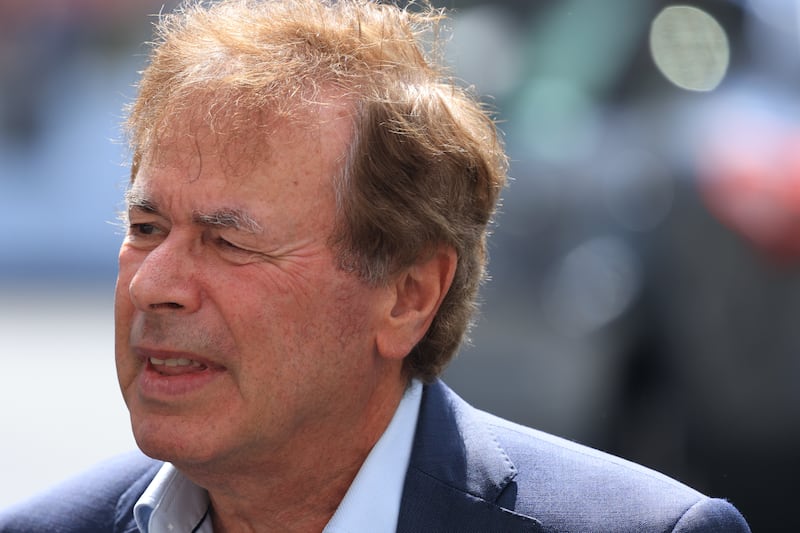
One of the more unexpected subplots of the Debrecen fixture unfolded not on the pitch but in the press box, where former Irish minister for justice Alan Shatter took his place among the regular football writers while filing a piece for the Jerusalem Post.
“After a berserk, topsy-turvy couple of days, of course the press box would include a former minister of justice,” remarked one of the travelling reporters, summing up the surreal feel of a week when sport and politics were never far apart.
Shatter, 75, has been a prominent critic of elements of Ireland’s response to events involving Israel and Palestine since 7 October 2023. The campaign to halt the Israel fixtures – both the Debrecen game and the return match – has been a particular focus of his commentary, and his presence at the stadium underlined how international football can become a real‑time stage for domestic political argument.
Bazunu’s stance and selection realities
Shatter’s article centred on the build-up drama rather than the match itself, devoting significant space to goalkeeper Gavin Bazunu’s decision to withdraw from the squad, citing his “belief that the killing of innocent people is wrong”. In his report, Shatter stressed that Bazunu was one of Ireland’s reserve goalkeepers and “was unlikely to have played” in Debrecen.
He also referenced Bazunu’s club status, describing him as Southampton’s goalkeeper “in the Premier League last season when they were relegated”, even though Southampton did not compete in the Premier League in the most recent campaign. He further wrote that Irish internationals Finn Azaz and “Brian Manning” – a reference to Ryan Manning – and Israeli goalkeeper Daniel Peretz were now team-mates at Southampton, and that Bazunu “interestingly” now plays for Bolton Wanderers in League One.
For an international readership, those details go beyond name‑checking. They point to the increasingly complex club‑country web in European football, where players sharing a domestic dressing room can find themselves on opposite sides of politically charged international fixtures. That reality shapes how governing bodies, clubs and national associations prepare for, and communicate around, games that sit at the intersection of sport and geopolitics.
Coverage focus and online reaction
Shatter’s match report allocated three paragraphs to the game itself, one to late‑game chants of “IDF, IDF” from Israeli supporters and one to the online fallout he said followed his updates, describing his X feed being hit by a “deluge of anti‑Semitic hate originating from Ireland”.
He also publicly objected to a reference in an Irish newspaper report from Debrecen that mentioned his age when noting his presence in the press box, questioning on X whether the line was “ageist or a tribute to my vim & vigour”.
Beyond the personal back‑and‑forth, the episode highlighted how the media environment around international football has broadened. Press boxes at major fixtures now frequently include former players, tacticians, political figures and commentators with substantial social‑media followings. Their focus may extend well beyond match analytics, and their accounts can quickly become a parallel arena for contesting narratives about the meaning of a game, particularly when that game features a team from Israel and is being played against a backdrop of ongoing conflict.
A broadcast window on a wider debate
While the scoreboard in Debrecen will enter the record books as a straightforward 3-0 Nations League win for Ireland, the contest around it has implications that stretch into governance, broadcasting strategy and the lived reality of international players.
For UEFA, the choice of neutral venues, the management of crowd presence and the protection of its competition calendar have become recurring tests of how a governing body balances political pressure with the need to provide a predictable competitive framework.
For RTÉ, the Israel fixtures have underscored the delicate balance between a legal obligation to show matches, the public-service duty to reflect societal concerns and the financial pressures that drive sports-rights investments. The decision to strip back presentation and refuse advertising did not diminish viewer interest entirely, but it did reshape how the game appeared on Irish screens.
And for the players and coaching staff, the window has combined the normal tactical and selection challenges of a UEFA Nations League campaign with the additional scrutiny that comes when a single match becomes a proxy for a much bigger argument. Between the 3-0 scoreline, the viewing figures, Parrott’s high‑profile strike and the presence of a former minister among the media, Ireland’s latest international break offered a pointed reminder that, in modern football, very little truly happens in isolation.