
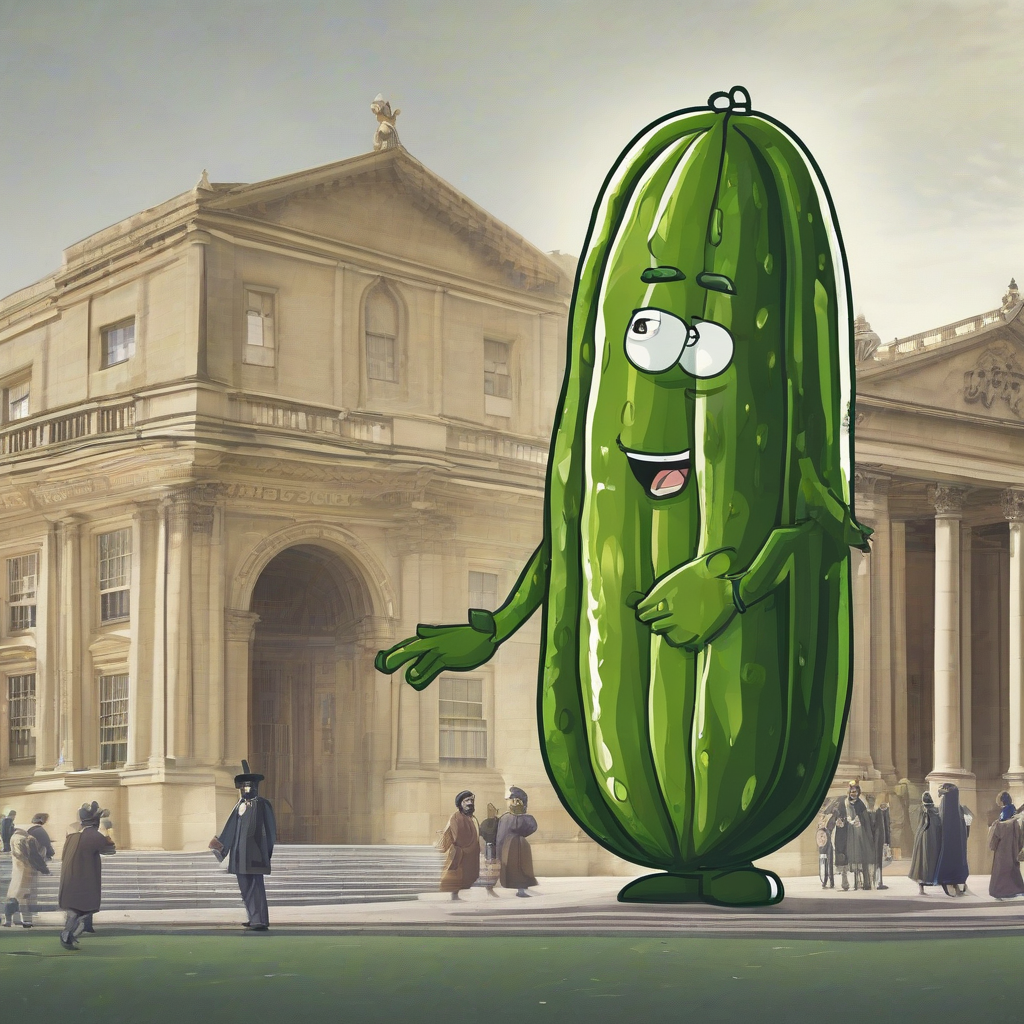
LONDON – The UK’s first Jewish culture month launched on 16 May, marked by the appearance of a giant green pickle at major London landmarks including the Southbank Centre and the Tate Modern.
Organized by the Board of Deputies of British Jews, the representative body for the UK’s Jewish community, the month-long celebration consists of more than 150 events across the country. The program spans a diverse range of disciplines including architecture, film, fashion, comedy, music, food, and literature.
The initiative aims to pivot the public narrative surrounding Jewish life in Britain, moving toward a theme of “less oy and more joy” following a period of heightened tension and security concerns. At a time when British lawmakers have sharpened their focus on hate crime and online abuse, the organisers present the programme as a cultural complement to the UK’s statutory protections against religious discrimination, including those set out in the Equality Act 2010.
The pickle on its travels around London. Photograph: Graeme Robertson/The Guardian
Shifting the Cultural Narrative
The project was developed following consultations with cultural workers and artists who noted that Jewish identity had become increasingly linked to grief and hostility since the attacks in Israel on 7 October 2023 and the subsequent rise in reported antisemitic incidents in the UK.
Liat Rosenthal, the Board’s director of culture, education and communities, stated that the celebration is a deliberate response to this atmosphere and part of a broader effort to ensure that British Jews are visible in public life for more than their vulnerabilities.
“For me, the response to antisemitism has to be this bold, proud, public moment,” Rosenthal said. “The history of British Jews is incredibly rich, and the contribution of British Jews to life across the UK spans not just arts and culture, but science, technology, innovation, psychotherapy, medicine and politics.”
Rosenthal emphasized that the events are open to the general public regardless of religious affiliation or background, adding, “Everyone should get involved, learn something and eat lots of food.” She described the month as an opportunity for local councils, schools and cultural institutions to engage with Jewish communities in a way that feels celebratory rather than solely reactive to security briefings.
Culinary Traditions and Community Ties
Food serves as a primary vehicle for the festival’s outreach, highlighted by the involvement of Shedletsky, an East London pickling company. The company is hosting a traditional Friday night dinner to highlight the link between Eastern European preservation techniques and modern deli culture, and to give non-Jewish guests a way into ritual life that is informal but recognisably observant.
James Cooper, a co-founder of Shedletsky, noted the historical trajectory of these traditions.
“The Jewish communities that came out of eastern Europe were deeply entrenched in pickling and preserving traditions,” Cooper said. “There’s this great through-line from ancient preservation techniques” to the “big explosion” in modern deli culture where pickles have become the perfect accompaniment.”
Co-founder Natalie Preston added that food is a tool for community reconciliation, particularly at a time when inter-communal tensions can quickly become politicised.
“I think that is one of the ways we can hopefully break down these awful barriers that are being put up at the moment,” Preston said. Shared meals, she added, give people “permission to ask questions they might otherwise be too nervous to raise.”
Subculture and Satire in London
At JW3, the Jewish community center in Hampstead, the programming focuses on the intersection of Jewish identity and British counterculture. An exhibition titled L’Chaim / L’Chaos: 50 Years of Jewish Punk examines the role of Jewish youth in the 1970s punk scene and its legacy in contemporary music and visual art.
The Jewish punk exhibition includes the work of the photographer Jamie Goldberg (pictured below). Photograph: Jamie Goldberg/c/o JW3 Photograph: c/o JW3
William Galinsky, JW3’s director of programming, explained that the outsider nature of punk appealed to a generation of Jewish youth who were often the first in their families to attend university or deviate from established family businesses.
“There was something about this outsider teen culture that really attracted young Jewish people in the 1970s,” Galinsky said. “It gave them a language to talk about class, migration and difference in a way that wasn’t always available in mainstream politics.”
Other JW3 events include:
- A “B’Mitzvah” celebration marking the center’s 13th anniversary, positioning JW3 itself as a coming-of-age institution within London’s cultural landscape.
- A satirical exhibition and book by Miriam Elia titled Moses and the 613 Health and Safety Commandments, which uses humour to probe contemporary bureaucratic culture alongside biblical law.
Galinsky referenced the influence of playwright Jack Rosenthal, who he said helped the non-Jewish public see that Jewish immigrants were essentially similar to other immigrant groups from South-east Asia and the West Indies, navigating housing, education and workplace discrimination under the same national frameworks.
Regional Outreach and Historical Memory
The celebrations extend beyond the capital through the Association of Jewish Refugees (AJR), which is conducting walking tours in various cities, including Cardiff, to explore how refugees shaped local high streets, civic institutions and postwar planning decisions.
Debra Barnes, AJR’s head of next generations, stated that the goal is to move beyond a perception of the community as solely defined by trauma.
“If you mention Jews in Britain today, you think of antisemitism and attacks. It’s a very depressing outlook at the moment,” Barnes said. “But we don’t want to only be seen as victims, and we don’t want to hide.”
The regional tours conclude at Wally’s Delicatessen & Kaffeehaus, a business established by a Jewish refugee and currently operated by his grandson, underscoring how family-run enterprises have become fixtures in towns that long ago ceased to think of them as “immigrant shops”.
The pickle is tempted by some salt beef. ‘Everyone should get involved, learn something and eat lots of food,’ the organisers said. Photograph: Graeme Robertson/The Guardian
Defining Jewish Identity
In Newark, Nottinghamshire, the National Holocaust Museum is hosting an event titled What Does it Mean to be Jewish?, featuring testimonials from young British Jews who grew up under curricula shaped by the UK’s statutory requirements for teaching about the Holocaust and religious diversity in schools.
The museum has curated an exhibition of meaningful objects used to illustrate community identity and religious observance. Featured items include:
- A Friday night dinner table with challah bread and Shabbat candlesticks, showing how domestic ritual can anchor identity far from major urban centres.
- Mezuzahs (scroll cases attached to doorposts) for tactile learning and inquiry, inviting visitors to handle items that are usually seen only in private homes.
Abi Levitt, chief executive of the National Holocaust Museum, said the exhibition asks “what are the meaningful objects that bring Jewish culture to life?”
“It’s about just bringing the Jewish world to people in this part of the country,” Levitt said, describing the show as a bridge between formal remembrance and everyday culture.
Major participating institutions for the month include the V&A Museum, the National Portrait Gallery, and the British Library, alongside smaller regional venues and local authorities. Together they form, for the first time, a loosely coordinated national platform for Jewish culture within the UK’s broader framework of protected faith communities, complementing existing understandings of the country as a multi-nation state comprising England, Scotland, Wales and Northern Ireland under a shared constitutional system [background].
Worth a look
- Urban Infrastructure Resilience: How European and Asian Megacities Are Adapting to Extreme Climate Oscillations in 2026
- UN General Assembly 2026 Framework on Autonomous Systems: International Diplomacy Faces Algorithmic Governance
- Two Iranian nationals charged with terror plot targeting Manchester Jewish community (globallypulse.com)
