
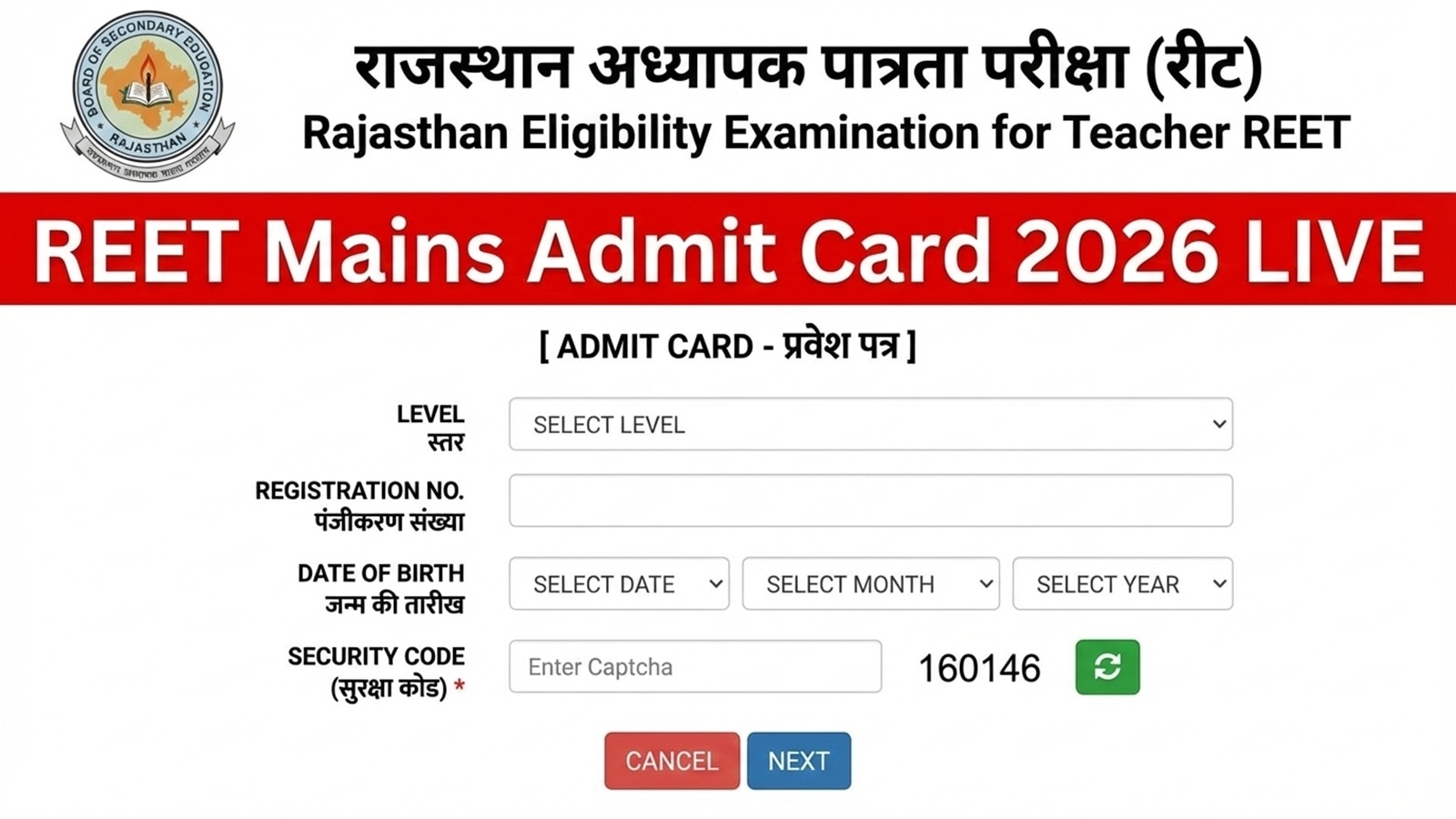
Rajasthan Staff Selection Board (RSSB) is preparing to release admit cards for the Rajasthan Teacher Eligibility Test (REET) mains cycle on its official recruitment portal, rssb.rajasthan.gov.in. As of January 13, 2026, there is no confirmed notice from the exam authority; however, some media reports suggest the hall tickets have been made available.
The written examination is scheduled to run across multiple shifts between January 17 and January 20, 2026. The admit card is required for entry to the exam hall.
Status of admit cards and where to check
The board has not published a formal release notice on January 13, 2026. At the same time, media coverage indicates admit cards may already be accessible. This discrepancy has not been clarified by the board, and candidates are advised to treat only the official RSSB portal as authoritative for hall-ticket availability and instructions.
Key points:
– Official portal: rssb.rajasthan.gov.in
– Sections to monitor: Admit Card and Latest Notifications
– What you’ll need to log in: application number and date of birth
– Physical copy: candidates are expected to carry a printed admit card to the test center
– Keep records: retain a soft copy (PDF) and note your exam date, shift, and center address as mentioned on the admit card
The detailed schedule is published in the official RSSB notification and will also appear on each candidate’s admit card. (Express Photo by Kamleshwar Singh/ representational)
Why this exam matters for state recruitment
REET functions as the state’s gateway eligibility test for schoolteacher recruitment, sitting alongside the national framework of the Central Teacher Eligibility Test under India’s Right of Children to Free and Compulsory Education (RTE) Act, 2009. RSSB conducts the mains cycle to shortlist candidates who can then be considered for regular teaching vacancies notified by the state government in government and government-aided schools.
Successful performance in REET does not by itself guarantee a job, but it is a mandatory credential for participating in subsequent recruitment rounds, including merit lists and document verification overseen by the state’s education and personnel departments.
Exam window and labeling
The current cycle is referred to as “REET mains” with the test window set for January 17-20, 2026. The source material uses both “REET 2025” and “REET Mains 2026” in connection with the same mains examination cycle, reflecting the fact that the recruitment notification and preliminary stages were tied to an earlier calendar year while the mains exam falls in 2026.
The board has not issued a clarifying statement on the cycle’s label in the public notice cited above. Until a formal clarification is published, candidates should rely on the combination of their application number, level (1 or 2), and exam dates rather than year-tags in media shorthand when tracking updates on the official site.
What the exam qualifies you for
The test serves as an eligibility benchmark for:
– Level 1: recruitment to Primary teaching posts (Classes 1-5)
– Level 2: recruitment to Upper Primary teaching posts (Classes 6-8)
In recent recruitment cycles, candidates who clear the relevant level are eligible to participate in subsequent state recruitment processes, including vacancy-specific examinations and counseling rounds conducted by RSSB and the state education authorities.
Participation snapshot from 2024
Reported registration and performance figures from the prior year provide a sense of scale and highlight the level of competition:
– Registered:
– Level 1: 3,46,626
– Level 2: 9,68,502
– Level 3: 1,14,696
– Appeared:
– Level 1: 3,14,195
– Level 2: 8,79,671
– Level 3: 92,767
– Qualified:
– Level 1: 1,95,847
– Level 2: 3,93,124
– Qualified in both levels: 47,097
– Pass rates:
– Level 1: 62.33%
– Level 2: 44.69%
– Overall: 50.77%
For the state government, these numbers feed directly into planning for future teacher appointments, pupil-teacher ratios, and budgeting for school staffing. For candidates, they underline the importance of precise documentation and compliance with exam-day protocols, as minor lapses (including issues with admit cards) can lead to disqualification despite strong academic preparation.
What candidates should know right now
– Examination dates: January 17-20, 2026 (multiple shifts each day; shift timing will be printed on the admit card)
– Admit card: mandatory for entry; verify your name, photograph, signature, application number, level, exam date, shift, and test center address immediately after download, and report discrepancies to the helpline given in the official notification
– ID proof: carry a government-issued photo ID in original along with the printed admit card, as invigilators typically cross-verify identity before allowing entry
– Reporting time: plan to reach the exam center well before the reporting time mentioned on the hall ticket to clear security, biometric, and document checks
– Portal to watch: rssb.rajasthan.gov.in for the link labeled “REET Mains Admit Card 2026”
– Syllabus and pattern: candidates may cross-check the detailed scheme of examination and syllabus in the official mains notification issued earlier by RSSB and, where relevant, in the broader norms notified under the RTE framework
Story continues below this ad

As of January 13, 2026, the board has not posted a formal admit-card release notice on its site; candidates should keep checking the Admit Card/Latest Notifications sections of rssb.rajasthan.gov.in for the “REET Mains Admit Card 2026” link.
Keep reading
- Urban Infrastructure Resilience: How European and Asian Megacities Are Adapting to Extreme Climate Oscillations in 2026
- UN General Assembly 2026 Framework on Autonomous Systems: International Diplomacy Faces Algorithmic Governance
- G7 to release up to 100m barrels of emergency oil and diesel reserves (globallypulse.com)
