
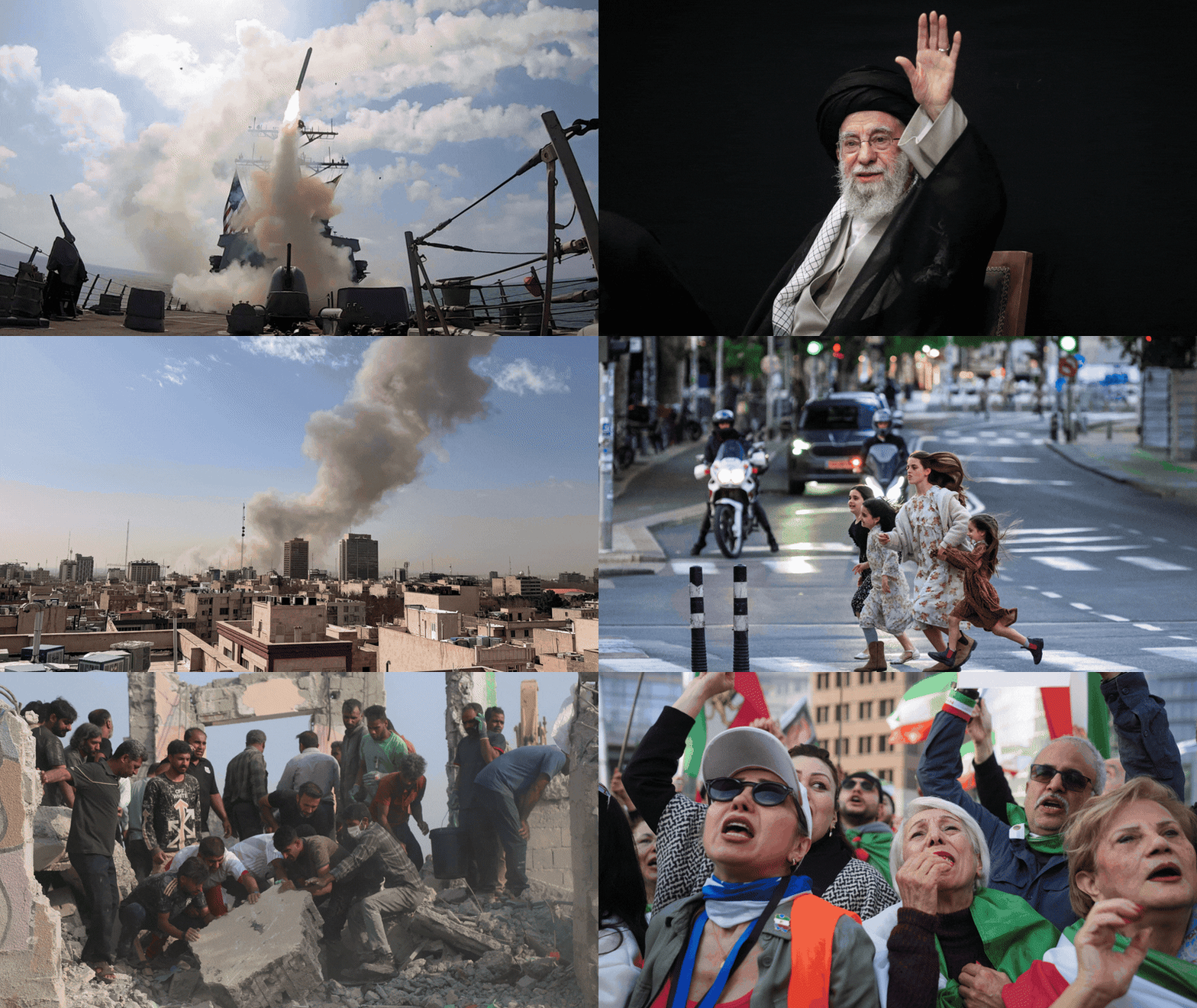
JERUSALEM – Israeli warplanes struck a high-security government compound in Tehran at 06:00 Israel time on February 28, 2026, during a scheduled morning meeting of senior Iranian officials that included Ayatollah Ali Khamenei, Iran’s supreme leader, according to people briefed on the operation. Later on February 28, 2026, Donald Trump confirmed Khamenei was dead.
The strike followed a period in which Israeli and American intelligence services, including the U.S. Central Intelligence Agency, tracked Khamenei’s routines and contacts to determine when and where he could be most effectively targeted, according to five people familiar with the matter. The compound that was hit houses the offices of the ayatollah, the Iranian presidency and the national security apparatus, a nerve center for decision-making over Iran’s security posture and regional policy.
According to an Israeli source, Khamenei believed daytime offered less risk and relaxed some precautions. Three people familiar with the matter said the United States and Israel adjusted their plans accordingly, revising an initial concept for a night operation to a daylight attack designed to catch senior officials in session.
Key times on February 28, 2026
- 06:00 (Israel time): Israeli warplanes fired into the Tehran compound that houses the offices of the ayatollah, the Iranian presidency and the national security apparatus, during what officials described as a scheduled high-level meeting.
- Later the same day: Donald Trump confirmed publicly that Khamenei was dead, signaling Washington’s assessment that the strike had eliminated Iran’s top decision-maker.
How the strike was timed
People familiar with the operation said intelligence services watched where Khamenei lived, whom he met regularly, how he communicated and where he might move if threatened. That monitoring extended to other senior Iranian officials, according to the same people, and included efforts to map routines inside the leadership compound itself.
An Israeli source said Khamenei felt less vulnerable during daylight hours and reduced some safeguards. Those assessments, three people familiar with the matter said, led U.S. and Israeli planners to switch from a night assault to a daylight strike timed to coincide with a planned morning gathering of top officials, increasing the likelihood of decapitating Iran’s security chain of command in a single blow.
The target and the site
Officials said the chosen target was a compound in Tehran that concentrates core state power, bringing under one roof the offices of the supreme leader, the presidency and national security decision-makers who oversee Iran’s armed forces and regional proxies. The meeting that morning included Khamenei alongside other senior figures, according to people familiar with the planning, making the site both symbolically and operationally central to Iran’s system of rule.
The compound also functions as a secure complex for closed-door consultations between the supreme leader’s office, the president and security chiefs on matters ranging from nuclear policy to crisis management. Hitting it at the start of the political day, officials said, was intended to maximize disruption of Iran’s command structure.
What officials are saying
- People familiar with the matter said Israeli and American intelligence services, including the CIA, tracked Khamenei’s patterns and inner circle to determine the best opportunity to strike, focusing on moments when key decision-makers would be physically co-located.
- An Israeli source said Khamenei felt less vulnerable in daylight and lowered his guard, prompting planners to see daytime as the window when security habits were most predictable.
- Three people familiar with the matter said U.S. and Israeli planners revised the operation to a daylight strike, aligning flight paths and munitions profiles with the timing of the scheduled leadership gathering.
- Donald Trump later confirmed Khamenei’s death on February 28, 2026, framing the operation as a targeted action against Iran’s supreme leadership.
Why Khamenei’s death matters in Iran’s state structure
Khamenei held Iran’s most powerful office-the supreme leadership-positioned above the elected presidency and commanding Iran’s coercive institutions. The supreme leader has final say over the armed forces and national security strategy and exerts decisive influence across the government, from the judiciary and state media to the Islamic Revolutionary Guard Corps.
The authority of the office is rooted in Iran’s constitution, which enshrines the doctrine of “Guardianship of the Jurist” and defines the supreme leader’s role as head of state and ultimate arbiter of policy. Under that framework, the clerical Assembly of Experts is empowered to convene and select a successor to the supreme leader, a process expected to shape the balance of power among Iran’s political, military and religious factions.
Khamenei’s death therefore opens a period of institutional uncertainty, testing the capacity of Iran’s succession mechanisms and raising questions about continuity in decisions on nuclear policy, regional alliances and internal security. The Assembly’s closed deliberations, and any interim arrangements around the leadership office, will be watched closely by foreign governments and markets for signals of how firmly Iran’s governing system can absorb the loss of its central figure.
Worth a look
- Urban Infrastructure Resilience: How European and Asian Megacities Are Adapting to Extreme Climate Oscillations in 2026
- UN General Assembly 2026 Framework on Autonomous Systems: International Diplomacy Faces Algorithmic Governance
- Jay Clayton named White House AI czar by Trump to lead task force (globallypulse.com)
- Michael Olise confirmed his commitment to the French national team (archysport.com)
