
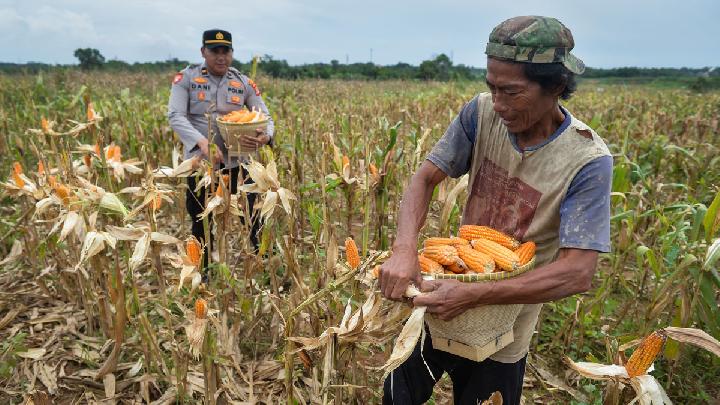
JAKARTA – Indonesia’s police have been drawn into large-scale food programs under President Prabowo Subianto, and an investigation has flagged irregularities in reported corn output even as National Police Headquarters says production targets were achieved.
The probe describes the police, formally charged with public order and law enforcement, taking on agricultural production and meal-service roles across the country. It cites cases in multiple provinces where outcomes and data appear inconsistent with stated goals.
Security agency pressed into farm targets and meal services
Under Prabowo’s direction, the Indonesian Military (TNI) and the Indonesian National Police (Polri) were asked to “intervene” to help reach self‑sufficiency in three staples: rice, corn, and soybeans. The investigation states:
– TNI was tasked with rice and soybeans.
– Polri was assigned corn.
The policy push builds on the long‑standing presidential authority over the police following their separation from the military in 1999 and their designation as a national force under the Law on the Indonesian National Police, which defines Polri’s primary mandate as law enforcement and public security rather than economic production.
It adds that National Police Chief Gen. Listyo Sigit Prabowo formed a Food Sustainability Task Force to utilize idle police land nationwide. According to the report, police units began staging food‑production activities, with some officers treating program events as “badges of honor” for career advancement and as visible demonstrations of loyalty to the President’s food‑security agenda.
Where the figures and fields don’t align
While the initiative has been presented as progressing toward targets, the report documents operational problems and describes tactics allegedly used to keep numbers on track. Examples include:
– Mojokerto Regency, East Java: police corn fields reportedly failed to produce a harvest because of poorly timed planting seasons and limited agronomic expertise within local units.
– Yogyakarta: stated harvest goals fell short following an onslaught of monkey pests that destroyed crops before collection.
– Data concerns: officers in some areas allegedly purchased corn from other regions or counted local farmers’ crops toward police achievements, and several areas without a history of corn farming were said to have suddenly reported large production totals.
Despite these accounts, National Police Headquarters maintains that it met a corn production target of 3.5 million tons, underscoring a sharp gap between official performance claims and the field‑level evidence cited by the investigation.
There are many irregularities in the data concerning the achievement of National Police production targets for corn. The President is taking the police away from its core responsibilities.
The criticism feeds into a broader governance debate over whether security institutions should be deployed to deliver social and economic programs, and how such roles are to be supervised when they sit outside normal sectoral ministries.
Meal‑service expansion and favoritism concerns
Beyond crop targets, the police are also involved in running Nutrition Service Units (SPPG) to provide free nutritious meals. The investigation says:
– The Kemala Bhayangkari Foundation – described as the organization for the wives of police officers – is operating more than 1,000 SPPG units.
– The National Nutrition Agency (BGN) granted the foundation a special privilege to manage that scale, while other operators are limited to a maximum of 10 units.
– These arrangements have prompted accusations of a monopoly and calls for BGN to broaden supplier participation so public spending benefits more local providers.
Critics quoted in the report say the concentration of SPPG operations in a foundation linked to the police hierarchy risks blurring lines between welfare policy and institutional patronage. They argue that procurement for the free meal scheme should be opened to a wider pool of community groups and private providers, with uniform standards and audits, to minimize conflicts of interest.
Leadership, funding and reform tensions
Gen. Listyo Sigit Prabowo was appointed National Police chief in January 2021. The investigation characterizes him as seeking to retain the post and describes him as the longest‑serving chief.
To fulfill the President’s directives, the report argues, program accountability – particularly around budgets – has been sidelined. It says duties beyond the police’s core remit are widely known to rely on off‑budget financing, a practice that can enable abuses of authority and weaken parliamentary oversight of security spending.
The publication also points to unfinished institutional reforms. It notes that Prabowo established a Commission for the Acceleration of Police Reform, but before the body could complete its work, multiple scandals surfaced, including:
– Exposure of drug syndicates involving the Police Chiefs of Bima (West Nusa Tenggara) and South Sulawesi.
– The killing of a student in Tual, Maluku, by a Mobile Brigade (Brimob) member.
The report frames these incidents as evidence that core criminal‑justice priorities – from narcotics enforcement to protection of civilians – are at risk when police resources and leadership attention are absorbed by politically driven programs such as food production and meal distribution.
Mandates and roles at a glance
– Polri: national law enforcement, public order, crime prevention and investigation, operating under the president and accountable to civilian authorities in parliament.
– Ministry of Agriculture: agricultural policy and production oversight, including national crop planning, farmer support and extension services.
– BGN: administration of the free nutritious meal program, including the accreditation and supervision of SPPG providers.
– TNI: national defense; under the President’s plan, the military was tasked with rice and soybeans, heightening concerns among rights advocates about the return of armed forces to civilian economic functions.
As of publication, National Police Headquarters says it has met the corn production target of 3.5 million tons.
