
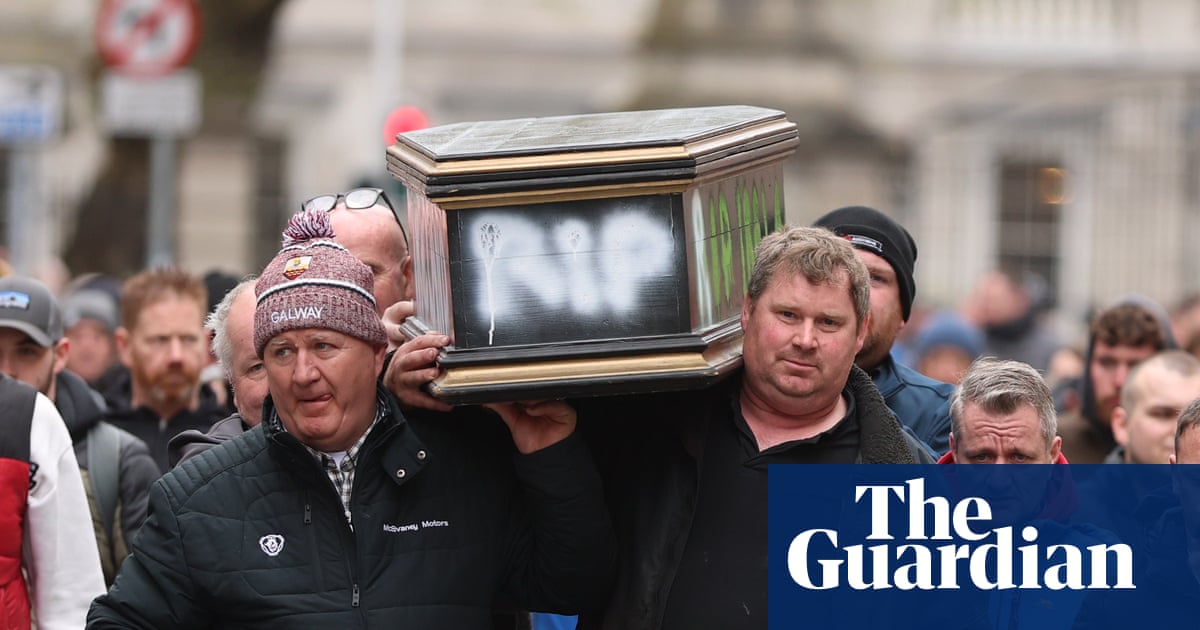
DUBLIN – National fuel protests in Ireland and Norway have escalated into widespread chaos, with hauliers and farmers blocking critical infrastructure in response to surging energy prices triggered by volatility in the Middle East.
The unrest, which has brought parts of the Irish capital to a standstill and seen lorry convoys descend on Oslo, is a direct ripple effect of global market instability following attacks on Iran and the effective closure of the Strait of Hormuz, a primary chokepoint for global oil transit.
In Ireland, the action has entered its fourth consecutive day, with protesters targeting essential supply chains. The national police force, An Garda Síochána, reported that blockades are currently endangering critical deliveries of food, fuel, clean water, and animal feed.
Infrastructure Blockades and Supply Failures
Protesters have paralyzed key transport arteries, including motorways and Dublin’s main thoroughfare, O’Connell Street. The disruption has extended to essential energy infrastructure, with blockades established at:
- The Whitegate oil refinery in County Cork (Ireland’s sole refinery)
- Fuel depots in Galway City
- Fuel depots in Foynes, County Limerick
The blockades have also affected access routes to key ports and logistics hubs, raising concerns inside government that Ireland’s status as a highly open, trade-dependent economy could magnify the domestic fallout if disruption persists.
The Taoiseach (Prime Minister), Micheál Martin, stated that the blockade of ports and the refinery left Ireland on the verge of turning away oil deliveries.
“It is unconscionable, it’s illogical,” Martin said regarding the potential loss of supply.
The operational impact has been immediate. Dozens of fuel forecourts have run dry, the courier company DPD has suspended deliveries, and the Irish Medical Organisation has warned that slower emergency response times and missed healthcare appointments are harming patient welfare. Health officials have privately signalled that, if shortages deepen, hospitals and ambulance services may have to activate contingency plans prioritising critical care and rural outreach.
Under Ireland’s Emergency Powers Act, the government can, in extremis, assume broad authority over essential supplies and transport. While ministers insist they do not yet intend to invoke such powers, senior officials say the legal framework is shaping internal discussions on how long the state can tolerate rolling blockades around strategic fuel infrastructure.
Energy Price Surges
The protests are driven by a sharp increase in costs since the U.S. and Israel began attacking Iran on February 28, 2026. In Ireland, pump prices have jumped significantly in recent weeks:
- Diesel: Increased from approximately €1.70 per litre to €2.17
- Petrol: Increased from approximately €1.74 per litre to €1.97
The Irish government implemented a €250 million support package in March 2026 to mitigate these costs. This package included:
- A temporary reduction in excise duty
- Expansion of the diesel rebate scheme for bus operators and hauliers
- An extension of the national fuel allowance
Officials argue the measures are designed to cushion households and preserve the viability of key sectors without fully disconnecting consumers from global price signals. However, farm and freight representatives say the support is lagging far behind real-world operating costs and warn of business closures and job losses if wholesale prices remain elevated into the summer.
Despite these measures, Deputy Premier Simon Harris admitted that further “intensive engagement” with the farming and haulage sectors would be required through the weekend, though he maintained that “the blockade has to end.” Harris said talks would focus on targeted reliefs and the phasing of any further tax changes, but ruled out direct price controls on fuel.
Norwegian “Diesel Roar” Protests
The unrest has spread to Norway, where lorry drivers associated with the Dieselbrølet (diesel roar) movement drove a convoy of 70 to 80 trucks toward the parliament in Oslo on April 10, 2026. Protesters carried banners reading “nok er nok!” (enough is enough!), and periodically sounded their horns in a rolling demonstration aimed at disrupting traffic around the Storting, Norway’s legislature.
Despite Norway’s status as an oil producer, its domestic market has been convulsed by the closure of the Strait of Hormuz. According to Statistics Norway:
- Fuel and lubricant prices rose 17.9% between February and March 2026
- Diesel prices specifically jumped by 23.6% in that period
A spokesperson for Statistics Norway noted that this represents the sharpest month-on-month increase ever recorded using the CPI inflation index, comparable only to the period following the Russian invasion of Ukraine in the spring of 2022. Although Norway cut fuel taxes on April 1, 2026, hauliers continue to demand lower and more predictable pricing, accusing the government of offloading the costs of global volatility onto small operators and regional supply chains.
The minority government in Oslo has come under pressure from both coalition partners and opposition parties to clarify how long existing tax reliefs will remain in place and whether strategic fuel reserves can be used to ease retail prices. Ministers have so far resisted calls for broad subsidies, arguing that Norway must preserve fiscal space in case the Strait of Hormuz remains effectively closed for months.
Global Energy Emergency
The volatility has triggered emergency responses across multiple continents, underscoring how a single shipping chokepoint can reverberate through national policy debates far from the Gulf.
- Philippines: Declared a state of “national energy emergency,” giving the executive branch expanded powers over pricing, allocation, and potential rationing of fuel.
- France: Authorized fuel tankers to circulate on weekends and public holidays until May 11 to prevent shortages, temporarily relaxing road-safety and labour restrictions on heavy-goods traffic.
- Denmark: In recent elections, the far-right Danish People’s Party attempted to capitalize on fuel discontent by paying voters for their petrol, prompting criticism from rivals over the politicisation of cost-of-living pressures.
Analysts say these measures, while nationally specific, reflect a common dilemma for governments: how to shield households and strategic sectors from price spikes without undermining long-term climate commitments or public finances. In the European Union, where energy policy is increasingly shaped by the bloc’s Green Deal and internal market rules, finance and energy ministers are bracing for renewed arguments over subsidies, windfall taxes, and coordinated stockpiling.
Political Tensions and Allegations
The Irish government has framed the protests as being influenced by external interests. Justice Minister Jim O’Callaghan alleged that “outside actors,” specifically British far-right activist Tommy Robinson, have been manipulating the movement to serve a separate agenda. Officials say the concerns centre on online organising, messaging apps, and fundraising channels that appear to overlap with transnational anti-government networks.
Protest spokesperson John Dallon rejected these claims, arguing that the government is ignoring the financial ruin facing citizens.
“How dare they come out and say that these people that are protesting are holding the country to ransom? It’s the government that’s holding this country to ransom, not the protesters,” Dallon said, adding that demonstrators are prepared to remain in Dublin for a month if necessary.
Civil liberties groups have warned that, while the state has a duty to keep essential supplies moving, any deployment of the army to dismantle blockades will be closely scrutinised for its compliance with Ireland’s obligations under European human-rights law. Senior officials insist that any intervention will be guided by existing public-order protocols and will focus on keeping emergency corridors open rather than dispersing peaceful assemblies.
The Irish government has placed the army on standby to assist in removing blockades. Taoiseach Micheál Martin has postponed a trade mission to Canada to remain in the country and manage the crisis, amid signs that the stand-off is evolving from a narrowly focused cost-of-fuel protest into a broader test of how democratic governments respond when global energy shocks collide with domestic anger over living costs.
As ministers weigh next steps, diplomats in Dublin and Oslo are also watching for signs that co-ordinated action at EU and NATO level on energy security and shipping routes could ease domestic tensions. For now, however, the political calculus in both capitals remains primarily focused on the streets outside: blocked roads, silent forecourts, and the prospect of a prolonged confrontation between governments insisting they must keep economies running and protesters who say they can no longer afford to do so.
- Urban Infrastructure Resilience: How European and Asian Megacities Are Adapting to Extreme Climate Oscillations in 2026
- UN General Assembly 2026 Framework on Autonomous Systems: International Diplomacy Faces Algorithmic Governance
- Cocoa Prices Crashed. Why Is Halloween Candy Still So Expensive? (daybreakwire.com)
- Tens of thousands expected in Paris for student protests – RTE.ie (archyde.com)
