

MUSWELLBROOK, NSW – A proposal to turn disused coal mining voids in New South Wales’ Upper Hunter into a connected chain of lakes is being advanced as a long-horizon tourism and recreation concept-one that, if it proceeds through government approvals and technical design, would create a new kind of large-format venue for outdoor leisure, sporting events, and destination entertainment in a region better known for mining and power generation.
The private company Hunter Lakes Corporation has described its plan as a network of interconnected artificial lakes spanning roughly 60 kilometres from Muswellbrook to Broke, using existing open-cut voids as water bodies linked by canals, and positioning the network for water-based recreation and tourism activity.
For entertainment and culture businesses, the significance is structural rather than speculative: large, managed water assets can become platforms for programming-boating and endurance events, outdoor performances, screen production, and seasonal activation-provided the governance, water allocations, safety systems, and long-term maintenance responsibilities are resolved at the outset. In New South Wales, that would mean navigating a formal planning pathway under the state’s Environmental Planning and Assessment Act, as well as mine-rehabilitation requirements, before any lake district could be treated as a dependable venue.
A post-mining leisure concept built on mine voids
In reporting dated February 19, 2024 and updated August 13, 2024, an independent assessment of a plan to repurpose disused Upper Hunter mining voids into a series of interconnected lakes was described as finding the proposal could be a driver in the region’s post-mining economy, including in services, tourism, and events.
The idea is not being pitched as a single attraction, but as a corridor-scale redevelopment concept-one that would sit across multiple assets, jurisdictions, and stakeholder groups over an extended timeframe and would intersect with state water management and mining-rehabilitation policy.
The company’s public materials frame the scheme as compatible with ongoing mining operations and dependent on coordination across government, industry, and local communities. In the entertainment economy, that distinction matters: a multi-site, multi-owner footprint changes how licensing, event approvals, and commercial access would be negotiated, and makes early master-planning decisive for any future screen or live-event usage. It also implies a heavier role for public agencies in defining safety rules, water-use priorities, and environmental performance benchmarks at the outset rather than retrofitting them later.
International precedent and an Australian reference point
Project advocates have pointed to European examples of mine rehabilitation that culminated in recreation-oriented lake districts, including the Lusatian Lake District in eastern Germany. The concept is also presented alongside a Western Australian reference point: Stockton open cut mine closed in 1957, leaving behind a 30-metre-deep void that gradually filled with water.
That void became Lake Stockton, described as a 15-hectare lake located about 2.5 hours from Perth and promoted as a tourism drawcard for camping and water sports.
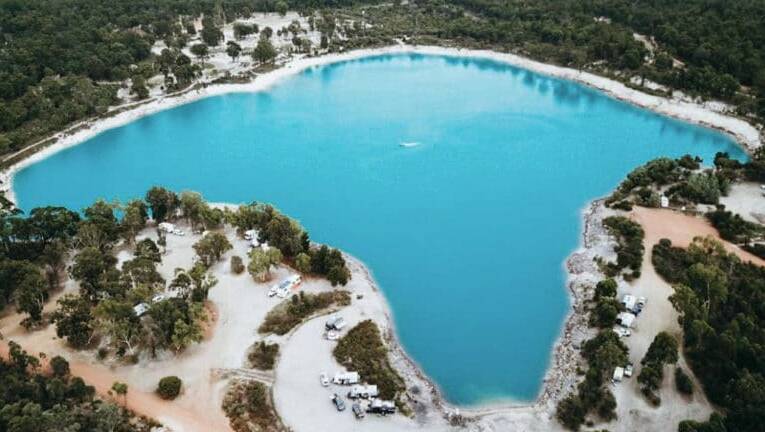
In the German model highlighted by proponents, former mine pits were turned into recreational lakes with cycling paths and water sports. Advocates have also cited the broader public-utility potential of such systems, describing the German post-mining lake network as having a role beyond tourism, including water management and landscape remediation.
These comparisons function less as aesthetic inspiration than as shorthand for what entertainment operators understand immediately: the difference between an unmanaged waterbody and a planned, serviced district that can host recurring activity with predictable access rules, safety standards, and visitor services. For investors and councils, they also demonstrate that long-decommissioned industrial land can, if managed to clear regulatory standards, support recurring events calendars rather than one-off spectacles.
What the company says the Upper Hunter scheme would involve
On its public website, Hunter Lakes Corporation describes a network stretching from Muswellbrook to Broke (south-west of Singleton), inspired by German lake districts. The company presents the plan as an attempt to address the long-term legacy of mining while generating jobs, supporting the local economy, and contributing to water security.

Hunter Lakes’ public description of stakeholder arrangements is explicit on two points relevant to the business of events and recreation:
- It says the scheme would involve all three levels of government and a wide range of stakeholders.
- It says mining operations would not be impeded, describing the approach as compatible with ongoing extraction while the environmental setting required for lakes formation is created.
The company also states that a master plan would guide the process, balancing ongoing mining and mine-closure timelines with lakes construction timelines, alongside engagement with residents, businesses, and community organisations. That master plan, if it advances, would sit within the state’s broader mine-rehabilitation and land-use framework and would need to clarify who ultimately owns and operates the lakes, who is liable for incidents on the water, and how competing priorities-such as water security, biodiversity, and mass events-are ranked.
In a separate account published April 24, 2022, the company was described as negotiating with mining companies to use three voids as the foundation of the lakes system, with assessment of another four voids expected to commence in 2022.
That same account described the company as seeking major project status from state and federal governments, a designation that-if pursued-typically signals an intention to move from advocacy into the procedural stages required for large, multi-year development. Major project recognition can also concentrate decision-making within senior planning and infrastructure agencies, which is relevant for promoters and producers assessing whether the concept is likely to move beyond the idea stage.
“We have engaged with all political parties both state and federal. All politicians are in favour of exploring the Hunter Lakes Scheme in detail owing to the enormous benefits it will deliver to communities and the state. It will also prevent the voids becoming saline sinks,” Hunter Lakes Corporation director Greg Story said.
Why this matters for the entertainment business-and why it is complex
Water-based destinations are not “set and forget” assets. For the entertainment industry, they sit at the intersection of physical infrastructure, public safety, and long-term operating models:
- Programming: Lakes that permit controlled public access can support ticketed participation (water sports, endurance events, guided experiences) and free-to-access visitation that still underwrites local hospitality. The more predictable the operating rules, the easier it is to build annual or seasonal events around them.
- Production: A large-scale water district can function as a screen location category-particularly for outdoor, sport, lifestyle, and regional tourism content-subject to permissions, safety plans, and environmental constraints. A defined agency or operator authorised to issue permits and manage closures becomes critical for producers working to tight schedules.
- Governance: Multi-site districts require clear rules for who can operate what, where, and under what conditions. That includes concessions, insurance standards, rescue capability, and operational boundaries during weather and seasonal variation, ideally codified in operating plans that align with state safety and environmental regulations.
The proposal’s setting-repurposed mine voids-adds additional layers. Mine pit lakes can raise technical questions around water balance, long-term water quality, and public safety management that typically require modelling, monitoring, and operational controls before they can be treated as reliable recreation venues. For governments, those questions sit alongside community expectations about post-mining land use, cultural heritage, and the visual transformation of long-worked landscapes.
In practical terms, that means any credible transition from vision to destination would likely depend on formal studies, public-agency oversight, and a durable operating entity with the authority to manage access, safety, and maintenance across decades. It would also demand stable arrangements between that operator, mining title holders, water authorities, and local councils so that programming decisions-for example, a major water-sports festival or a long-running screen production-are not undermined by shifting land-use permissions.
Where the proposal stands
As of February 19, 2024 (updated August 13, 2024), the proposal to repurpose disused Upper Hunter mining voids into interconnected lakes had been the subject of an independent assessment described as concluding the concept could support the region’s post-mining economy.
That assessment does not on its own grant approvals or funding, but it does move the idea into a more structured policy conversation about how the Upper Hunter transitions from coal dependency and how former mine sites are rehabilitated and reused. For entertainment and culture operators, the signal is that if the Hunter Lakes concept proceeds into the formal planning system, it could eventually reshape not just the local landscape but the scale and type of water-based events and productions that eastern Australia can reliably host.
Worth a look
