
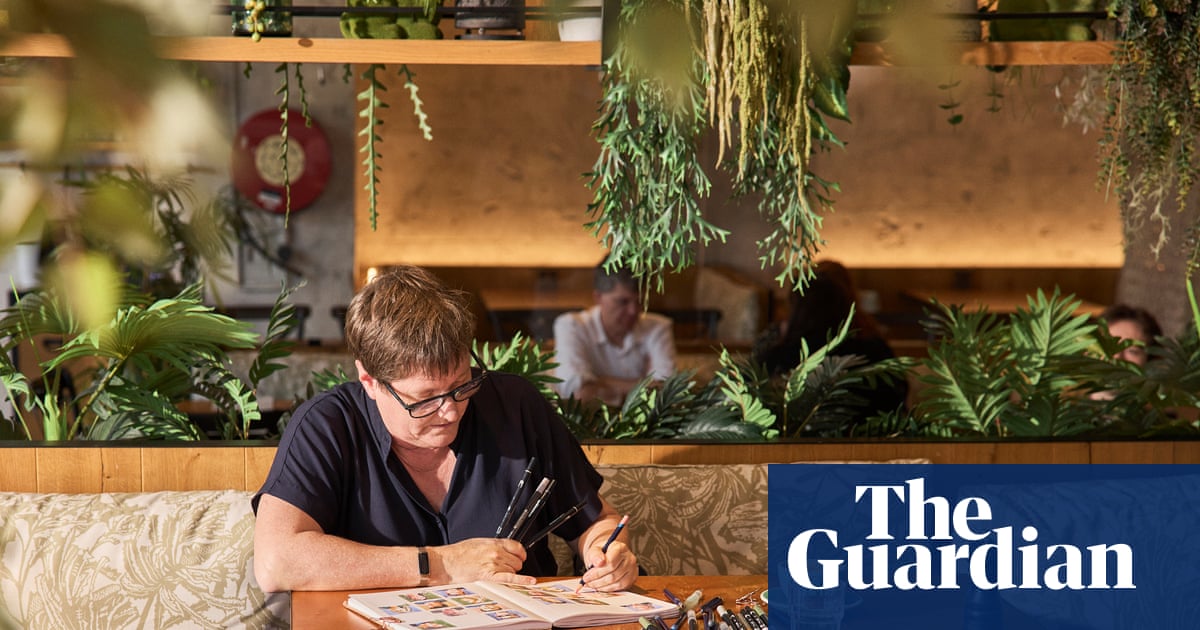
SYDNEY – In a sunlit Sydney cafe, Liz Steel, an architect-turned art educator, spends time with water-soluble pencils and markers, sketching the people around her. Across the world in Montreal, fellow artist and educator Marc Taro Holmes moves through the city with a sketchbook, “like a bear coming out of hibernation”.
Together, Steel and Holmes co-founded #OneWeek100People, an informal global initiative that asks artists to sketch 100 people in seven days. Now in its 10th year, the challenge is positioned by its organizers as a low-pressure creative exercise: Steel and Holmes stress that it is entirely for enjoyment, and participants can take it up and post with the hashtag at any time.
For the entertainment and culture economy-where attention, platforms, and community programming increasingly shape what gets made, seen, and sustained-#OneWeek100People offers a clear example of a creator-led format that scales without formal commissioning, ticketing, or institutional infrastructure. It is a repeatable “participation brief” designed for social distribution, but built around an offline act: sitting in public and drawing.
A global format built from a personal routine
Steel and Holmes met at the International Urban Sketchers Symposium in Lisbon in 2011. Their long-distance friendship led them to build a shared practice that could be repeated annually and undertaken anywhere. This year’s International Urban Sketchers Symposium is in Toulouse in July 2026, part of a wider movement of on-location drawing that now spans more than 60 countries.
From the outset, the pair framed the initiative as a way to stay connected through work rather than through conversation alone. What began as a personal accountability pact between two professionals has evolved into a lightly structured global event that artists, hobbyists, and design students treat as a yearly fixture in their calendars.
Holmes described the origins simply: “Liz and I started the challenge as an excuse to keep drawing together,” he said. “Speaking selfishly, this event is my free pass to spend an entire week drawing.”
Steel has been explicit that people-sketching was not always a natural strength, but said, “it’s no understatement to say that sketching the world around me changed my life and my career” – adding that, though trained as an architect, she is now an art educator, as is Holmes. Their shift from architecture and illustration into teaching mirrors a broader trend in the cultural sector: experienced practitioners building livelihoods not only from finished works, but from formats that invite others into the creative process.
The challenge began with Holmes pushing himself to sketch 20 people a day for a week. From that personal experiment, the pair developed a public-facing brief that could be adopted globally-one that sits comfortably inside the Urban Sketchers community, where hundreds now take part around the world. Over time, local art groups, continuing-education programs and community centers have informally folded the challenge into their calendars, using it as a ready-made format for public drawing meet-ups.
Steel and Holmes have intentionally kept the premise informal. There is no gatekeeping, no set venue, and no specified medium beyond the basic requirement of drawing people. In an era when creative communities are often built around paid access, courses, or membership tiers, #OneWeek100People has remained structured as an open prompt.
That openness matters in cities that regulate how public space can be used. In many jurisdictions, including Australia and Canada, small, non-commercial gatherings in parks and streets typically do not require formal permits under local public space and assembly rules, as long as they remain peaceful and do not obstruct traffic. By keeping the challenge decentralized and non-commercial, Steel and Holmes have built a format that can operate largely within existing freedom-of-assembly frameworks without triggering the bureaucratic hurdles that attend large-scale events.
Why the number is the point-and why quality isn’t
The core target-100 people in seven days-is designed to be ambitious. Holmes has said high targets encourage drawing without self-criticism, arguing that the volume itself can lower the stakes that often stop beginners from working in public.
“Quantity is the only goal, not quality,” he says. “Secretly, that’s the best way to improve your drawing.”
Steel described a similar logic in the momentum of repetition: there is a “special type of magic” in the pace, she said. “It’s about practice rather than perfection.”
Those statements function as a kind of governance for the challenge. Rather than rules about style or outcomes, the co-founders set expectations about process and mindset-an approach increasingly familiar across platform-native creative communities, from short-form video prompts to daily songwriting briefs. What differentiates #OneWeek100People is that it asks participants to shift attention outward, toward strangers in shared space, and to sustain that attention long enough to translate it into a line.
Holmes also framed the act of drawing as structurally different from capturing images on a phone. “Drawing uses the brain in a different way than taking a photo,” he said. “You’re forced to really look. It’s active and creative, rather than passively consuming media.”
He connected the practice to lifestyle choices and mobility: “Drawing is a terrific way to engage with the world. I go places and do things I wouldn’t normally get to. My sketchbook is my motivation to live a good life.”
Steel, for her part, described what she called a “tactile relationship” with the environment. When sketching on location, she said, she finds the world “happens” around her. “You see things you wouldn’t normally … People stop and talk to you, you hear the sounds, and that gets encoded into your page,” she said, adding that sketchbooks become powerful memory objects: “You can actually remember what the conversation of the person next to you was about.”
In cities grappling with the social costs of screen time, isolation and commercialized public space, the co-founders’ emphasis on observation and presence has made the challenge quietly attractive to librarians, arts officers and educators looking for low-cost, low-risk ways to invite residents back into parks, plazas and transit hubs-without turning them into branded events.
Chicago: a participant’s view of attention, burnout, and empathy
In Chicago, participant Quincy Nadel sketched in a park while her children played, using a moment alone to observe everyday gestures-people leaned into conversation, a parent carrying a tired child, the posture of someone waiting alone.
“There is a profound, quiet beauty in the way strangers interact with the world,” she said.
Nadel described the one-week format as a practical intervention for perfectionism, calling it “exposure therapy” after teaching herself to sketch in her 30s. “I was digitally burnt out,” she said. “Sketching is my ‘permission slip’ to sit and watch the world without the pressure of productivity. My sketchbook has become a record of me being ‘here’ instead of ‘online’.”
While she documents her journey on Instagram, she said the drawings are not the only point. “It was about recalibrating my brain to notice the people who usually move through my peripheral,” she said.
For cultural policymakers and local officials, stories like Nadel’s highlight why small, self-organized practices can matter at city scale. A hashtag challenge cannot solve burnout or social fragmentation, but #OneWeek100People shows how a simple, replicable brief-owned by artists rather than institutions-can be picked up by schools, neighborhood groups and public agencies as a tool for rebuilding the habit of looking closely at one another in shared space.
