
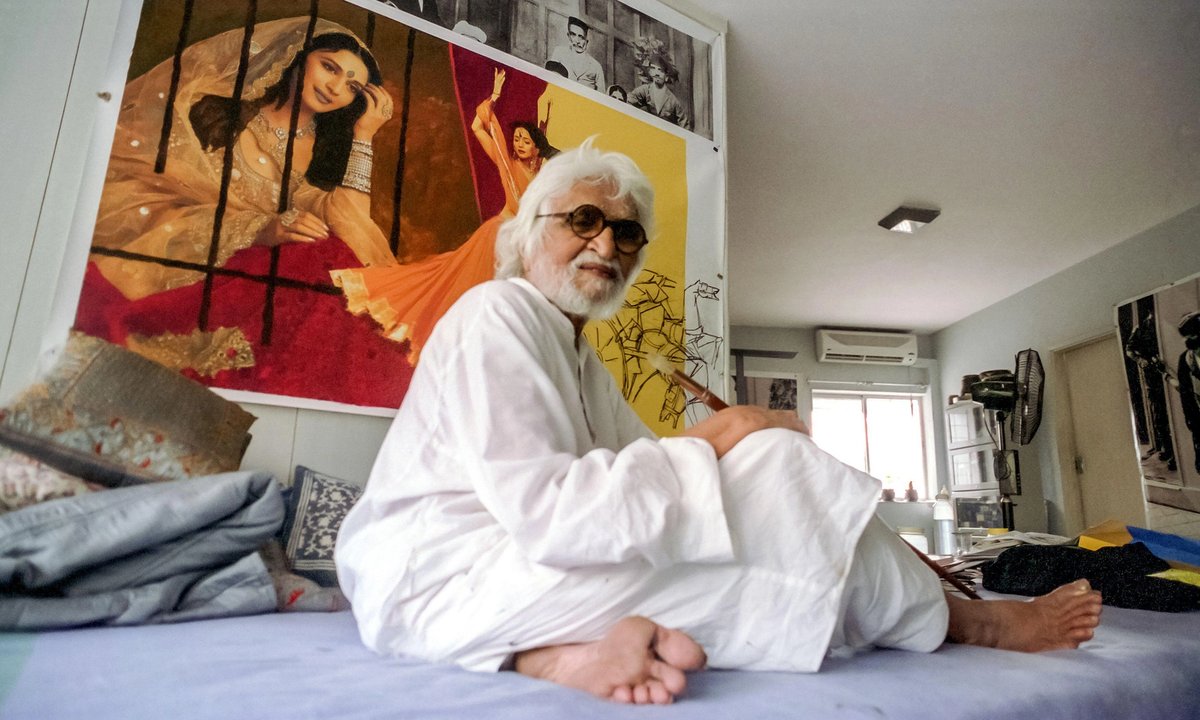
DOHA – A Doha institution, Lawh Wa Qalam: M.F. Husain Museum, is positioning the final chapter of Maqbool Fida Husain’s career inside the Gulf state that became his home in the last years of his life-after the painter long described as India’s “national artist” left India amid controversy and ultimately died in London in 2011 as a Qatari citizen.
Husain is often called India’s answer to Pablo Picasso: an artist who achieved pre-eminence among his peers and whose work, in different ways, tracked the political history of his time and place. For Husain, that arc runs through the forging of an independent democratic state from the remnants of the British Raj, and into a later period when his ability to live and work in India became increasingly constrained.
By the time he died in 2011, Husain was no longer an Indian citizen. He had moved to Qatar in 2009 and accepted Qatari citizenship the following year. The Doha museum explicitly takes on the question embedded in that timeline: what it means for an artist repeatedly claimed as a national cultural figure to have spent his final years working outside the country most associated with his public legacy.
The museum itself, commissioned by Qatar Foundation and inaugurated at Education City in November 2025, is embedded in a broader state-backed cultural strategy that uses flagship institutions to project soft power and convene cross-border conversations on art, identity, and modernity.[1]
Husain’s monumental Battle of Badr (2008), which he painted at the age of 95 Khalid Abdulrahman/© Qatar Foundation
A modernist vocabulary built inside India’s post-independence project
Husain was born in 1913 to a Shia Muslim family of distant Yemeni heritage in the small town of Pandharpur, around 200 miles southeast of Mumbai-then Bombay-described as a glittering, cosmopolitan mercantile hub with powerful political and business elites.
He came of age in the years leading up to India’s independence in 1947, and through the violent Partition that threatened, at least temporarily, to fracture the syncretic milieu in which he began working as a young artist. Alongside a diverse group of artists known as the Progressives, he innovated an idiom that was forward-looking while remaining rooted in the visual and cultural traditions of the subcontinent.
“I thought we must find our own roots,” Husain recalled decades later. “I must find a bridge between the Western technique and the Eastern concept.”
That bridge was not framed as nostalgia. Husain produced work explicitly concerned with Indian heritage-drawing on folk art, religious iconography, and cultural traditions-while maintaining a contemporary look aligned with global Modernism. He also drew inspiration from the ideology and character of the nation state he chose to become a citizen of, placing civic identity and cultural pluralism into the material of his art.
As the Doha galleries present it, that aesthetic project is inseparable from the institutional frameworks of post-independence India: a secular constitution, a parliamentary democracy, and a state-led narrative that sought to hold together linguistic, religious, and regional plurality. Husain’s canvases, especially from the 1950s onward, are read here as visual counterparts to those founding commitments rather than as detached studio experiments.
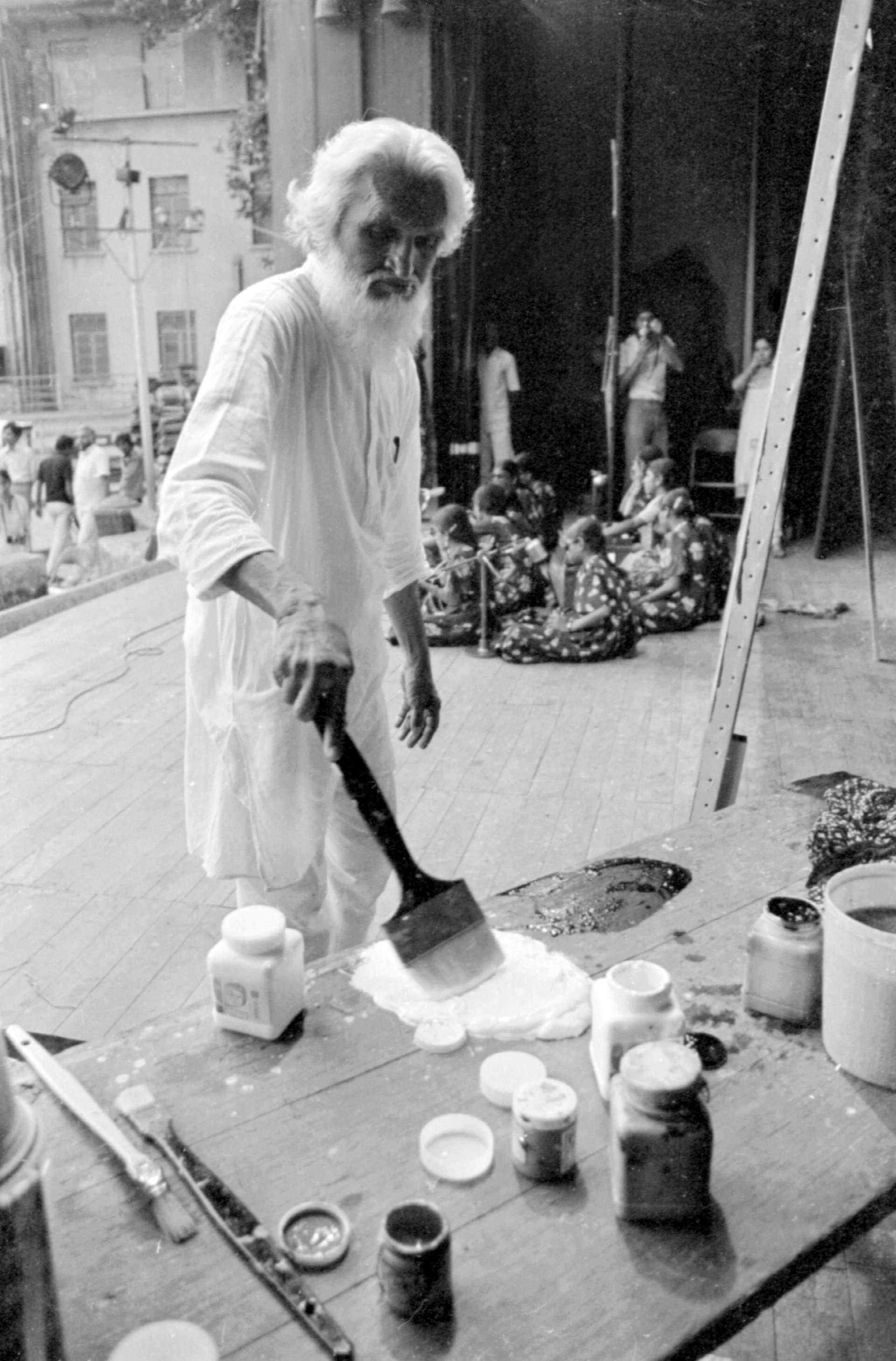
The artist in the process of creating work Dinodia Photos/Alamy Stock Photo
Secular symbolism, political portraiture, and a public role
Art historian Zehra Jumabhoy has argued that Husain’s significance extends beyond the studio into the realm of civic ideas. “Husain wasn’t just an artist,” Jumabhoy said. “He represents a particular vision of a secular India.”
Husain was a practising Muslim, described in the museum’s narrative as an international playboy who followed some religious rules more rigorously than others. But his work repeatedly staged India’s multiplicity of identities as a central subject, celebrating Hindu divinities and epics alongside giants of Urdu literature, including “Allama” Muhammad Iqbal.
This breadth also encompassed direct engagement with political history through portraiture and allegory. Husain repeatedly painted national political and ideological leaders, including a striking portrait of Jawaharlal Nehru-India’s first prime minister-held in the Doha collection.
Another work cited in the museum’s framing is his controversial 1975 depiction of Indira Gandhi, Nehru’s daughter, in the guise of Durga, the many-armed Hindu goddess of war. The work was made in a period when Gandhi had suspended civil liberties in a two-year phase of autocratic rule known as the “Emergency.”
Husain’s public proximity to power was not limited to the canvas. He served for six years as a member of the upper house of India’s Parliament, nominated to the Rajya Sabha by the Indian National Congress, the party associated in the museum account with a secular political identity. That institutional role-within a legislature operating under India’s post-independence constitutional framework-reinforces how closely his artistic project tracked questions of governance, citizenship, and the state’s responsibility to protect minority expression.
Controversy after 1996 and the constraints on working in India
The Doha museum’s attempt to interpret Husain’s late years is inseparable from the professional constraints that followed controversy in India. After 1996, Husain was accused of blasphemy for depicting a Hindu goddess in the nude.
According to the museum’s account, he received little official support and was even charged with “hurting religious sentiments.” In India, such offences have typically been investigated under provisions that criminalise deliberate and malicious acts intended to outrage religious feelings-a legal architecture that, in practice, can bring artists, publishers, and filmmakers into prolonged litigation. By the 2000s, it became impossible for him to continue living and working in India, as repeated legal complaints and threats made exhibitions and normal studio life untenable.
Dadiba Pundole, described as Husain’s friend and gallerist for two decades, characterised the period as a turning point shaped by politics rather than a shift in the artist’s own convictions.
“He was hugely disappointed [after 1996], because it was a politically motivated campaign,” Pundole said. “But his belief in a Nehruvian secular India didn’t change at all.”
The museum’s wall texts lean into this tension: a national legal and political environment that allowed works to be prosecuted and shows to be attacked, set against an artist who continued to insist on pluralist, secular symbolism. For policymakers and cultural institutions across the region, Husain’s trajectory is held up here as a case study in how quickly “national treasure” status can collide with majoritarian sentiment when cultural protection frameworks are weakly enforced.
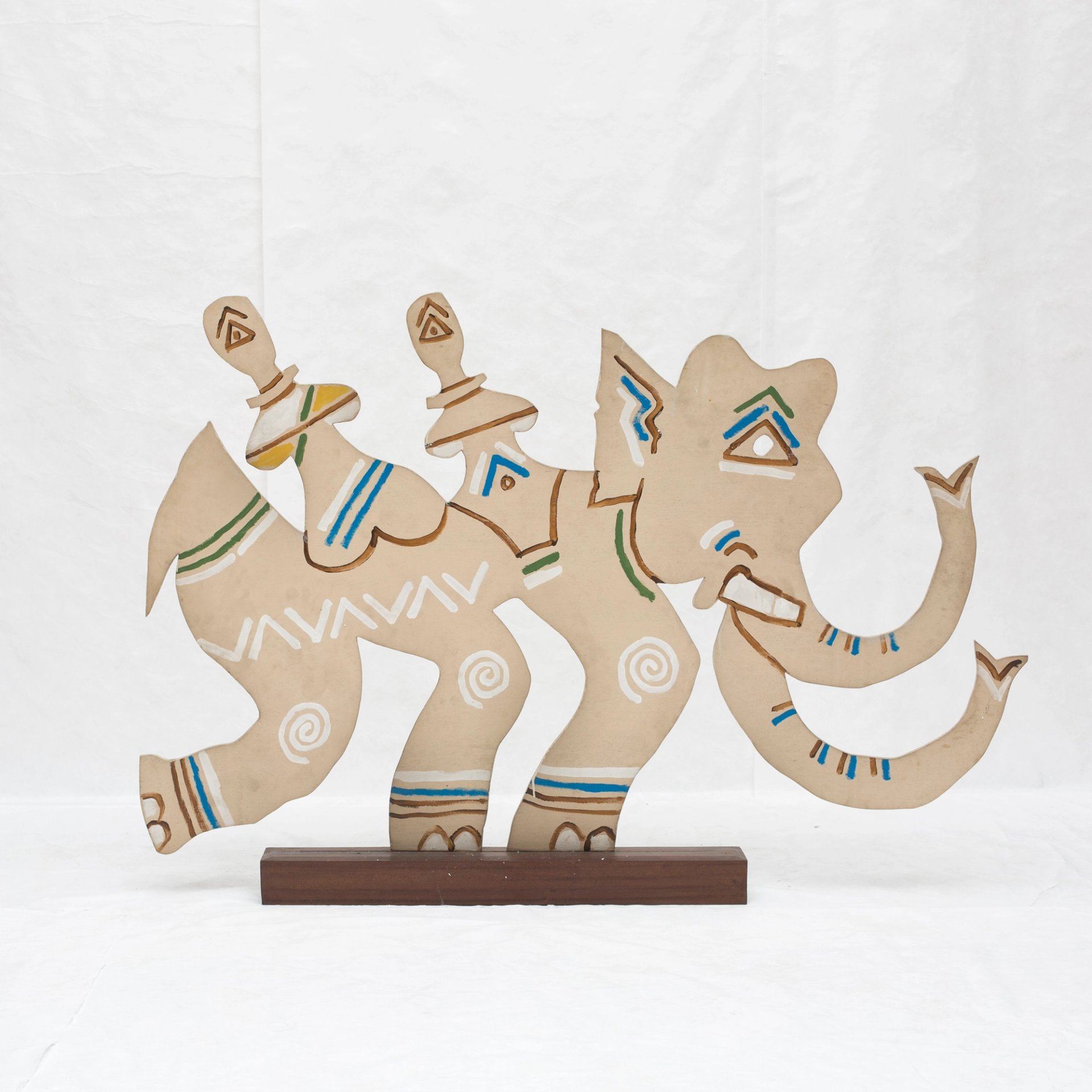
Husain’s cut-out work Elephant (1992), which reflected his
enduring fascination with Indian culture © Qatar Foundation
Qatar as patron, workplace, and the base for a late-career commission
Within that context, the museum’s curator, Noof Mohammed, has presented Qatar as a place where the artist could continue working at scale. “He found in Qatar a supportive environment for his artistic practice,” Mohammed said.
Sheikha Moza bint Nasser, identified in the museum account as the mother of the current Emir of Qatar, described the relationship in personal terms during a speech at the museum’s opening.
“We became fast friends,” recalled Sheikha Moza bint Nasser, the mother of the current Emir of Qatar, in a speech at the museum’s opening. “Just as Maqbool swiftly rediscovered his sense of belonging by returning to his Arab cultural roots.”
Around the time he moved to Qatar in 2009, Husain took on a major project titled Arab Civilisation: a set of 99 works on different aspects of Islamic and Middle Eastern history, commissioned by the Sheikha. The museum frames the commission as an extension of Husain’s long-standing interest in large-scale patronage, and as a thematic pivot after a career largely focused on Indian civilisation.
Jumabhoy described the late period as an expansion rather than a narrowing of identity. “He was embracing other aspects of world culture and his own identity,” she said. “So one shouldn’t say he was exploring the fact that he was Muslim specifically-he had a more philosophic way of looking at it in his later years.”
Mohammed has argued that Husain’s late work resists a single national label. Husain’s art “a narrative that speaks across cultural boundaries”, she said. “Even his works that are deeply Indian in spirit are universally resonant and showcase the full range of Husain’s artistic language.”
The scale of the Arab Civilisation commission also underscores the pressures of time on a late-career production schedule. Husain ultimately completed around 35 works from the 99-work series, working intensely in Qatar in the last years of his life.
“He always said he was fighting time,” Pundole said. “He had a lot to say and a very limited time to say it.”
Mehreen Rizvi-Khursheed, described as an art adviser who visited Husain in Qatar, recalled a sense of emotional tension beneath the stability of his working conditions. “I found him feeling comfortable and secure to carry on working in peace,” she said. “But he was still pining for India.”
For Qatar Foundation, which operates under the state’s broader cultural and education policy framework, the museum is also a governance instrument: a permanent, publicly accessible site tying together higher education, cultural diplomacy, and the stewardship of an artist whose story exposes both the fragility and the promise of legal protections for artistic freedom.[2]
A late style defined by simplification, scale, and immersive narrative
The museum also uses the Qatar years to map formal changes in Husain’s painting practice. Pundole said Husain had already begun shifting in the 1980s, moving away from “thick impasto” to “flat blocks of colour juxtaposed around each other.”
“I asked him why and he said, ‘It’s very easy for me to romanticise an image with thick paint on the canvas, so this was a new challenge to me,'” Pundole recalled.
In the museum framing, the development of a new visual approach accompanied an increased willingness to tackle large themes-particularly after the controversy that intensified after 1996-and a turn toward new forms of storytelling, immersive environments, and public engagement.
Mohammed cited the Gulf’s influence on Husain’s motifs and subject matter. “The Gulf’s landscapes, heritage and cosmopolitan energy inspired recurring motifs of horses, deserts and the idea of ‘home'”, she said, pointing to works including an enormous, immersive multimedia installation from 2009, Seeroo fi al Ardh-a Quranic phrase meaning “travel through the Earth”-which she described as “among his most ambitious”.
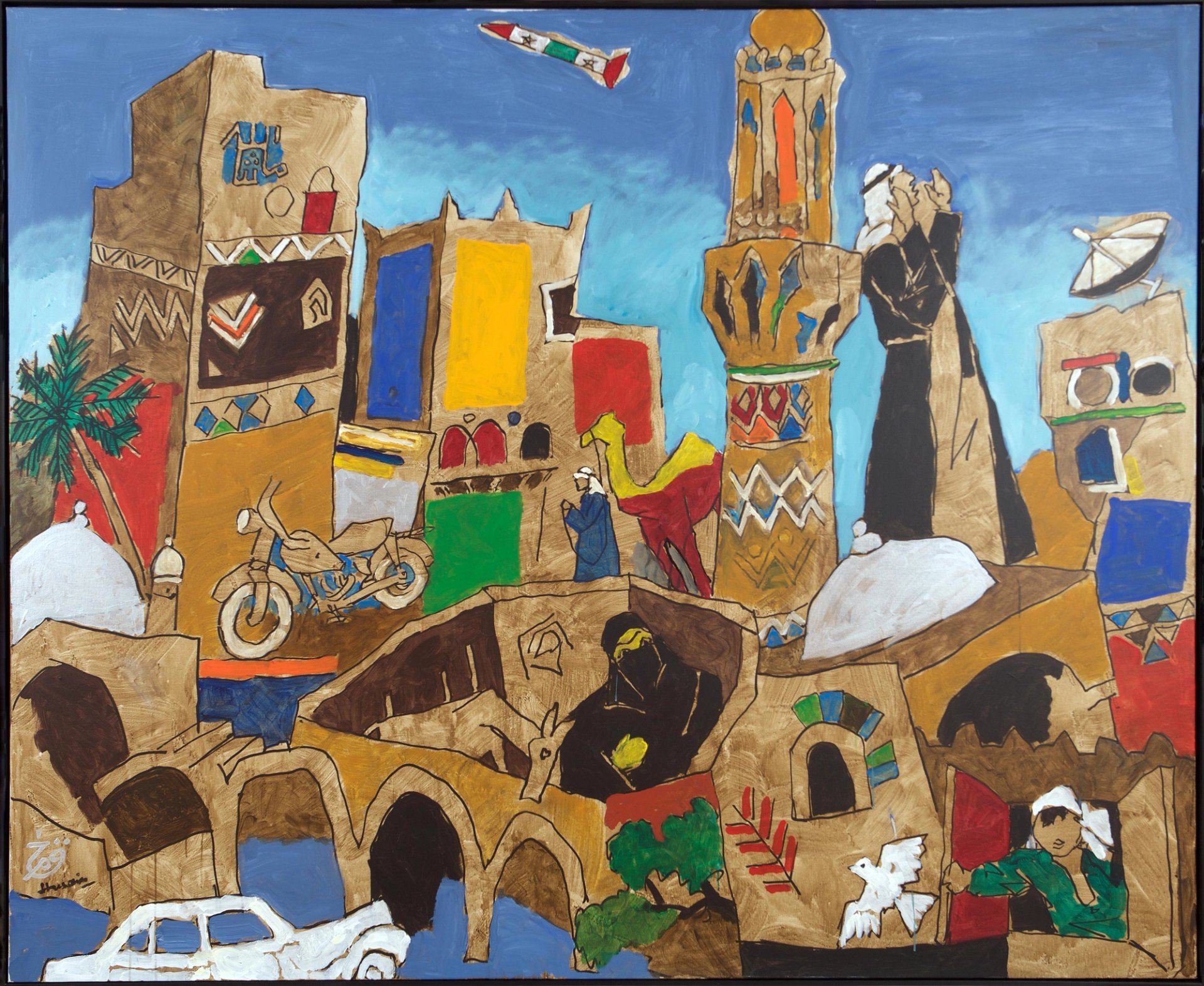
Husain’s painting Yemen (2008) Khalid Abdulrahman/© Qatar Foundation
Within the museum, one gallery, The Eternal Muse, asks visitors to consider the recurring figure of the horse across Husain’s decades of work. The motif appears with consistent formal signatures-angular, jutting necks and manes, and jaws held taut with animal energy-yet shifts meaning over time.
In an early work such as Doll’s Wedding (1950), the horse is framed as signifying elements of India’s cultural identity. In the enormous 2008 canvas The Battle of Badr-painted when Husain was 95-the museum narrative reads the subject differently, emphasising how the artist’s imagery moved beyond India in his final period: fragmented strands of Kufic script burst from clashing war horses, turning calligraphy into a visual force comparable to shrapnel.
As presented in Doha, the museum’s argument is less about replacing Husain’s long association with India than about placing his final years-2009 to 2011-inside a coherent institutional story: one that includes exile from a practical working life in India, a new base of patronage in Qatar, an ambitious commissioned series he only partially completed, and a late style that prioritised flat color, scale, and immersive narrative forms. The museum’s current public presentation centres these works and the Arab Civilisation commission, which Husain began after his move to Qatar in 2009 and completed at around 35 works before his death in London in 2011.
In doing so, Lawh Wa Qalam does more than consecrate a single artist. It quietly sets a benchmark for how state-backed museums in the Gulf, South Asia, and beyond might handle politically contentious legacies: by acknowledging the legal and policy failures that precipitated exile, and by insisting that the governance of culture-who funds it, who secures it, and under which rules-will shape not just where artists can work, but how their stories are ultimately told.
Keep reading
