
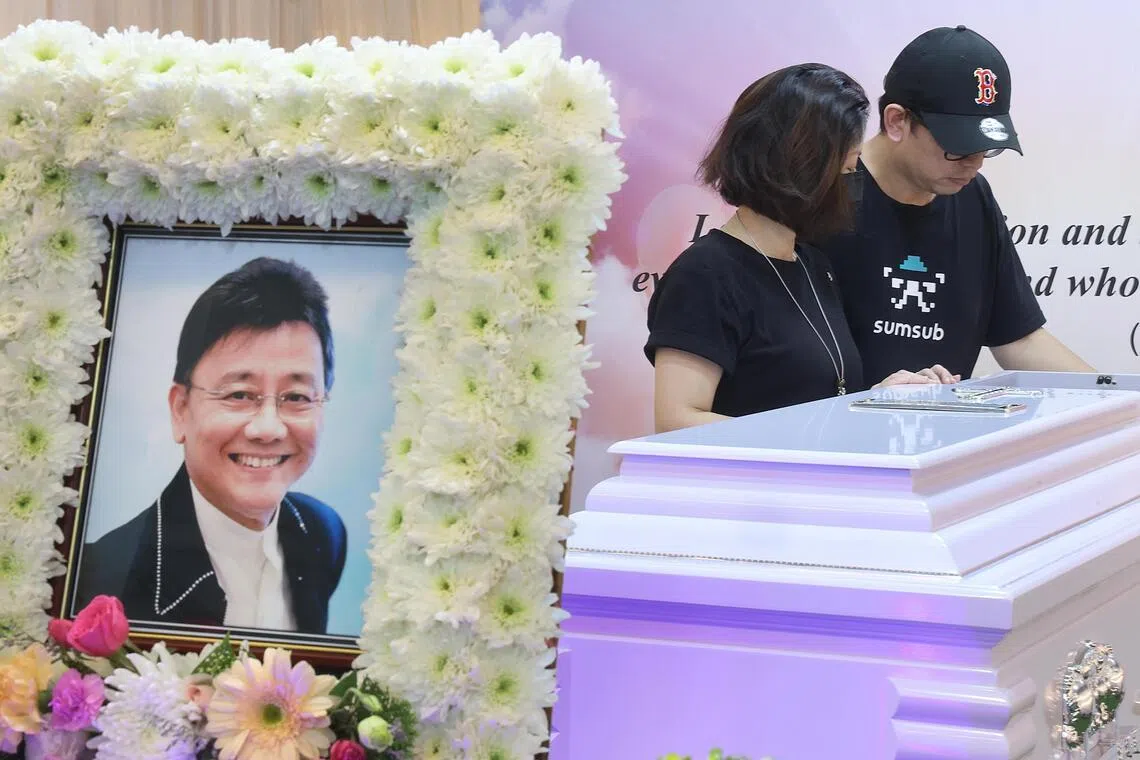
SINGAPORE – David Chia, a veteran Singapore Hokkien singer also known by his Chinese name Xie Jinshi, has died at the age of 73 on Jan 8.
His daughter, Lindy Chia, said he had been hospitalised during the Christmas period and was discharged on Dec 31, after which he went on a cruise.
Chia collapsed at about 3am on Jan 2 due to a cerebral haemorrhage while the cruise ship was sailing near Melaka. Lindy Chia said a connecting boat took him from the ship to a hospital in Melaka on shore, before he was transported back to Singapore overnight by ambulance.
She said he was not in good condition after being admitted to Tan Tock Seng Hospital, with tubes inserted all over his body.
A medical emergency mid-journey, and a final week in hospital
Lindy Chia described a difficult final stretch for the family as Chia remained in hospital following the Jan 2 collapse.
“He had been struggling for many days and the family braced themselves for the worst,” she said. “He suddenly got out of bed on Jan 6 and walked around, but that night, his breathing became laboured. He suffered from severe pulmonary edema and was in agony, constantly trying to pull out the tubes. The moment he took his last breath was peaceful and serene. We didn’t want him to suffer.”
In an interview published in August 2024, Chia said he had been diagnosed with advanced prostate cancer in June 2024. He remained positive and optimistic despite significant weight loss during treatment, and continued to teach singing.
Medical staff continued to manage his condition in a high-dependency setting in the days that followed. Under Singapore’s healthcare regime, end-of-life care is guided by national frameworks such as the Advance Medical Directive Act, which enables patients to indicate ahead of time if they wish to avoid extraordinary life-sustaining treatment. The family did not disclose whether any such directive was in place but stressed that their focus was on minimising his suffering in his final hours.
Work, repertoire and the mechanics of a veteran career
Chia’s career reflects a pathway familiar to many performers who built reputations in Singapore’s Chinese-language entertainment economy across the 1970s and beyond: contest circuits, broadcast opportunities, and then a long working life sustained through live venues and teaching.
He joined the local radio drama industry after participating in the Rediffusion Hokkien Singing Contest in 1972. In 1979, he secured an opportunity to record Hokkien songs on vinyl records, marking his entry into the music industry. Over the decades, he also performed in lounges and served as a singing coach.
For the music business, that mix of activities is not incidental. In markets where dialect-language recordings have historically circulated through small labels, physical formats, and community-driven demand, veteran singers often maintain relevance through live bookings and direct teaching work even when mainstream broadcast exposure shifts to newer acts. Teaching, in particular, can function as both an income stream and an informal talent pipeline, passing repertoire and performance discipline to younger singers who may later enter competitions, stage shows, or commercial gigs.
Chia’s long involvement in Hokkien music also dovetailed with wider policy shifts. Dialect programmes, once curtailed on free-to-air broadcast channels, have in recent years seen selective revival through heritage-themed productions and community events, as agencies such as the National Arts Council support efforts to document and sustain vernacular cultures. For performers of Chia’s generation, such initiatives helped keep older repertoires in circulation even as mainstream pop moved towards Mandarin and English.
Chia’s schedule indicates he was still professionally active close to his death. He was slated to perform with local veteran actor-host Marcus Chin on Jan 17 after his year-end holiday, followed by a performance with a wind orchestra on Feb 8.
“My father’s songs and sheet music were all prepared, and he originally planned to start rehearsals after the cruise trip,” Lindy Chia said.
The cancellation or reconfiguration of such shows typically triggers practical decisions across the live ecosystem-promoters, venues, fellow performers and musicians, and ticket holders-though no further details on those arrangements were announced in the information provided.
David Chia with his daughter Lindy in a file photo from 2015.
PHOTO: COURTESY OF DAVID CHIA’S FAMILY
Personal account from family, and funeral arrangements
Lindy Chia said her father remained active in temperament even during cancer treatment, and did not see himself as a patient.
“He lived a more exciting life than I did,” she said. “He had been to many places – Canada, Las Vegas in the United States and Huangshan in China, and even went whitewater rafting in New Zealand.”
Friends and fellow performers are expected to pay their respects over several days, in line with common practice for multi-day wakes in Singapore’s heartland estates. Such gatherings often double as informal reunions for veterans of the local entertainment scene, providing space for stories and songs that rarely surface on commercial stages.
Chia’s wake is being held at Block 428 Hougang Avenue 6, with the funeral to take place on Jan 11. Following the service, arrangements will proceed under standard funeral and burial or cremation rules overseen by the National Environment Agency, which regulates wakes and columbaria to minimise disruption while allowing families to observe their traditions.
Worth a look
