

The recent alignment of Jupiter and Venus over Heilongjiang Province underscores a broader shift in how celestial events are documented and governed. While planetary conjunctions are timeless astronomical occurrences, the precision with which they are now captured across diverse urban and rural landscapes-from Tongjiang to Harbin-is a result of significant advancements in optical sensor technology and aerial imaging platforms, as well as evolving national rules on low-altitude airspace and civilian drone use under the Civil Aviation Administration of China. For local authorities, the same systems that enable citizens to photograph the night sky also raise new questions about safety, data management, and the use of shared airspace during public events.
Aerial Imaging and Drone Integration in Astronomy

The use of drone-based photography to capture the June 9 conjunction over Shuangyashan demonstrates the migration of high-resolution imaging from fixed tripods to mobile, autonomous platforms. Modern drones have evolved beyond simple surveillance or cinematography, integrating sophisticated gimbal stabilization systems that counteract atmospheric vibration and wind shear, allowing for the long-exposure shots necessary to resolve planetary bodies while maintaining flight stability above built-up areas.
This capability is driven by the miniaturization of CMOS sensors, which now provide the high dynamic range required to capture the brilliance of Venus alongside the dimmer light of Jupiter without overexposing the frame. The integration of GPS-synced timing ensures that photographers can align their shots with exact orbital windows, turning consumer hardware into tools for precise astronomical observation and, increasingly, into informal sensing nodes in the wider digital infrastructure over northeast China.
Sensor Precision and Low-Light Architecture
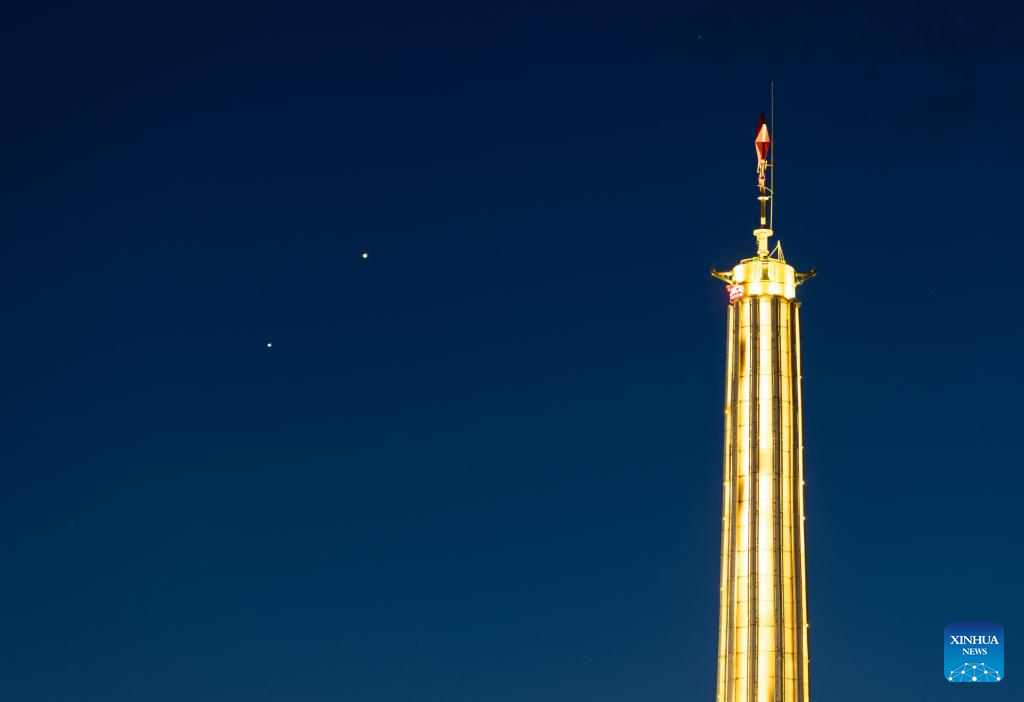
Capturing the conjunction across Jiamusi and Fujin requires hardware capable of managing high signal-to-noise ratios. The clarity seen in these images is a product of back-illuminated sensor designs that maximize photon collection, reducing the grain typically associated with low-light, high-ISO settings and enabling consistent results from both hobbyist and semi-professional equipment.
| Technical Requirement | Traditional Method | Modern Digital Approach |
|---|---|---|
| Stabilization | Heavy-duty equatorial mounts | Electronic Image Stabilization (EIS) & 3-axis gimbals |
| Light Capture | Chemical film / Early CCD | Stacked BSI-CMOS sensors |
| Positioning | Manual star-charting | Real-time GPS & app-based tracking |
| Post-Processing | Darkroom chemical development | Algorithmic noise reduction & RAW processing |
Infrastructure, Environmental Interference and Local Planning
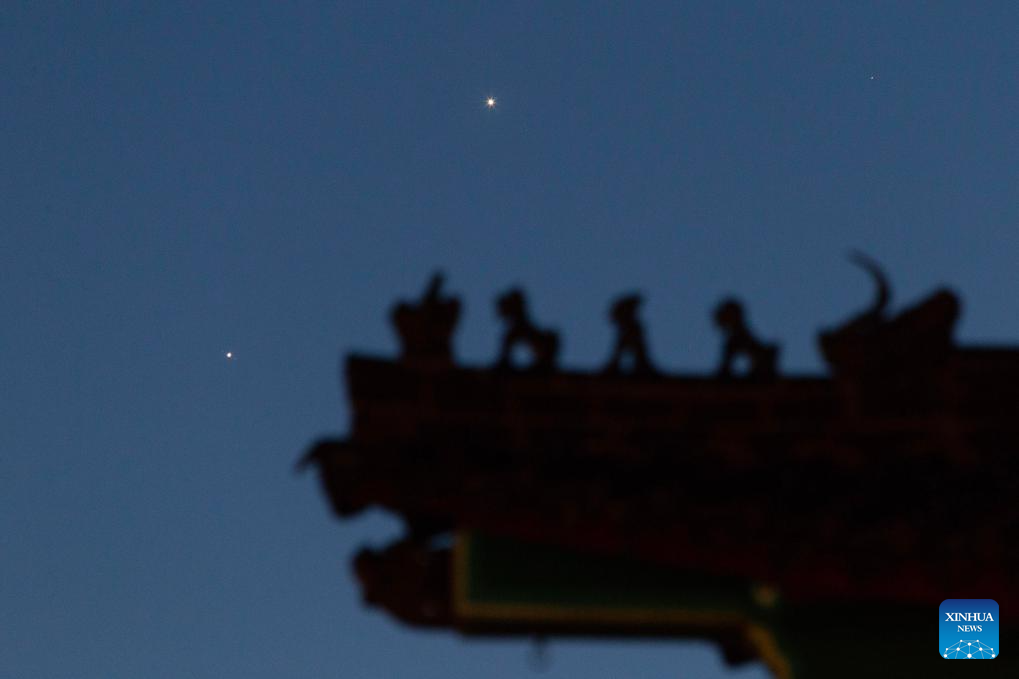
The visual data captured from the Yabuli Ski Resort and Harbin highlights the impact of local infrastructure on astronomical visibility and, by extension, on how cities think about lighting and skyline policy. Light pollution in urban centers typically obscures celestial events, but modern computational photography uses AI-driven masking to isolate planetary light from city glow, effectively “cleaning” the image in real-time and allowing residents to participate in skywatching even from dense downtown districts.

To achieve professional-grade results in these environments, the following system layers are typically employed, often in consultation with local astronomy clubs and municipal regulations on night-time lighting and drone operations:
- Optical Filtration: Using narrow-band filters to block specific wavelengths of artificial light from street lamps, commercial signage and resort infrastructure.
- Algorithmic Stacking: Combining multiple short-exposure frames to increase the total signal while averaging out random electronic noise, a process that now runs on consumer laptops and smartphones rather than specialist observatory hardware.
- Thermal Management: Active cooling of sensors to prevent thermal noise (dark current) from appearing as hot pixels in the image, preserving detail in both the planetary discs and the surrounding star field.

The Convergence of Consumer Tech, Citizen Science and Policy
The proliferation of these high-fidelity images suggests a democratization of astronomical data collection. When photographers across a province use synchronized technology to document a single event, they create a distributed network of observational data that can, in principle, complement professional observatories. This intersection of consumer electronics and orbital mechanics allows for a more comprehensive understanding of atmospheric conditions and light refraction patterns across different geographic coordinates, while also giving policymakers a real-time, visual measure of how air quality, illumination standards and building design affect public access to the night sky.
As authorities in China and other countries refine rules for low-altitude airspace, data privacy and the safe operation of small unmanned aircraft, the kind of imagery captured over Heilongjiang is likely to sit at the crossroads of public enthusiasm and regulatory oversight. For now, the Jupiter-Venus conjunction serves as both a spectacular natural event and a case study in how everyday technology, guided by evolving governance frameworks, is reshaping who gets to observe-and record-the universe above them.
Worth a look
