
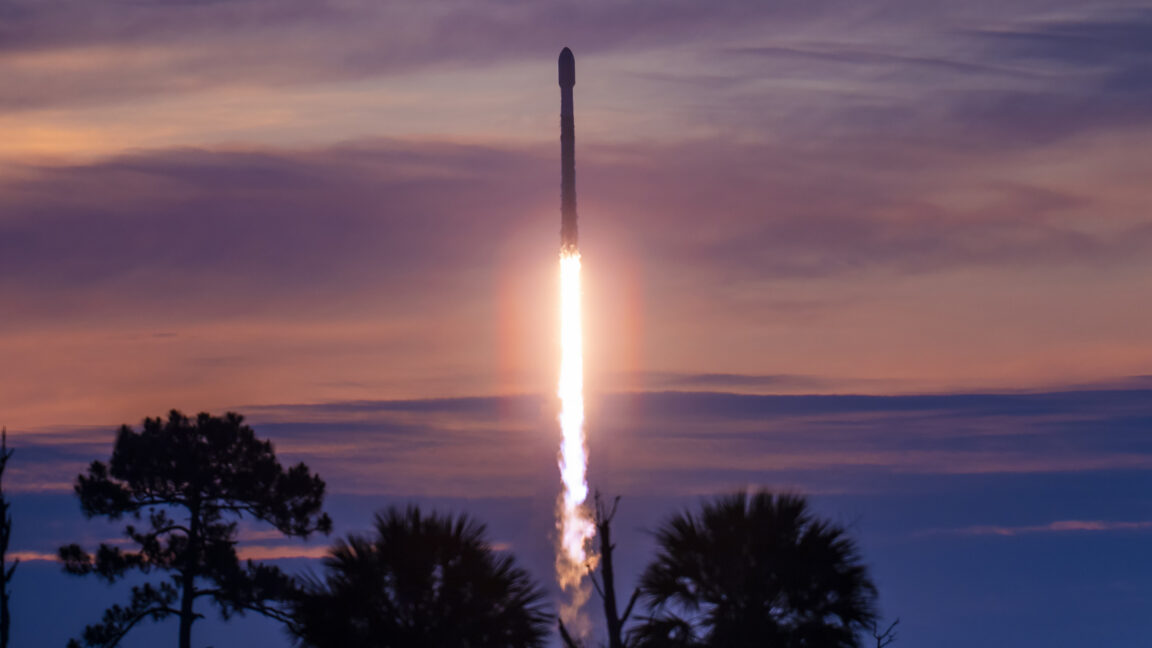
The transition of spaceflight from a series of high-stakes spectacles to a routine logistics operation is best exemplified by a single piece of hardware: booster B 1067. This Falcon 9 first stage has evolved from a vehicle tasked with high-profile human and cargo missions to a workhorse of the Starlink constellation, fundamentally altering the economics of orbital access.
On Monday morning, B 1067 successfully deployed 29 Starlink Internet satellites into low-Earth orbit. Following its descent and precise landing on the A Shortfall of Gravitas drone ship in the Atlantic, the vehicle marked its 35th successful mission. This milestone establishes B 1067 as the current fleet leader, demonstrating a level of reliability that was unthinkable in the era of expendable launch vehicles.
The Shift Toward Orbital Logistics
The operational history of B 1067 reflects a broader strategic pivot in SpaceX’s launch architecture. Early in its lifecycle, the booster supported the critical infrastructure of the International Space Station, launching Cargo Dragon and astronaut missions under NASA’s Commercial Crew framework. However, the current phase of its deployment is focused almost exclusively on the rapid scaling of the Starlink network, a privately owned but de facto global communications utility in low-Earth orbit.
| Operational Phase | Mission Focus | Primary Objective |
|---|---|---|
| Initial Deployment | ISS Logistics & Crew | Establishing reliable, contracted access to the ISS |
| Infrastructure Scaling | Starlink Constellation | High-frequency deployment of LEO communications satellites |
| Endurance Qualification | High-Cadence Recovery | Testing and extending the limits of hardware reusability |
By flying these experienced boosters multiple times a month, SpaceX is effectively treating rocket stages as reusable aviation assets rather than consumable munitions. This cadence reduces the pressure on manufacturing lines and maximizes the utility of each airframe. It also normalizes a level of launch capacity that regulators, spectrum allocators and defense planners must now factor into long-term policy and procurement decisions.
Engineering the Threshold of Reusability
The successful recovery of B 1067 brings the company closer to its stated goal of qualifying its Falcon 9 first stage vehicles to support 40 missions each. While 40 was the benchmark established over two years ago, the consistent safety record of high-flight-count boosters suggests that this limit may be expanded as engineering data accumulates and regulators gain confidence in lifetime-certification models.
Pushing a booster beyond 40 flights introduces complex engineering challenges related to structural integrity and thermal stress. Each reentry exposes the vehicle to extreme plasma heating and mechanical loads that can lead to material fatigue, all of which must be documented and modeled to satisfy safety standards for crewed missions and for launches from populated coastal ranges.
- Thermal Degradation: Repeated atmospheric reentry erodes protective coatings and stresses the primary alloy structure, forcing incremental redesigns and more granular inspection regimes.
- Cryogenic Cycling: The constant transition between ambient temperatures and cryogenic fuel loading causes expansion and contraction cycles in the propellant tanks, a key driver of life-limit calculations.
- Engine Wear: The Merlin 1D engines must maintain precise thrust parameters across dozens of ignition and shutdown cycles, with performance trending closely monitored for any signs of systemic drift.
- Refurbishment Efficiency: The economic viability of re-flight depends on minimizing the man-hours required between landings and subsequent launches without compromising the inspection thresholds expected by aviation and spaceflight regulators.
The comparison to the space shuttle Discovery, which achieved 39 flights over nearly four decades, highlights the acceleration of the current pace. B 1067 is approaching that same total in a fraction of the time, moving the industry toward a model of rapid, iterative reuse that challenges legacy assumptions embedded in national launch licensing regimes and human-rating standards.
The Financial Engine of Commercial Space
The reliability of the Falcon 9 is not merely a technical achievement; it is the primary driver of SpaceX’s market valuation and of broader investor confidence in launch-as-infrastructure. The ability to amortize the cost of a first-stage booster over 30 or 40 flights drastically lowers the price per kilogram to orbit, creating a formidable barrier to entry for competitors relying on expendable architecture or still-untested reusable systems.
This infrastructure dependency extends beyond the company’s own Starlink goals. The Falcon 9 has become the bedrock of the global satellite launch market, providing a stable platform for government agencies and private enterprises alike. In practical terms, that leaves national space agencies, export-control authorities and spectrum regulators managing a critical piece of orbital infrastructure operated by a single, privately held firm.
Whether the company pursues an IPO or remains private, the underlying asset is the proven reusability of its fleet and the regulatory licenses that enable high-cadence operations. As more civil and defense payloads rely on this capacity, oversight under frameworks such as the U.S. commercial launch licensing regulations becomes an increasingly important lever for public-interest safeguards, from debris mitigation to range safety.
The operational success of B 1067 proves that the Falcon 9 is no longer an experimental system but a mature piece of industrial infrastructure. By treating rocket launches as a non-event, SpaceX has shifted the conversation from whether a rocket can be recovered to how many times it can be flown before the economics of replacement outweigh the cost of refurbishment-and, for policymakers, how that new normal should be governed.
Keep reading
