
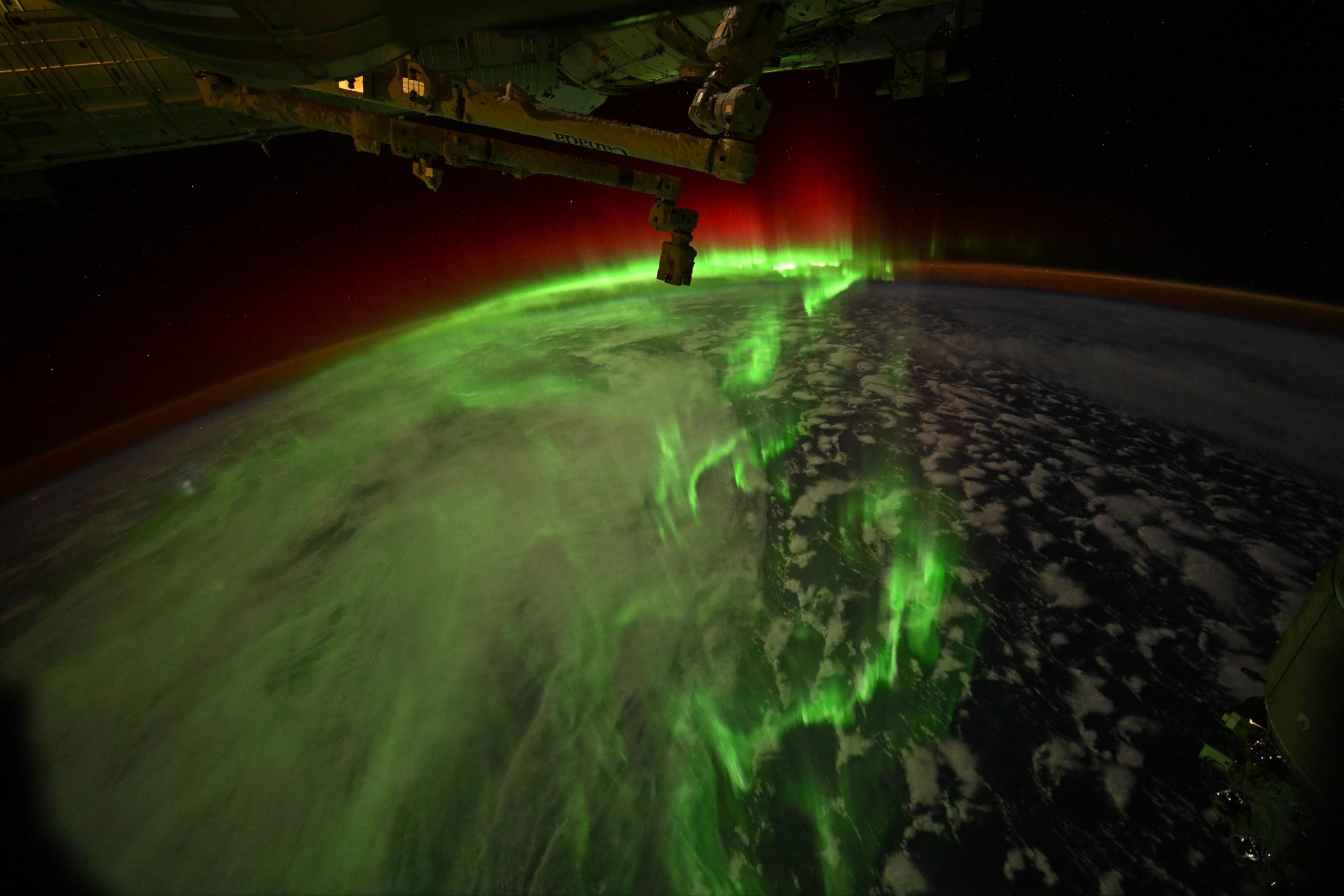
The fragile boundary between Earth’s atmosphere and the vacuum of space has become a vivid canvas this week, as a sequence of high-energy solar events triggers intense geomagnetic storms. For crews aboard the International Space Station and the SpaceX Dragon capsule, the result is a perspective of the aurora that transcends ground-based observation, revealing the atmospheric layers as razor-thin ribbons of light wrapped around the planetary limb.
NASA astronaut Jessica Meir captured the phenomenon via time-lapse, documenting vivid waves of green light rippling beneath the spacecraft. Her observations emphasized the stark contrast of the orbital environment: the thinness of the atmosphere, the neon glow of the aurora, and the undisturbed density of the star-filled void beyond.
Veteran astronaut Don Pettit reported an even more immersive experience, describing views of blood‑red arcs so bright they seemed to engulf the spacecraft. While ground observers see the aurora as a curtain of light, orbital views reveal a glowing ring encircling the poles, expanding toward mid-latitudes as the magnetosphere reacts to increased solar wind pressure. For mission planners, these vantage points are more than aesthetic; they provide real-time visual cues that help validate space‑weather models used to protect satellites and crew.
The Mechanics of Cannibal CMEs
The current atmospheric display is the result of a complex solar interaction involving coronal mass ejections (CMEs). On June 3, a series of CMEs were launched from the Sun; one of these faster-moving clouds of plasma overtook a previous eruption, creating a “cannibal CME.” This merger increases the density and velocity of the plasma hitting Earth’s magnetic field, amplifying the resulting geomagnetic storm and compressing the magnetosphere closer to the planet.
This activity coincides with the approach of the solar maximum in the Sun’s 11-year cycle, a period characterized by increased sunspot activity and frequent eruptions. A specific “anti‑Hale” sunspot-one with reversed magnetic polarity-has recently emerged, triggering eruptions roughly every eight hours and maintaining a steady stream of plasma toward Earth. Space weather agencies treat such active regions as high‑priority targets, feeding their behavior into models that inform grid operators, satellite controllers, and civil aviation authorities.
Systemic Risks to Terrestrial Infrastructure
While the visual displays are spectacular, G2 (moderate) and G3 (strong) storms introduce tangible risks to global technological infrastructure. High-energy particles can induce currents in long-distance power lines and disrupt the ionosphere, which is critical for satellite-to-ground communication and global positioning signals relied upon by logistics, emergency services, and financial markets.
In the United States, the NOAA Space Weather Prediction Center serves as the official civil authority for these alerts, feeding into mandatory reliability standards overseen by federal energy and aviation regulators. The potential impact varies based on the storm’s intensity scale:
| Storm Level | Classification | Primary Infrastructure Risk |
|---|---|---|
| G1 | Minor | Weak power grid fluctuations; minor aurorae at high latitudes. |
| G2 | Moderate | Voltage spikes in power grids; GPS precision degradation. |
| G3 | Strong | Potential power outages; satellite navigation signal loss. |
| G4 | Severe | Widespread grid instability; HF radio blackouts. |
| G5 | Extreme | Complete grid failure in some regions; satellite hardware damage. |
The risk to aviation and maritime sectors is particularly acute during G3 events, as high-frequency (HF) radio communications often fail during solar flares, forcing aircraft to divert from polar routes to maintain contact with air traffic control. Airlines, air navigation service providers, and shipping companies increasingly build space-weather contingencies into their operational playbooks, weighing delays and reroutings against regulatory safety obligations and insurance exposure.
Short-Term Forecast and Monitoring
The current window of activity is expected to persist through the second week of June. Forecasts indicate a G3 geomagnetic storm watch for June 8 and a G2 watch for June 9, driven by a fresh CME that departed the Sun on June 6. These watches function much like severe weather advisories on Earth: they do not guarantee impact, but they trigger readiness protocols across power, telecoms, and transportation networks.
Whether these events result in significant infrastructure disruption depends on the magnetic orientation of the CME. If the solar magnetic field aligns opposite to Earth’s, energy couples more efficiently into the magnetosphere, increasing the likelihood of bright displays and technical interference. For those tracking these events via NASA and allied agency data, the best viewing opportunities on the ground remain centered around local midnight in higher latitudes, away from urban light pollution. For policymakers and operators, however, the real focus over the coming days will be on how reliably early-warning systems translate this celestial spectacle into actionable decisions that keep grids stable, aircraft connected, and satellites on line.
