
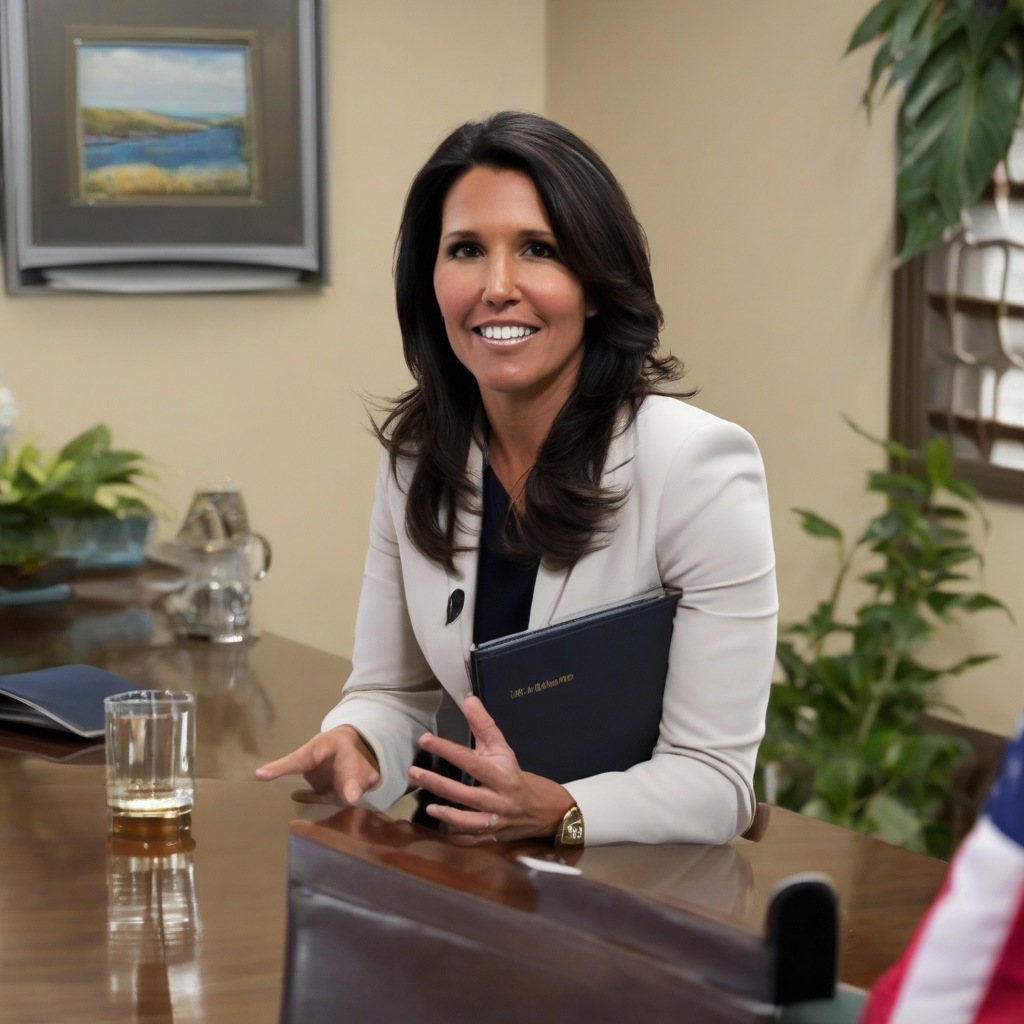
WASHINGTON – Tulsi Gabbard, the Director of National Intelligence, announced her resignation on May 22, 2026, citing a medical crisis involving her husband. Her departure marks the fourth exit from the presidential cabinet this year, with all four departing officials being women.
The resignation coincides with a sudden shift in President Donald Trump’s personal and professional schedule. Amid escalating uncertainty regarding the conflict with Iran, the president announced he will skip his son’s wedding in the Bahamas this weekend and cancel a planned trip to his New Jersey golf club to remain at the White House.
As the Director of National Intelligence, Gabbard served as a cabinet-level official overseeing the United States Intelligence Community, with direct responsibility for agencies including the Central Intelligence Agency (CIA) and the National Security Agency (NSA). The role, created after the 9/11 attacks under the Intelligence Reform and Terrorism Prevention Act, is intended to coordinate intelligence for the president, including on issues such as the standoff with Iran.
Resignation and Internal Conflict
Gabbard revealed on social media that her husband, Abraham Williams, has been diagnosed with a rare form of bone cancer.
“He faces major challenges in the coming weeks and months,” Gabbard stated. “At this time, I must step away from public service to be by his side and fully support him through this battle.”
While the official reason is familial health, reports of internal friction have emerged, raising questions about how national security policy is being managed inside the administration. Reuters cited a source familiar with the matter claiming Gabbard was forced out by the White House.
White House spokesman Davis Ingle denied these reports, describing Gabbard as a patriot who served her country extremely well. “Any suggestion that the White House forced her to resign over her husband’s health is slanderous,” Ingle said.
President Trump supported the official narrative via social media, stating that Gabbard was “unfortunately” leaving due to the diagnosis. “Tulsi has done an incredible job, and we will miss her,” he wrote, without indicating who might succeed her or how the administration plans to manage the intelligence portfolio in the interim.
Iran Conflict and Presidential Schedule
The resignation occurs as the administration navigates a stalemate over a potential deal with Iran and heightened tensions over freedom of navigation in the Persian Gulf. On May 22, Trump presided over the swearing-in of Kevin Warsh as the new chairman of the Federal Reserve before traveling to Suffern, New York, for a campaign event.
However, Trump later confirmed he would not attend the wedding of his son, Donald Trump Jr., and his fiancée, Bettina, in the Bahamas. He also canceled his Memorial Day weekend plans at his private New Jersey golf club, underscoring the degree to which the Iran file and the departure of his top intelligence adviser are now consuming his time.
Writing on Truth Social, Trump stated: “While I very much wanted to be with my son, Don Jr, and the newest member of the Trump Family, his soon-to-be wife, Bettina, circumstances pertaining to government, and my love for the United States of America, do not allow me to do so.”
He added, “I feel it is important for me to remain in Washington DC at the White House during this important period of time.” The decision effectively ties the president’s public schedule to decisions on war and peace that draw heavily on the intelligence assessments Gabbard’s office oversees.
Cabinet Turnover and Governance Concerns
Gabbard is the latest in a series of high-profile departures of women from the Trump administration this year, deepening concerns among some lawmakers and governance experts about continuity at the top of key departments.
The officials who have exited the cabinet in 2026 include:
- Pam Bondi, former Attorney General
- Kristi Noem, former Secretary of Homeland Security
- Lori Chavez-DeRemer, former Secretary of Labor
- Tulsi Gabbard, Director of National Intelligence
Each of those posts carries Senate-confirmed authority over major policy levers – from domestic law enforcement and border security to labor regulation and intelligence collection. The wave of departures leaves acting officials or newly nominated successors to steer some of the federal government’s most sensitive portfolios at a moment of international strain.
Geopolitical Reactions and Military Pressure
Gabbard’s tenure was marked by an anti-interventionist foreign policy profile and a willingness to publicly contest hawkish views within the administration. She previously clashed with President Trump regarding Iran; last year, she told Congress that Iran was not building nuclear weapons, to which Trump responded, “I don’t care what she said, I think they were very close to having one.” Her testimony placed her at the center of the debate over how intelligence on Iran’s nuclear ambitions should inform U.S. policy and compliance with frameworks such as the international nuclear verification regime.
Following the announcement, the Iranian embassy in Armenia issued a statement wishing Gabbard and her husband well, claiming she “spoke truths about Iran that Trump hated.” The unusually personal message from an Iranian diplomatic outpost underlined how closely Tehran had tracked her public statements.
Simultaneously, members of the U.S. Senate are calling for a more aggressive military posture. Roger Wicker, the Republican chairman of the Senate Armed Forces Committee, urged the president to resume military strikes against Iran, reflecting mounting pressure on the White House from Capitol Hill.
“Our commander-in-chief needs to allow America’s skilled armed forces to finish the destruction of Iran’s conventional military capabilities and reopen the strait. Further pursuit of an agreement with Iran’s Islamist regime risks a perception of weakness. We must finish what we started. It is past time for action.”
Gabbard is scheduled to officially leave her position as director of national intelligence at the end of June, setting a tight timeline for the White House to nominate a successor, secure Senate confirmation, and stabilize intelligence leadership as decisions on Iran and broader U.S. national security posture come to a head.
Worth a look
- Urban Infrastructure Resilience: How European and Asian Megacities Are Adapting to Extreme Climate Oscillations in 2026
- UN General Assembly 2026 Framework on Autonomous Systems: International Diplomacy Faces Algorithmic Governance
- Trump names national intelligence chief Jay Clayton as new AI czar (globallypulse.com)
