
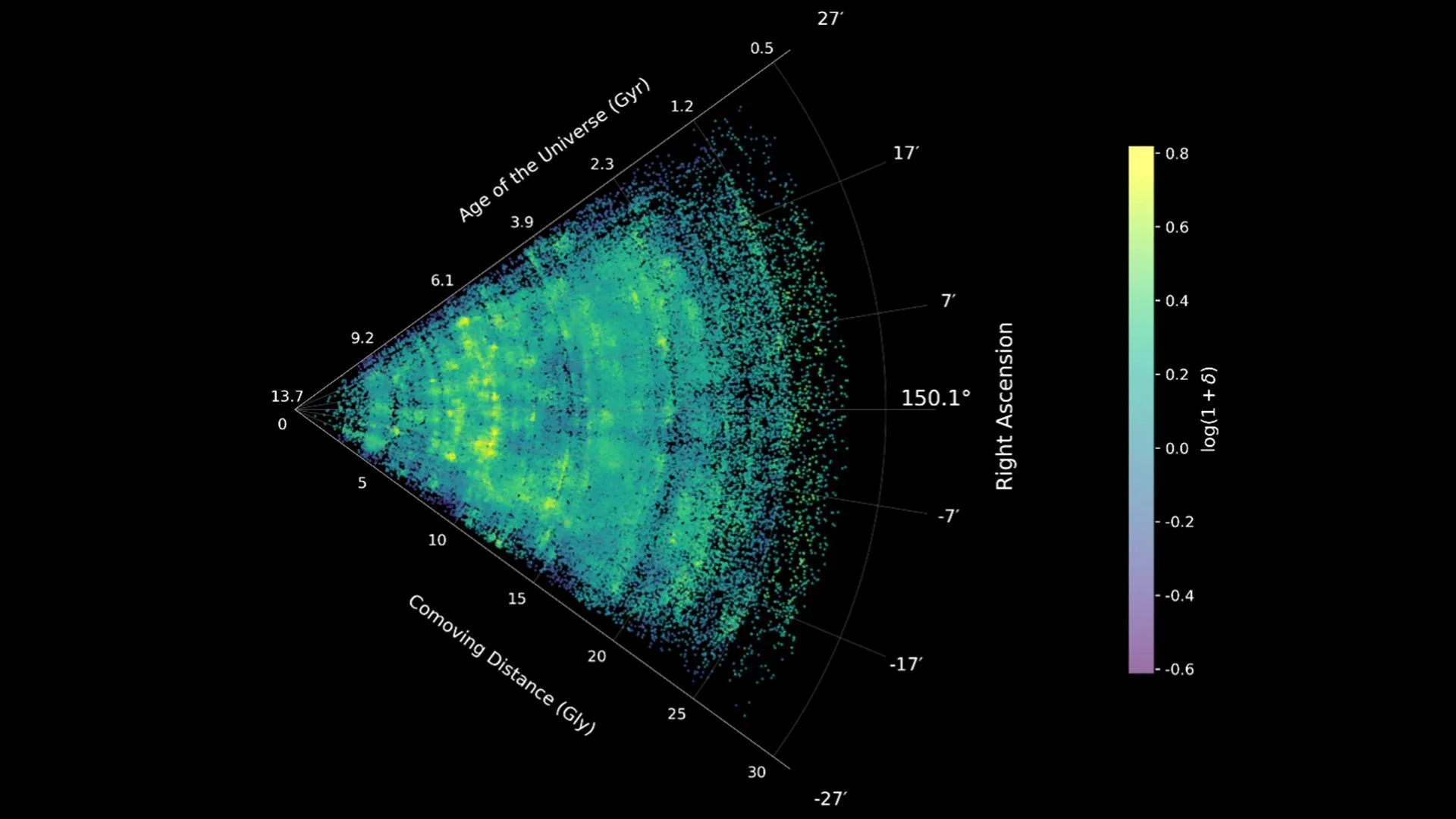
Infrared Resolution and the Large-Scale Architecture of Space
The universe is underpinned by a massive, skeleton-like framework known as the cosmic web. This network of filaments and sheets, composed primarily of dark matter and gas, serves as the structural scaffolding for the cosmos, surrounding vast, empty voids and connecting galaxy clusters across billions of light-years.
Utilizing the James Webb Space Telescope (JWST), a flagship mission overseen by NASA, the European Space Agency and the Canadian Space Agency, researchers have successfully mapped this architecture back to a period when the universe was approximately one billion years old. This achievement relies on the telescope’s advanced infrared instruments, which allow astronomers to penetrate dense cosmic dust and detect faint, distant galaxies that were invisible to previous generations of hardware.
“JWST has completely changed our view of the universe, and COSMOS-Web was designed from the start to give us the wide, deep view we need to see the cosmic web,” said Hossein Hatamnia, a graduate student at UCR and Carnegie Observatories, and lead author of the study. “For the first time we can study the evolution of galaxies in cluster and filamentary structures across cosmic time, all the way from when the universe was a billion years old up to the nearby universe.”
The COSMOS-Web Computational Framework
The precision of the new cosmic map is a result of the COSMOS-Web survey, the largest General Observer (GO) program currently operating on the JWST. Under the JWST time-allocation system, GO programs compete through a formal proposal and peer-review process, a governance mechanism that effectively prioritizes projects expected to deliver high-impact public science returns.
By analyzing a continuous section of the sky roughly the size of three full Moons, the team has been able to distinguish between overlapping structures that appeared blurred in earlier observations. The field is large enough to capture multiple galaxy clusters and extensive filaments while still being observed at a depth that makes the faintest galaxies statistically meaningful, enabling robust comparisons between regions of high and low matter density.
The technical leap is driven by the synergy of increased sensitivity and precise distance measurement, allowing each galaxy to be placed into a specific chronological slice of cosmic history. In practice, that means astronomers can now chart how galaxies switch on, grow, merge and quench in different environments along the same filamentary backbone, rather than inferring those trends from smaller, disconnected pencil-beam surveys.
| Technical Parameter | COSMOS-Web Specification |
|---|---|
| Instrument Base | James Webb Space Telescope (JWST) |
| Survey Area | Approx. 3 full Moons of sky coverage in a contiguous field |
| Galaxy Catalog | 164,000 identified galaxies with environmental classifications |
| Temporal Reach | Tracing evolution up to z ~ 7 (within the universe’s first billion years) |
| Primary Detection Method | High-resolution infrared imaging with precision distance estimates |
Bahram Mobasher, a distinguished professor of physics and astronomy at UCR, noted the resolution gap between the current data and legacy imagery from the Hubble Space Telescope. “The jump in depth and resolution is truly significant, and we can now see the cosmic web at a time when the universe was only a few hundred million years old, an era that was essentially out of reach before JWST,” Mobasher said. “What used to look like a single structure now resolves into many, and details that were smoothed away before, are now clearly visible.”
For policymakers and institutional funders, the result is an early proof point that the multi-billion-dollar investment in JWST is not only returning striking imagery but also delivering the kind of precision cosmology needed to test models of dark matter, dark energy and structure formation-inputs that inform long-term national and international research roadmaps.
Open-Source Astronomy and Data Integrity
The project adheres to a rigorous open-science model, ensuring that the data pipelines and findings are available for global peer validation and further research. This transparency is critical for maintaining the integrity of large-scale astronomical datasets, where algorithmic processing plays a significant role in interpreting “voids” and “filaments,” and where undetected biases can ripple into the cosmological parameters used by public agencies in their strategic planning.
The research team has released the structural maps, the galaxy catalog, and the evolutionary visualization via publicly available repositories. In parallel, the mission itself is governed by the civil-space policy and oversight structures set out in the U.S. National Cislunar and Space Policy framework, which anchors JWST and its successors in a long-term program of publicly funded, internationally coordinated space science.
“The pipeline used to build the map, the catalog of 164,000 galaxies and their cosmic density, and a video showing the cosmic web evolving across billions of years, has been released to the public,” Mobasher said. That decision aligns with a wider shift toward open data mandates among space agencies and research ministries, designed to maximize the societal return on public investment in large observatories.
This data release enables an international coalition of scientists from the U.S., Denmark, Chile, France, Finland, Switzerland, Japan, China, Germany, and Italy to collaborate on the paper “Large-Scale Structure in COSMOS-Web: Tracing Galaxy Evolution in the Cosmic Web up to z ∼ 7 with the Largest JWST Survey.” The research was supported by funding from the European Union’s Horizon 2020 research and innovation program and sits alongside broader moves by governments and funding bodies to treat flagship sky surveys as shared strategic infrastructure rather than isolated national projects.
- Quantum Networking Milestones: How Quantum Key Distribution (QKD) Testbeds Are Moving to Financial Hubs in 2026
- The Rise of Specialized Small Language Models (SLMs) in Enterprise On-Premise Deployments
- Median Net Worth Peaks at 75+ in the Fed's Survey, but the Lead Is Thin (daybreakwire.com)
- Timé Zoppé expresses desire for queer-gaze architecture film (archyde.com)
