
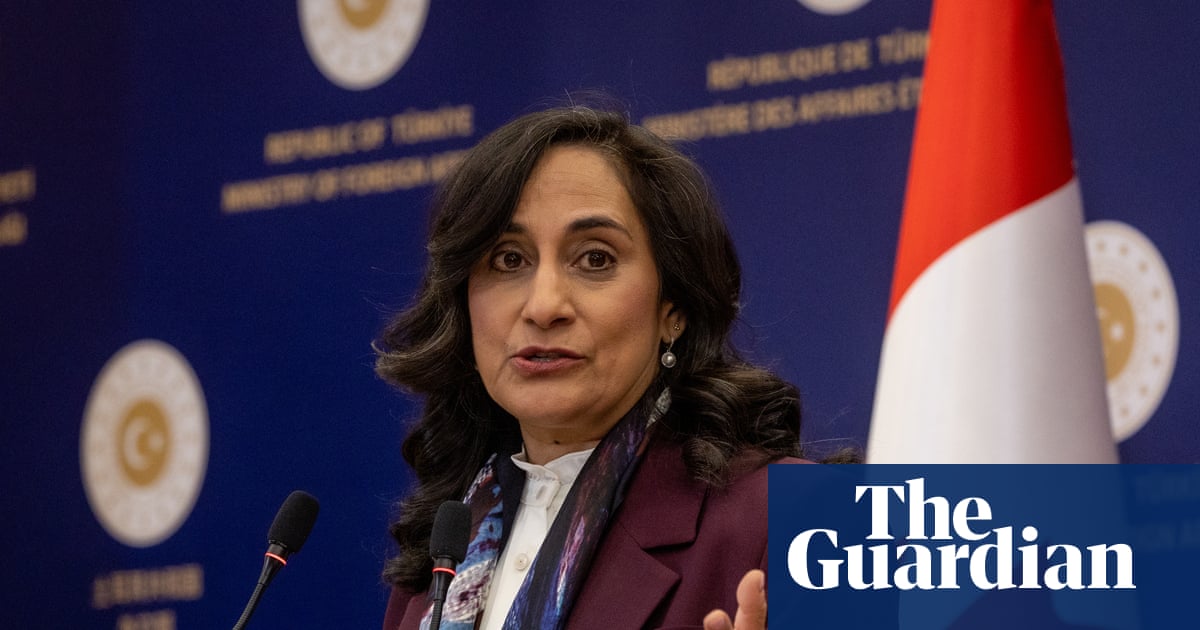
LONDON – Anita Anand, Canada’s foreign minister, said Canada is pushing for a coordinated plan among the G7 and key Middle Eastern governments to de‑escalate the Iran war, including agreed “off ramps” aimed at ending the conflict. Speaking in London after meeting UK foreign secretary Yvette Cooper and following talks with Turkish foreign minister Hakan Fidan, she said she wants the initiative taken up at a G7 gathering chaired by France.
Anand said she has drafted a “document of principles” to circulate to partners to reduce regional spillover, limit harm to civilians and non‑belligerent states, and cushion economic shocks. She added: “It’s a document I am working with a number of countries on. I am speaking with every G7 country and every partner impacted by the war in the Middle East to stress the principle of de-escalation.”
The push comes as European governments and Canada, which have not participated in the U.S.-Israeli bombing campaign, have begun aligning positions while Iran has responded with missile and drone strikes on Gulf neighbors and threats to shipping in the Strait of Hormuz – a waterway through which roughly a fifth of globally traded oil normally transits under the rules of the UN Convention on the Law of the Sea (UNCLOS).
What Ottawa is proposing
Anand said the emerging “document of principles” is designed to channel disparate efforts into a single track focused on de‑escalation and to give capitals a shared vocabulary for negotiating “off ramps” from the current cycle of retaliation. She added: “It’s important for us to have a conversation about the off ramps. I want to engage with the countries being directly impacted by the retaliatory strikes in particular, so this is a collective and coordinated discussion about off ramps.”
Canadian officials describe the document as an attempt to knit together crisis diplomacy, humanitarian protections and economic stabilization into one framework that G7 leaders and regional governments can endorse.
Key elements described by Anand and Canadian officials include:
– A collective G7 discussion, under France’s presidency, to begin shaping a broader approach to the crisis and to align messaging to Tehran, Washington and regional partners.
– Parallel outreach to Middle Eastern governments directly affected by retaliatory fire, including those hosting Western forces or controlling key shipping lanes.
– Practical measures aimed at limiting civilian harm, protecting non‑belligerent states and preventing the conflict from widening, including agreed lines of communication and parameters for maritime de‑confliction.
The G7 comprises Canada, France, Germany, Italy, Japan, the United Kingdom and the United States, with the European Union participating in the group’s work. France holds the rotating presidency this year, giving Paris a central role in setting the agenda and convening emergency ministerial meetings.
Canada distances itself from combat, stresses maritime risk
Anand said Canada was not part of the offensive action and does not intend to join it, while describing aspects of Iran’s response as unlawful under international humanitarian and maritime law.
“We were not consulted on the offensive military operation. We did not participate in the offensive operation. We have no intention of participating in the military operation period,” she said.
She added that Ottawa is focused on the economic and humanitarian implications of danger to maritime traffic: “That does not mean we are not concerned about the strait of Hormuz. We recognise the importance of the stoppage of 20% of the world oil reserves. It’s extremely problematic for food supply chains and energy supply chains.”
Canadian officials say the foreign ministry and defence department are working with allies on contingency planning for rerouting shipping, insuring cargoes and protecting crews, even as Ottawa keeps its distance from combat operations.
Where allied positions are converging
European states and Canada were initially slow to synchronize responses to the U.S. strikes, but their stances are now coalescing, according to diplomats engaged on the file. Those diplomats also say any settlement will be difficult because Iran is seeking a guarantee it will not be attacked again – assurances that are unlikely to be offered in terms Tehran would accept.
Levels of trust between Washington and Tehran are described by diplomats as exceptionally low, limiting the scope for back‑channel assurances and making formal security guarantees politically toxic on both sides. Maritime security, particularly the reopening of normal traffic through the Strait of Hormuz, has become a central focus of Western deliberations, alongside efforts to keep oil and food prices from spiking further in vulnerable import‑dependent states.
Allied officials say Anand’s “document of principles” is viewed in some capitals as a potential umbrella under which separate U.S., European and regional initiatives could be coordinated, even if not all parties sign up formally.
Canada’s diplomatic posture and domestic considerations
Anand said Canada has not had diplomatic relations with Tehran for 15 years and has designated Iran’s Islamic Revolutionary Guard Corps as a terrorist entity. Canada is also home to a large Iranian diaspora, whose security concerns and views on the regime in Tehran weigh on Ottawa’s calculations.
She linked Ottawa’s approach to a wider concept advanced by Prime Minister Mark Carney encouraging “middle powers” to act together more assertively rather than waiting for great‑power deals. “It identified that we are at a unique point in time where countries with like-minded interests and values can be more powerful and influential together than apart,” she said.
According to Anand, the coalitions needed will vary by issue and geography: “different on different issues whether it is the coalition of the willing in Ukraine, whether it is the Nordic five plus Canada on Arctic sovereignty, whether it is Australia, India and Canada on information technology”. Canadian officials say the Iran crisis is being treated as another test case of that middle‑power strategy, with Ottawa acting as a convener rather than a combatant.
Trade diversification and industrial security
Anand said Canada has pursued trade diversification since early 2025, partly to reduce exposure to U.S. economic cycles and to geopolitical shocks like the Iran war. “Since Mark Carney became prime minister we have signed more than 12 trade agreements over six months on four continents.” She said the goal is to double non‑U.S. trade over the next decade. “We are doing it with alacrity.”
She also urged the UK to join the Defence Security and Resilience Bank, a planned institution intended to provide capital to defence firms seeking to scale up to meet higher demand. Canadian officials say the bank is being structured to align with NATO defence‑spending commitments and national security screening rules on foreign investment, so that increased production does not open critical supply chains to adversarial control.
Key meetings and immediate priorities
– London: Meeting with UK foreign secretary Yvette Cooper to discuss coordination, the proposed G7 role and how far European governments are prepared to go in backing a common set of de‑escalation principles.
– Ankara/Ankara‑linked talks: Discussions with Turkish foreign minister Hakan Fidan ahead of the London stop, reflecting Turkey’s position as a NATO member with direct stakes in regional security and energy transit.
– G7 outreach: Ongoing contacts with all G7 partners and regional governments directly affected by retaliatory strikes, aimed at securing political endorsement for the “document of principles” before the next leaders’ meeting.
– Maritime security: Engagement on measures aimed at reducing shipping risk through the Strait of Hormuz, including potential convoy arrangements, insurance backstops and clearer notification procedures for military movements.
Negotiations on the Defence Security and Resilience Bank’s charter are scheduled to take place in Montreal next week, with officials hoping to agree basic governance and capital‑raising rules before the next G7 foreign ministers’ meeting.
