
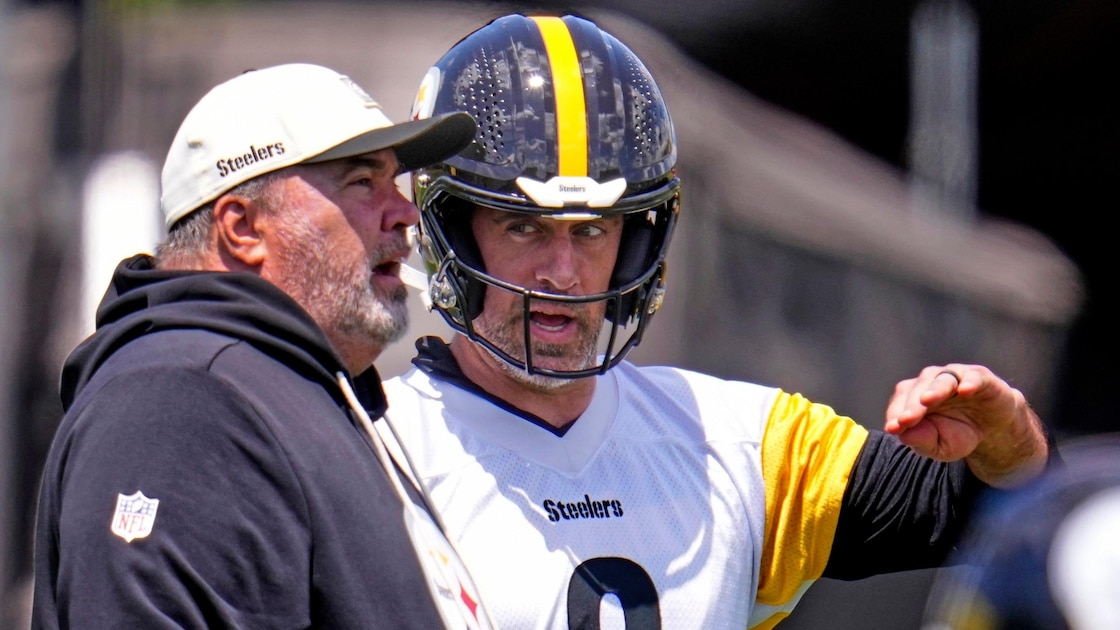
Rodgers’ Public Salvo at McCarthy Backfires as Steelers Rally Around Coach
Veteran quarterback Aaron Rodgers telegraphed his headline-grabbing appearance on The Pat McAfee Show before he unloaded on Pittsburgh Steelers head coach Mike McCarthy, setting up one of the most public and combustible player‑coach fallouts in recent NFL memory.
Rodgers, a former league MVP, signaled behind the scenes that he was prepared to go public with his grievances unless he was granted greater control over the Steelers’ offense. He told McCarthy he was “going to expose everything going on here” if he wasn’t given more influence over play‑calling. McCarthy’s reported response – “Go for it. I’m tired of your bulls–t, I’m proud of what we’re building here, I like the direction we’re going” – framed the confrontation as a direct clash over power, philosophy, and the direction of the franchise.
Power Struggle Boils Over Into Public View
The dispute did not materialize overnight. By the time Rodgers sat down for his pivotal interview with McAfee, tension within the building had already reached breaking point. Reporting has indicated that Rodgers “had been holding the building hostage with his demands,” using his star power and status to push for a level of operational control that extended beyond the normal remit of even elite quarterbacks.
For a global audience less familiar with the NFL’s internal dynamics, this kind of standoff strikes at the heart of how teams are structured. In the National Football League, which is overseen at competition level by the league’s central operations office, head coaches are formally responsible for game management, staff coordination, and system design. Quarterbacks are increasingly influential, but ultimate authority on scheme and play‑calling typically rests with the coaching staff, sometimes an offensive coordinator, and, indirectly, the front office.
Rodgers’ push for expanded say over play‑calling, and his threat to expose internal issues, therefore challenged not only McCarthy’s leadership but the standard governance model most franchises rely on to maintain hierarchy and accountability.
Allegations, Ice Cream Sandwiches and a Damaged Reputation
This has been a bruising stretch for McCarthy’s public standing. In the aftermath of the McAfee interview, Rodgers reportedly presented a largely accurate account of how the coach has operated day‑to‑day, including a detail that quickly became symbolic: McCarthy’s habit of having ice cream sandwiches brought to him on demand by staff.
That anecdote, while trivial on the surface, landed heavily within a locker room culture where every action by leadership is scrutinized for signs of professionalism and commitment. In a league built on marginal gains and relentlessly competitive habits, optics matter. Such details can be interpreted by players and observers as a shorthand for a coach’s standards and discipline, fair or not.
Yet despite the unflattering portrayal, the fallout has not played out entirely in Rodgers’ favor. McCarthy’s willingness to address some of the accusations head‑on, including acknowledging mistakes, likely helped him preserve credibility internally. For players, a coach who confronts criticism openly can be easier to rally around than a star who detonates a season publicly.
Swift Steelers Response and an Unmistakable Line in the Sand
If Rodgers’ ultimate goal was to undermine McCarthy and derail Pittsburgh’s campaign, early evidence suggests he misjudged the effect of going public.
On the field, the Steelers responded with a comprehensive 27-5 win over the Denver Broncos on Friday, a result that steadied the team competitively and provided an immediate counter‑narrative to the notion of a fractured locker room. In a league where point differential, conference record and momentum can prove decisive in shaping postseason chances, a dominant victory in the immediate wake of turmoil carries tangible value.
Key match facts from Friday’s win included:
- Final score: Steelers 27, Broncos 5
- Opposition limited: Denver held to just 5 points
- Response context: First game after Rodgers’ public criticism of McCarthy
Just as significant was the organization’s speed in dealing with its quarterback. Within hours of Rodgers’ appearance on The Pat McAfee Show, the Steelers announced through their official channels that he had been released. The timing left little doubt: the team viewed his comments as a clear breach of internal lines and saw no realistic path to repair the relationship.
By acting decisively, the franchise sent a message on several fronts – to remaining players, to the wider league, and to supporters around the world – that no individual, however decorated, would be allowed to publicly challenge the integrity of staff and structure without consequences. For other teams and executives observing from abroad, the episode underlined how tightly franchises will cling to established governance when faced with high‑profile dissent.
Locker Room Dynamics: Galvanized, Not Broken
On the evidence of the Broncos game, Rodgers’ public broadside may have had the unintended effect of strengthening the bond between McCarthy and his players.
The Steelers’ performance suggested a group prepared to work even harder for their head coach. At the very least, nothing in their display against Denver hinted that they were as weary of McCarthy as Rodgers appeared to be. Energy, defensive intensity and execution all pointed toward a team eager to show that the coaching staff still had its backing.
For a roster competing in a tightly regulated environment with hard salary caps and limited roster sizes, such unity matters. The NFL’s structure means mid‑season roster overhauls are limited, and in‑house cohesion often proves as important as talent in deciding whether a team can maintain form through the long regular season and into the playoff race.
Transparency, Governance and the Limits of Star Power
Beyond the day‑to‑day storyline in Pittsburgh, the Rodgers-McCarthy episode carries broader implications for how elite athletes and franchises manage internal conflicts in the modern era.
As the cliché goes, sunlight is the best disinfectant. Having Rodgers air out grievances in public forced the Steelers to acknowledge how bad the situation had become and to confront what needed to change. From a governance standpoint, it accelerated decision‑making: the club clarified hierarchy, reaffirmed its coaching structure and moved quickly to remove a destabilizing presence.
At the same time, the saga highlighted the limits of star influence. Rodgers’ status and résumé were not enough to override institutional lines once the team judged that he had “crossed a line” and that reconciliation was no longer realistic. In a league built on collective bargaining, strict competitive regulations and centralized scheduling, the long‑term health of the institution remains paramount.
For international observers who may see the NFL primarily through the lens of individual stars, this confrontation serves as a reminder: in the most tightly governed American football competition, power ultimately resides with ownership, front offices and the structures that underpin them – not even a veteran quarterback can bend those systems indefinitely without consequence.
