
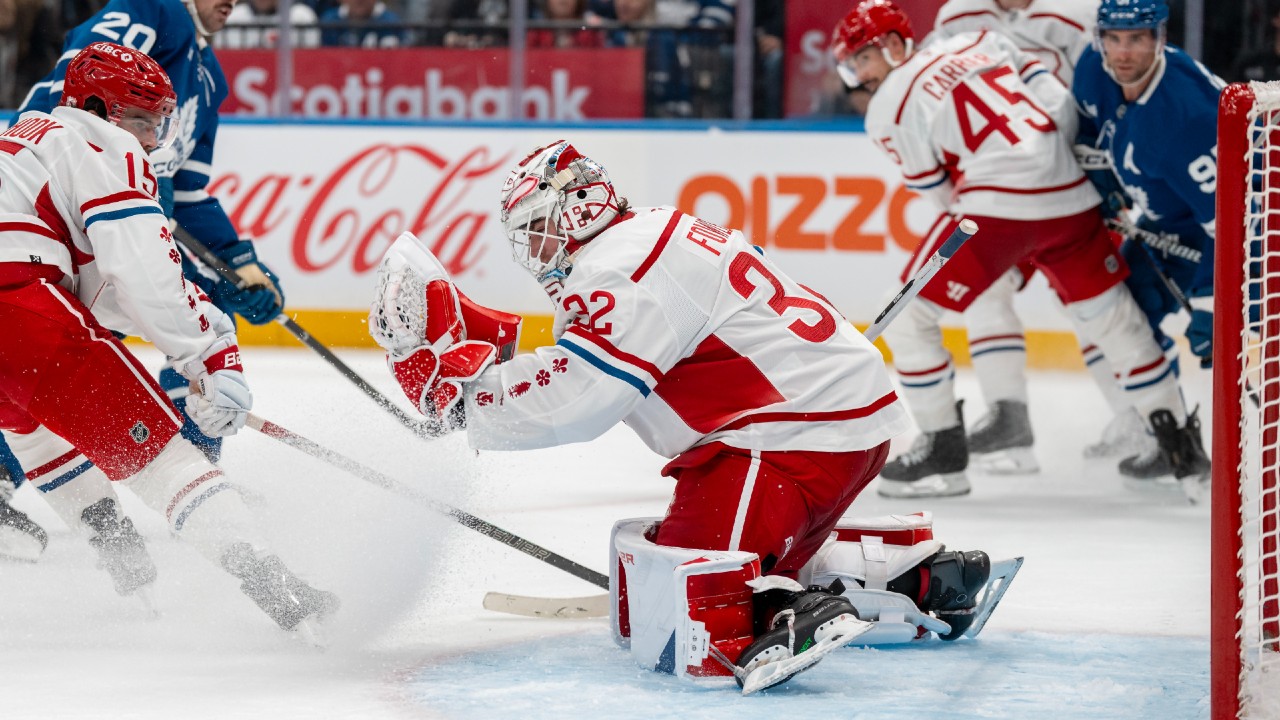
Carey Price Watches as Jacob Fowler Delivers a Statement Night in Toronto
Young Canadiens goaltender steadies team after historic collapse to Jets and closes out Leafs on Hall of Fame weekend
Admit it, you were nervous for a moment.
If not when the Montreal Canadiens allowed two quick goals to turn a 3-0 cushion into sudden belief for the Toronto Maple Leafs, then certainly as the final minutes ticked down with both Alex Newhook and Kirby Dach defending a six-on-four with no sticks in their hands.
For Montreal, it was the exact scenario they could not afford to relive just days after a late collapse against the Winnipeg Jets. For Jacob Fowler, it was a direct test of how quickly a 21-year-old goaltender can process one of the worst nights of his professional life and move on.
From historic collapse to measured response
This week did not end the way it began for the Canadiens, much to Fowler’s relief.
He was the one player who did not get an immediate chance to reset against the Utah Mammoth on Thursday, two nights after the Canadiens allowed Winnipeg to make NHL history by completing the latest four-goal comeback ever in a game – in the final 2:39 of regulation – then lose it 1:30 into overtime. Fowler had made 36 saves before five Jets shots beat him; then he had to sit with that result until the start of Saturday’s game in Toronto.
For any goaltender, that kind of defeat lingers. In the context of an 82-game regular season under the framework of the National Hockey League, it also becomes an early test of psychological durability. For a 21-year-old in his 27th NHL appearance, it can shape internal trust in the room and the coaching staff’s confidence in close games.
As momentum in Toronto shifted back toward the Leafs, the risk of that Winnipeg performance resurfacing – mentally as much as on the scoreboard – was obvious. Fowler, by his own actions, prevented that from happening.
Fowler’s composure changes the bench
Montreal closed out a 4-2 victory, with Newhook scoring the first two goals of the night and then revealing post-game that Fowler had come over to the bench to steady the group.
“It was good to see,” Newhook said. “He’s got a good presence back there. He’s got a calming presence for sure. For a young guy to be able to step up like that and come to the bench, he’s not panicking and we know he’s gonna be on it behind us, so it’s good. I liked hearing it.”
Those are not routine comments about a young goaltender in a rivalry setting. In a league in which coaches and players talk constantly about “resetting” after setbacks, it matters when a rookie-level netminder is not just stopping pucks but actively managing the bench mood in a hostile building.
Hall of Fame weekend, with Carey Price in the building
The backdrop elevated everything. This was Hall of Fame weekend in Toronto, with freshly enshrined Canadiens legend Carey Price watching from the stands. It was Fowler’s first-ever game against the Maple Leafs, on a Saturday night when national attention in Canada pivots toward hockey and the rivalry between these two Original Six clubs.
He had to play it after what must have felt like an eternal stretch between the loss to Winnipeg and puck drop at Scotiabank Arena, carrying the weight of a historic collapse and walking into one of the sport’s most scrutinized environments.
In front of Price, Fowler quickly made it clear that Winnipeg was behind him.
“I think the first period Fowls made some massive saves that kept the score 2-0,” Canadiens captain Nick Suzuki said in the visitors’ room. “Could’ve been different.”
Of Fowler’s nine saves in those opening 20 minutes, the standout was a close-range stop on Auston Matthews, who had scored 12 times on Price in the 16 games they faced each other. That individual duel – a young goaltender facing the league’s premier scorer with Price looking on – underlined how quickly Fowler has been asked to operate at a high emotional and technical level.
Key moments: Matthews denied, Nylander strikes, Bolduc responds
Fowler’s night was defined by sequences rather than a single highlight. He robbed Matthews again in the third period, only for William Nylander to score shortly afterwards on a power play Toronto received when Arber Xhekaj was called for unsportsmanlike conduct. Xhekaj was sent to the box alone despite several retaliatory actions from Leafs players in the preceding exchange.
Canadiens coach Martin St. Louis challenged that decision in real time and returned to it in his post-game comments, saying, “I just don’t think that’s a penalty.” His response pointed to the broader scrutiny officials face in managing physicality and retaliation in high-stakes rivalry games. For Montreal, though, what mattered more was the way the team absorbed the call and regrouped.
St. Louis expressed satisfaction with how his players responded. Fowler settled things down again, and Zach Bolduc restored the two-goal advantage on a power play with 5:45 remaining. That sequence – disputed call, immediate composure, a power-play goal – is exactly the type of response coaches and general managers look for when assessing whether a young team is learning how to manage swings in NHL game states.
Six-on-four chaos and a veteran-like close
From Bolduc’s goal onward, Fowler added three more saves. The last came against Jack Roslovic while Toronto effectively enjoyed a six-on-two advantage, with Newhook and Dach both without sticks and reduced to blocking lanes with their bodies.
By the final horn, Fowler had stopped 26 shots. The performance lifted him to an 8-1-1 record on the season, with a 2.15 goals-against average and .925 save percentage – numbers reminiscent of the standard Price set across his career in Montreal.
Those figures matter beyond simple aesthetics. Early in a season, such underlying numbers for a young goaltender can influence deployment patterns, back-to-back management and trust in giving him difficult road starts. For a Canadiens team still shaping its long-term core, Fowler’s form provides management with additional evidence that he can handle both volume and pressure in the current competitive cycle.
Price’s shadow and a developing mentorship
Of his first experience in Toronto, Fowler said, “It’s cool; obviously get to see a bunch of cool things, you get to honour Carey Price – one of the greatest goalies to ever play the game.”
Price has not been a distant figure in this storyline. During a podcast appearance last spring, he said Fowler reminded him of his younger self. He has stayed in touch with the young goaltender since, checking in via text and, by Fowler’s account, encouraging him to be himself rather than a replica of anyone else.
Asked by Kyle Bukauskas what that mentorship has meant, Fowler replied, “It means the world.”
“It’s so surreal now,” he continued. “I still feel like a little kid now every time I get to put on the gear. It’s so special to play here and in this organization. And the greats that have come before him, and now before me, it’s so special to even have my name in the same sentence. It’s pretty cool to be a Hall of Famer, and that’s just part of the dream right now. Every time he texts me, it’s pretty cool, and we got the win for him tonight.”
For an international audience, the depth of that connection is significant. Montreal is one of the NHL’s flagship franchises, with a long line of elite goaltenders. Having a Hall of Fame figure publicly identify a successor’s traits – and then maintain one-on-one contact – embeds Fowler’s development within a wider institutional story rather than isolating it as a single hot start.
Officiating decisions and how the Canadiens managed them
Beyond the individual performances, the night also highlighted how teams adapt to officiating decisions within the NHL’s regulatory environment. The unsportsmanlike conduct call on Xhekaj, which St. Louis openly questioned, placed Montreal back in a fragile game state with the Leafs’ top unit on the ice.
Under the league’s rules, referees have broad discretion to call such penalties to control escalation. For a young lineup, that can feel punitive; it can also be an inflection point. Montreal’s response – organized penalty killing, goaltending composure, and then a timely special-teams goal of its own – demonstrated an ability to operate within that framework without unravelling, a key requirement over a long regular season schedule.
From déjà vu to defining moment
For a few minutes late in the third period, it looked like events might slip away again, with a sense of déjà vu from the Winnipeg loss creeping back. For fans who had just invested in new jerseys and leaned back into optimism, it would have been easy to reach for the symbolic torch.
Instead, Fowler showed the calm and poise traditionally associated with someone who has played more than 800 games in the league – regular season and playoffs combined – and who holds the record for most wins by a Canadiens goaltender. In reality, this was only Fowler’s 27th NHL game.
How he handled it, especially coming directly after that collapse against the Jets, offers an early indication of where his ceiling might be. It also matters in more immediate, practical terms: in the rhythm of an NHL season, one emotional rebound performance can prevent a damaging run of results from taking hold, stabilise a locker room and influence how coaching staffs script future matchups in key rivalry games.
For Montreal, this night in Toronto will not count for more than two points in the standings. For Fowler and for a franchise trying to chart its next era in goal after Carey Price, it may still resonate longer than most early-season wins.
