
Socceroos delay squad call as Middle East safety fears collide with pay dispute
A squad announcement for the upcoming international window has been delayed for the Socceroos as players continue to raise concerns about travelling to the Middle East due to conflict in the area.
Australia is scheduled to face Qatar and Jordan at their respective home grounds next week, with pressure mounting on organisers to find an alternative venue for the match against Jordan amid unease over player safety.

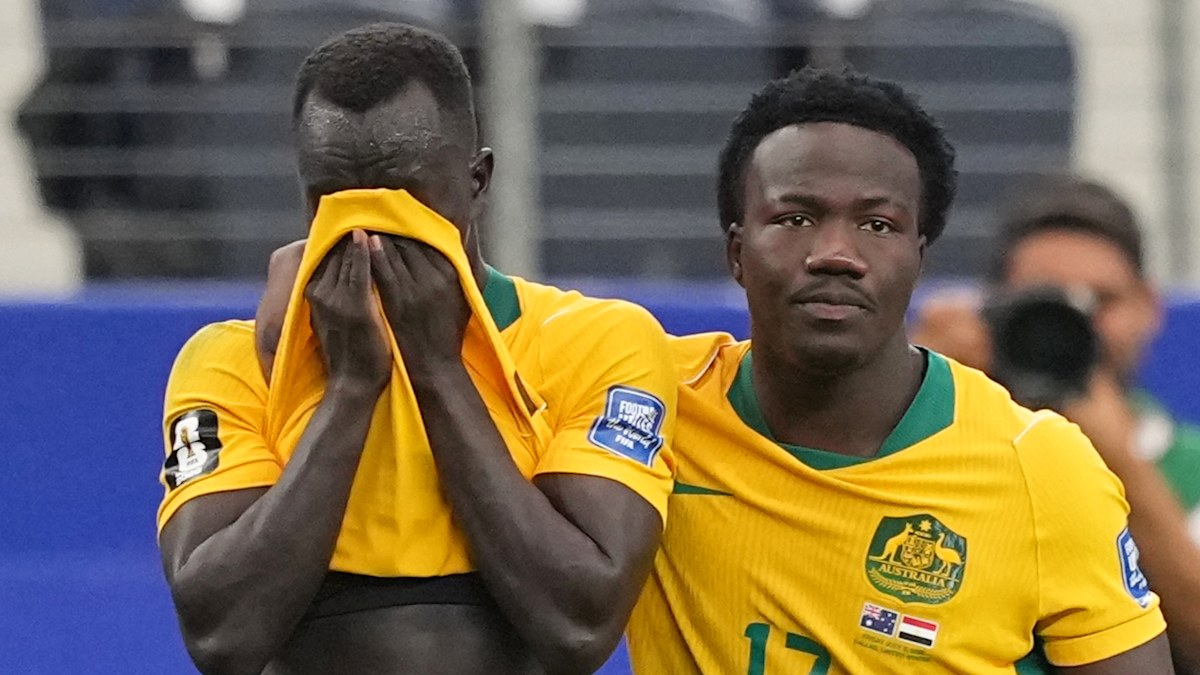
Vinicius jnr, Tete Yengi and Nestory Irankunda talk after the match. Getty Images
Selection on hold as safety doubts grow
Tony Popovic, who comes off contract in January, was set to unveil his team for the looming friendlies on Friday. The announcement has now been pushed back to the weekend, underscoring how uncertainty around the fixtures is feeding directly into squad planning.
Professional Footballers Australia (PFA) has led calls for the venue or date of the Jordan match to be changed, with Indonesia already pulling out of its own friendly against Jordan for safety reasons.
It remains unclear whether Australia will proceed with the games in their current form amid heightened conflict in Jordan. Nine people were killed by a gunman during a funeral service in the country’s south two weeks ago, an incident that has sharpened concerns over bringing national-team players and staff into the region at this time.
Jordan’s Football Association has maintained that the fixture “is still scheduled to take place, without any changes”, leaving a gap between local organisers’ position and the growing caution from players and their representatives.
Players given discretion over participation
Football Australia’s executive director of football, Heather Garriock, has indicated that players are free to withdraw themselves from this international window without any consequence for the two scheduled matches.
That stance is significant in an international calendar where players are normally expected to report when called up and federations are usually entitled to select from all eligible club-based talent. Offering an opt-out option places player welfare ahead of on-field continuity, but it also raises practical questions over how competitive a reduced or reshaped squad could be if withdrawals mount.
It is not yet clear whether players will be able to make a split decision – choosing to play in the match against Qatar while sitting out the trip to Jordan. That detail will shape how coaches balance risk, preparation and fairness in selection.
Tension between preparation and player welfare
For Australia, fixtures against Qatar and Jordan are part of a broader programme of internationals used to build cohesion, assess emerging talent and fine-tune tactical structures ahead of future qualifying campaigns and tournament play under the global calendar supervised by the Asian Football Confederation.
In practical terms, any postponement, relocation or late reshaping of the squad would disrupt that preparation work. Friendly matches often serve as opportunities for fringe players and younger prospects to press their case for selection in competitive qualifiers; if senior figures exercise their right to withdraw, it could accelerate opportunities for others but make it harder for coaches to read how a first-choice XI will function under pressure.
At the same time, the situation highlights how modern national-team management is no longer limited to tactics, fitness and club-versus-country tension. Safety assessments, travel risk and legal obligations around duty of care now sit alongside football decisions when federations weigh whether to fulfil scheduled fixtures abroad.
Unpaid World Cup fees deepen strain on trust
Compounding the pressure on Football Australia, Socceroos players are still waiting for their match fees from the World Cup.
Payments were due to be finalised a fortnight after the squad departed from the team camp, having been eliminated from the tournament on July 3. For those who featured in all of Australia’s World Cup games, roughly $24,000 remains outstanding. Other squad members are due around $6000 per match they were on the team list, even if they did not step onto the pitch and were unused substitutes.
In addition, players are reported to be awaiting payments from two pre-tournament friendlies against Mexico and Switzerland. For athletes whose club seasons are structured around international windows, such delays cloud the financial certainty that is supposed to accompany national-team duty.
Football Australia has been contacted for comment on the status of those payments.
Legal action over revenue share agreement
The issue of late fees arrives just days after it emerged that the Socceroos and Matildas are pursuing legal action against Football Australia in a dispute over the game’s revenue share agreement.
That case goes to the heart of how international football income is distributed between the governing body and the players who generate it on the pitch. With both senior national teams involved, the outcome has potential implications beyond one pay cycle, touching on long-term trust between players and administrators and the sustainability of agreed collective arrangements.
Former Socceroos captain Craig Foster described the situation as “predictable” yet “very sad”, expressing frustration at any attempt to shift blame onto players.
“In a period of mismanagement of the game, for people to now turn around and blame the players is patently ridiculous,” he said.
Upcoming fixtures under a cloud
As it stands, Australia’s upcoming friendly schedule is:
- Qatar v Socceroos – Abdullah bin Khalifa Stadium, Saturday, November 14, 1.45am AEDT
- Jordan v Socceroos – Amman International Stadium, Wednesday, November 18, 3am AEDT
Both matches were initially framed as chances to test Australia’s depth in demanding away conditions and to strengthen relationships with regional opponents. They now sit at the intersection of player welfare concerns, local security conditions and an unresolved financial dispute at home.
How Football Australia navigates the coming days – from finalising a squad and clarifying opt-out rules to communicating with players over outstanding payments – will shape not only this international window, but also broader confidence in the federation’s governance among current and future Socceroos.
Worth a look
