
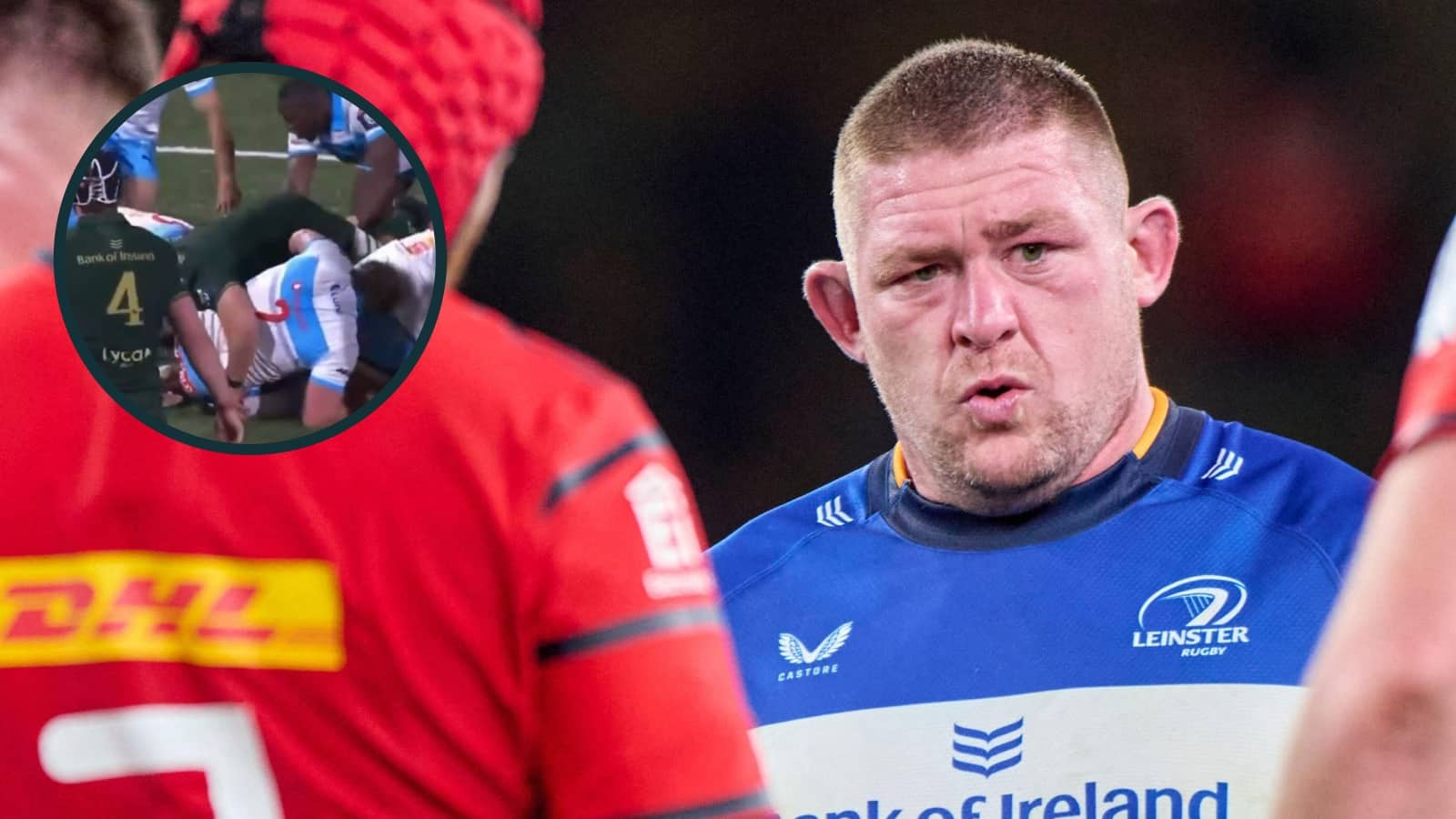
Doyle: Furlong verdict exposes grey area in rugby’s disciplinary process
Former head of Irish referees Owen Doyle claims the disciplinary cases involving Tadhg Furlong and Jan-Hendrik Wessels should not be treated as identical, arguing that the panel would have faced significant difficulty in suspending the British and Irish Lions tighthead prop on the evidence available.
Furlong cleared after Munster-Leinster flashpoint
Tadhg Furlong avoided a ban after he was cited for allegedly groping Gavin Coombes during Leinster’s 24-18 win over Munster in Dublin.
Coombes reported the alleged incident to referee Andrew Brace during the first half, prompting the match officials to review the footage. However, television match official Colin Stanley was unable to locate conclusive video evidence to sanction Furlong during the game.
The Leinster prop was subsequently cited and appeared before a disciplinary panel last week. That panel unanimously dismissed the complaint, concluding that he had not committed an act of foul play.
In practical terms, the outcome leaves Leinster and Ireland free to select one of their most influential forwards without interruption. For a club and national side built heavily around continuity in the tight five, the difference between a lengthy ban and a cleared player has immediate implications for selection and cohesion in the front row.
Comparison with Wessels case fuels controversy
The decision not to ban the Ireland and Leinster front-rower has sparked debate because of its contrast with the sanction handed down to Jan-Hendrik Wessels. The Springboks and Bulls forward received an eight-week suspension last year following a similar incident involving Connacht’s Josh Murphy.
In that case, Wessels was banned despite the lack of clear video evidence that he groped the Connacht back-rower. Murphy’s red card for punching the Bulls front-rower in immediate retaliation was later rescinded.
This discrepancy has fed into a wider discussion among players, coaches and supporters about consistency in rugby’s disciplinary outcomes. Where one player is free to continue playing and another serves two months on the sidelines, clubs and unions inevitably question how match evidence and on-field reactions are being weighed.
Doyle’s view: same law, different circumstances
Former international referee Owen Doyle has weighed in on Furlong’s verdict and insists there is an important distinction between the two incidents. He has again pushed back at those arguing that citing commissioner Peter Ferguson should not have cited Furlong, and at criticism directed towards Coombes for raising the issue on the field.
“The judicial tribunal hearing Tadhg Furlong’s case undoubtedly faced a very tricky assignment. It took the guts of a full working day before they dismissed the charge, and the Leinster player was free to go. Irrespective of what the final written judgment will say, it’s unlikely that we will hear the full detail of everything which transpired,” Doyle wrote in his column.
He stressed that, while the footage appeared damning at first glance, the crucial element in such a case is what can be clearly seen.
“While the video of Furlong’s action on Gavin Coombes looked damning, nobody could actually see whether or not there was testicle-grabbing. There has been some criticism of citing commissioner, Peter Ferguson, for levelling the charge in the first place. Not so; once he saw what we’ve all seen, he would have been negligent not to cite. Neither should Coombes be criticised.”
For an international audience, Doyle’s argument underlines an established principle within rugby’s judicial framework: intent and contact in sensitive areas are serious matters, but the burden of proof remains high, particularly when panels are dealing with body positions obscured by mauls and clearouts.
How Wessels-Murphy shaped perceptions
Doyle goes on to explain that there was a line of defence available to Furlong that would have made it difficult for the disciplinary committee to convict him, especially without incontrovertible footage. He believes the Wessels case sits in a different category largely because of the on-field reaction.
“One potential defence would have been for Furlong to deny the charge, and to state that any contact was inadvertent and completely unintentional,” he continued.
“Without clear evidence to the contrary, and putting aside the emotion involved, the tribunal would have found it hard to convict; a verdict which may well have seen everybody heading to the Four Courts.
“Also, despite the commentary coming out of South Africa, it was different from the Jan-Hendrik Wessels incident, where Connacht’s Josh Murphy was red carded for his immediate retaliation in whacking the Bulls’ player. On that alone, the probability that something nasty occurred seemed beyond reasonable doubt, which in Furlong’s case it wasn’t. Murphy’s reaction – what all of us would have done – was later adjudicated not to have reached the threshold for red, which was rescinded.”
The contrast Doyle highlights is central to the current debate. In one case, a dramatic, instant retaliation was interpreted as strong circumstantial evidence that something unacceptable had occurred. In the other, there was no such reaction, and the panel had only partial images from a congested breakdown.
From a governance standpoint, this raises a difficult question for World Rugby’s disciplinary structures: how much weight should be placed on a player’s immediate response when the footage alone is inconclusive? Too little, and potential foul play may go unpunished; too much, and judicial hearings risk turning on subjective reactions rather than observable acts.
Implications for teams and selection
In competitive terms, the difference between an eight-week ban and no sanction at all is substantial. A suspension of that length can rule a player out of multiple rounds of domestic league action, European fixtures, or international windows, altering squad rotation, scrummaging depth and leadership hierarchies in the pack.
For Leinster and Ireland, Furlong’s availability ensures stability at tighthead prop – a position where elite depth is difficult to replace. For the Bulls and the Springboks setup, Wessels’ enforced absence last year would have affected selection options and development minutes in a key front-row role.
These contrasting outcomes feed into broader perceptions among unions and clubs about the balance between player welfare, deterrence for dangerous acts and competitive fairness across competitions that span hemispheres.
Breakdown technique and player safety
Doyle also views the Furlong case as a warning sign about trends at the breakdown in the modern game. Beyond the disciplinary verdict itself, he argues that certain clearout techniques now routinely place players at risk in the groin area.
“As for this most recent incident, perhaps some good can come out of it all. On health and safety grounds, there is a strong case for specifically outlawing the practice of putting an arm between an opponents legs, in proximity to the groin region, in an effort to lift or destabilise the player. It’s a clearing out technique which the game does not need.”
With breakdowns already recognised as one of the most injury-prone phases in rugby, calls to refine what is and is not permitted in jackal contests and cleanouts have been growing. A clearer prohibition on techniques that risk the groin could, in time, reduce both injury risk and the number of citing commissioner referrals stemming from these areas.
Any move in that direction would fall within the remit of World Rugby’s law review and welfare processes, which already govern how decisions on high tackles, ruck entry and dangerous cleanouts are framed and applied across the global game.
Fine margins in the judicial process
At the heart of Doyle’s commentary is the acknowledgement that the judicial panel in Furlong’s case operated within narrow margins. He notes that the hearing took almost a full working day before the charge was dismissed and the player was free to go, and that the full detail of what was presented is unlikely to be made public.
That opacity is built into rugby’s current disciplinary model, which seeks to protect players and match officials while still sending deterrent messages when bans are imposed. The downside, particularly in contentious cases like these, is a perception gap for fans and for those comparing sanctions across competitions.
As elite rugby continues to put player welfare and disciplinary consistency under the microscope, cases such as Furlong’s and Wessels’ will remain reference points in the ongoing discussion about how best to interpret intent, protect sensitive areas of the body and maintain trust in the process from dressing rooms on both sides of the equator.
Related reading
