
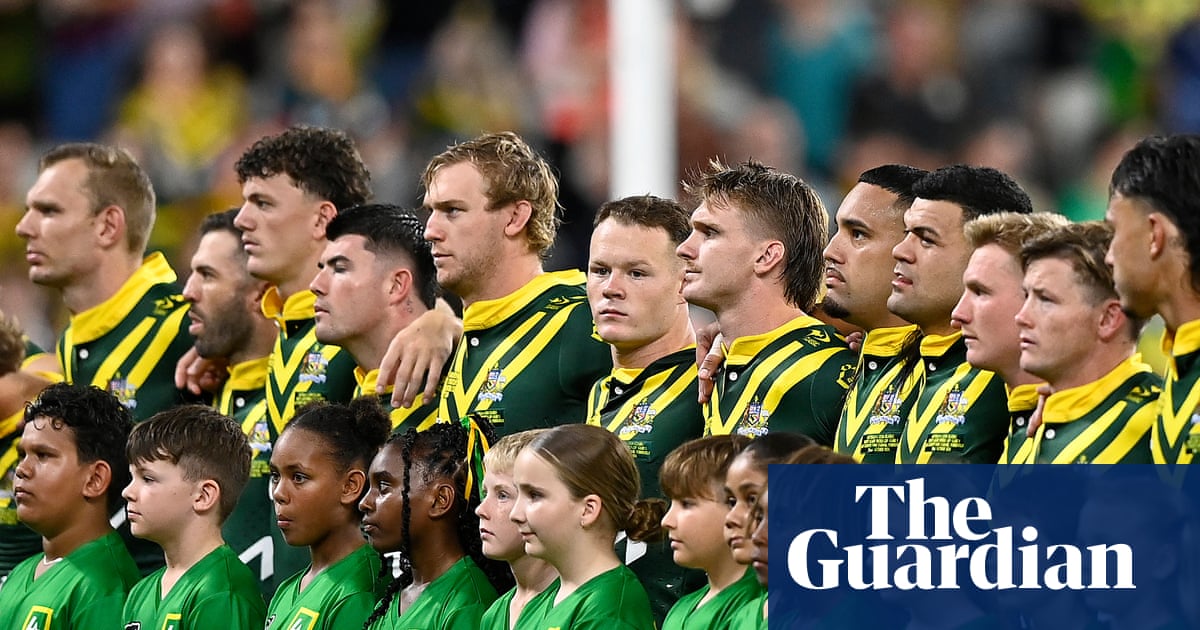
Kangaroos in control, but Rugby League World Cup semi-finals close gap on dominant hosts
The rugby league World Cup has reached the knockout stage and, from a distance, it appears business as usual for Australia. Three wins from three matches, home advantage and a tilt at a fourth consecutive title frame the Kangaroos once more as tournament favourites.
Yet the surface calm disguises meaningful pressure. As the semi-finals arrive, Australia face a field that is deeper, more settled and more confident than at any recent edition of this tournament, now played under the structure overseen by the Rugby League International Federation’s successor body, the International Rugby League.
Hosts unbeaten, but vulnerability has been exposed
Australia’s record is perfect; their performances are not. They have advanced with victories over New Zealand, Fiji and the Cook Islands, and will meet Samoa in Sunday’s semi-final at Allianz Stadium in Sydney.
In all three pool matches the Kangaroos trailed at stages, including against Fiji when they briefly appeared to be two tries behind with half an hour to play before a video referee intervention halted the slide. A dominant second-half surge against the Cook Islands then papered over an error-prone, disjointed start.
That pattern matters in a World Cup knockout setting. In a competition where one poor 20‑minute period can decide a campaign, repeated slow starts and possession errors leave the defending champions less insulated from an upset than their perfect record suggests.
Forward battle narrows the gap to the chasing pack
Inside the Australian camp, the scrutiny centres on a forward pack that has been outplayed at times. New Zealand averaged five more metres per set in their group-stage meeting, and Fiji’s pack also disrupted the Kangaroos’ rhythm.
Australia have selected for mobility in the middle rather than pure size. The trade-off is clear: to justify that approach they must consistently attack down the edges, move the ball early and stretch defensive lines. When execution is even slightly off, they are vulnerable to sets played almost entirely on the back foot.
Coach Kevin Walters brings a calm, player-friendly presence suited to an end-of-season tournament, particularly for players arriving from lengthy NRL campaigns. He is not widely characterised as a hard-line tactician or micro-manager. In a semi-final environment, that hands greater responsibility to senior playmakers and shifts the narrative from systems to decision-making at critical moments.
Free agency and selection uncertainty as a live backdrop
This Australian squad enters the decisive fortnight with unusual off-field noise. A clutch of Kangaroos are in or approaching contract negotiations, including Latrell Mitchell, Cameron Munster, Harry Grant, Liam Martin, Bradman Best, Jack Bostock and halfback Sam Walker.
Walker has slipped behind Tom Dearden in the national pecking order after missing out against the Cook Islands and faces his own uncertainty after parting ways with the Roosters during a contract stand-off. On the team sheet he is now a depth option; in the marketplace he is a major story. That tension underlines how World Cup minutes – or the lack of them – can influence both representative futures and club valuations, even if those details sit outside the tournament’s official frame.
James Tedesco, meanwhile, finds himself in the unfamiliar position of being a high-profile understudy. Reece Walsh’s performance at fullback against the Cook Islands, alongside his broader form under Walters in England last year, makes it unlikely that Tedesco will reclaim the No 1 jersey during this campaign. In practical terms, that turns the World Cup into a live handover of Australia’s most influential attacking position.
Samoa’s surge and the Pacific power shift
Australia’s semi-final opponents Samoa have already helped redefine the competitive balance of this World Cup simply by the calibre of player now aligned with Toa Samoa. Hamiso Tabuai-Fidow, Brian To’o and Stephen Crichton are all fixtures at the top end of the NRL and, in different circumstances, would be strong candidates for Kangaroos selection.
Tabuai-Fidow, who previously represented Australia and has six Kangaroos caps, might not have displaced either Walsh or Tedesco at fullback this year, but his decision to represent Samoa highlights how flexible international eligibility rules are reshaping national team strength. To’o has been the NRL’s premier winger in recent seasons and Crichton the benchmark centre; even in slightly subdued 2026 form, they give Samoa strike that would once have been almost exclusively Australian or New Zealand property.
Samoa’s level of commitment was evident in their dramatic group-stage meeting with Tonga in Parramatta. With semi-final qualification already secured, both teams still played at full intensity across an 80‑minute contest that many in attendance viewed as the tournament’s standout spectacle to date. A capacity crowd, thousands of national flags and a disallowed late Samoan try produced a match that combined high skill and high stakes with deep cultural resonance.
That final non-try is more than a footnote: it underlines that the gap between these Pacific nations and the traditional superpowers is now often measured in single refereeing calls rather than entire tiers of performance. For Australia, it is a warning that Sunday’s semi-final will pit them not against an outsider making up the numbers, but against a squad with genuine World Cup-winning quality in key positions.
Tonga and New Zealand set up a heavyweight collision
Tonga’s reward for their Parramatta win is a semi-final against New Zealand, the side that should feel they let Australia off the hook in round one and who now carry the most imposing forward unit left in the tournament.
Isaiya Katoa has established himself as the premier halfback available since Nathan Cleary’s injury, while Rob Toia arrives as Dally M centre of the year. Tonga can draw on enough power through the middle to use a State of Origin regular such as Stefano Utoikamanu from the bench – a luxury that encapsulates just how far depth has broadened across the international game.
New Zealand, still without the injured Kalyn Ponga, have responded to their narrow loss to Australia by overwhelming the Cook Islands and Fiji, scoring 160 points across those two matches. Jahrome Hughes directs them with authority in the halves and Casey McLean’s four tries against Fiji underline his finishing threat on the edge.
The Kiwis’ forward dominance is also structural. Their ability to consistently outgain the Kangaroos by around five metres per set in the group-stage clash points to a pack that bends the line more reliably than any other in the competition. For Tonga, that presents a direct challenge to their own identity as one of the most physically imposing teams in world rugby league.
Bostock’s intercepts and the thin margins of knockout play
New Zealand would be entering the semi-finals as clear tournament favourites were it not for the opening-round escape engineered by Australia. That match turned on a pair of intercepts and two Jack Bostock tries which flipped a contest the Kiwis had largely controlled.
Those moments are emblematic of knockout rugby league at this level. The competition format used at recent World Cups, featuring group stages followed by straight elimination, places a premium on game management in high-pressure phases. A single loose pass can tilt an entire bracket. For coaching staffs, that reality informs selection calls – backing decision-makers who protect possession – as much as it does substitutions and interchange strategies.
Edge play, officiating focus and tournament direction
While no detailed disciplinary outcomes are referenced from these matches, the tournament has already placed the spotlight on two areas that will likely prove decisive in the final week:
- Edge attack and defence: Australia’s tactical need to play wider, New Zealand’s structured shifts and the individual quality of Pacific outside backs push contests towards the three-quarter lines, where defensive reads are exposed and set-piece plays must be precisely executed.
- Video officiating: The reversal of the apparent second Fijian try against Australia and the late disallowed Samoan score against Tonga underline how central the bunker has become to World Cup outcomes. In a competition governed by International Rugby League’s laws and protocols, teams must calibrate their risk in grounding and contest situations with an acute awareness that every frame will be reviewed.
For administrators, a tournament in which Tonga, Samoa and New Zealand are all credible title threats against an unbeaten host nation is close to the competitive balance long sought by the game’s global leadership. For players, it means no margin for complacency, particularly for a Kangaroos side whose dominance on paper has not fully translated to the field.
Semi-final weekend as a pivot point
By Sunday night, the World Cup narrative will have narrowed to two. For now, the semi-final line-up presents a rare convergence: four teams with realistic ambitions of lifting the trophy and a host nation that, while still the standard-bearer, can no longer rely solely on history and depth to carry it through.
For Australia, the stakes extend beyond another title. The performance of Walters’ side will feed into ongoing debates about selection philosophy, the balance between mobility and power in the modern international game and the way the national team is refreshed as generational stars such as Tedesco transition into new roles.
For Samoa and Tonga, each match at this stage advances more than a single campaign. Deep runs reinforce the viability of Pacific nations retaining their elite NRL talent and strengthen the case for more meaningful fixtures outside World Cup cycles. For New Zealand, this is an opportunity to turn statistical dominance into tangible silverware and to reassert itself as the most consistent challenger to Australian supremacy.
The Kangaroos remain the side to beat. But as the semi-finals loom, they are no longer the only side built to win.
Worth a look
