
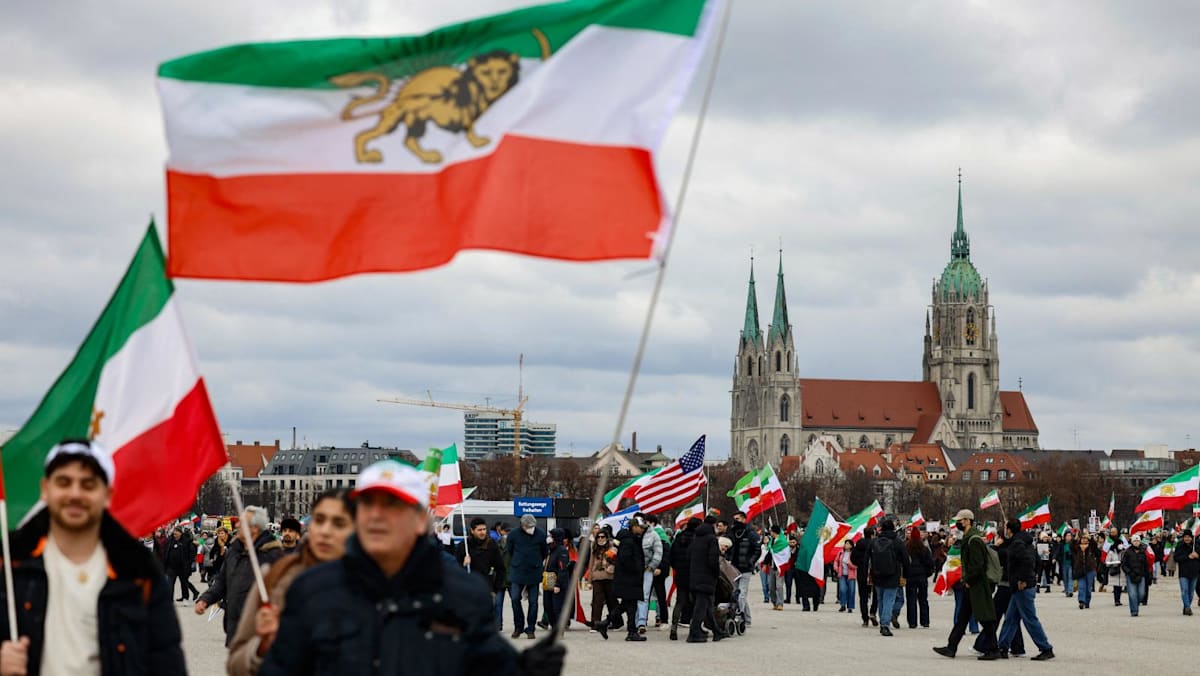
MUNICH — Police said about 200,000 people gathered on Saturday, February 14, at Munich’s Theresienwiese fairgrounds to protest Iran’s Islamic Republic, a pro‑monarchist demonstration that unfolded less than 3 km from the security conference venue where world leaders convened.
The rally’s size and timing turned a focal point of international diplomacy into a staging ground for Iran’s exiled opposition and supporters, who framed the protest as a response to what they described as deadly repression of nationwide demonstrations in January. Human rights groups have reported that thousands of protesters were killed in Iran.
Participants waved pre‑1979 flags bearing the lion and sun emblem and chanted in support of exiled royal figurehead Reza Pahlavi, the son of the former shah. Speakers led calls of “Javid shah” (long live the shah), “Pahlavi bar migarde” (Pahlavi is coming back) and “Reza II.”
Key details from the Munich demonstration:
- Attendance: about 200,000 (police estimate)
- Date and location: Saturday, February 14; Theresienwiese fairgrounds, Munich
- Protests referenced: nationwide unrest in Iran in January
- Principal slogans: “Javid shah,” “Pahlavi bar migarde,” “Reza II”
- Diaspora actions: rallies also planned in Toronto and Los Angeles for February 14
- Recent precedent: an estimated 10,000 rallied in Berlin the previous week in response to a call from the MEK, an exiled opposition group considered “terrorist” by Tehran
Calls for outside backing and a transitional path
The rally played out against the backdrop of the Munich Security Conference, where Pahlavi appeared on the sidelines rather than as an official delegate and urged Western governments to “help” the Iranian people. He called for what he described as a “humanitarian intervention to prevent more innocent lives” being lost in Iran, language likely to be closely parsed in Western capitals wary of any step that could be read as military escalation.
On the fairgrounds, multiple speakers and attendees echoed demands for a transitional authority and a referendum on Iran’s future political system, arguing that any post‑Islamic Republic order should be determined through a popular vote. Some invoked international human rights law and Iran’s own constitutional history, framing their appeal as an attempt to bring the country back into alignment with basic civil and political protections.
Razieh Shahverdi, a 34‑year‑old Iranian living in Paris, said she traveled to Munich after Pahlavi appealed to the diaspora for public support. “So that is why we are here, to amplify their voices and to show our support,” she said. “We are here to ask the world to support the leader of Iranians in the transition phase, to have a transitional government and then to have a referendum,” she added. “And also we need intervention from the foreign powers.”
Opponents of Iran’s clerical leadership have long argued that the Islamic Republic is failing to meet its obligations under the International Covenant on Civil and Political Rights, to which Tehran is a state party, citing restrictions on assembly, speech and due process in crackdowns on protest.
Personal testimonies from the crowd
The Munich protest drew a cross‑section of the Iranian diaspora from across Europe, many carrying portraits of relatives they said had been jailed or killed in earlier rounds of unrest.
One participant, 40‑year‑old Ali Farzad, said, “We are here today to support the people in Iran that were murdered by the mullah regime,” adding, “And we are here to support Reza Pahlavi as our leader through the transition for a period.” Farzad said he believed a clearly defined transitional structure would make it harder for foreign governments to dismiss exiled opposition figures as divided or unserious.
A 62‑year‑old protester originally from Iran who gave his name only as Said described the government in Tehran as beyond reform: “The Iranian regime is a dead regime. It must be game over.” He said he had previously supported efforts to negotiate incremental change but had lost confidence after successive crackdowns.
“They shouldn’t talk to them because they are not actually a government. We don’t like them, we don’t accept them,” said Riana, a 40‑year‑old doctor in Germany who declined to give her last name out of concern for her family’s safety. “When a government kills their people on the street, they are not (trustworthy),” she said, adding that the world should know that “too many people have been killed and too many people have been injured”.
Farzad argued that international negotiators were engaging the wrong counterpart: “The people that you are negotiating with are not representative of the Iranian people.” His comments underscored a central tension in Western policy debates over whether continued engagement with Tehran on issues such as nuclear safeguards and regional security inadvertently sidelines dissident voices.
Security‑conference backdrop and site logistics
The Theresienwiese, best known for hosting Munich’s annual Oktoberfest and large‑scale public gatherings, provided space for the assembly within walking distance of the heavily guarded conference precinct in the city center. Police placed the crowd estimate at about 200,000 and said the event remained largely peaceful, with officers maintaining a visible but non‑confrontational presence. No additional official details were provided in the protest’s immediate aftermath within the fairgrounds.
City authorities authorized the demonstration under Germany’s constitutionally protected right to peaceful assembly and coordinated with organizers on security, transport and crowd‑management measures, according to police at the scene. The nearby Munich Security Conference, an annual forum that brings together senior officials, military leaders and policy experts, continued under tight restrictions, but attendees were well aware that a parallel debate over Iran’s future was unfolding just beyond the perimeter.
Organizers and activists also planned rallies in Toronto and Los Angeles for Saturday, February 14, part of a coordinated day of action they said was designed to keep Iran high on the agenda of Western governments as they weigh future negotiations with Tehran. For many in Munich, the measure of success was whether their chants at Theresienwiese would carry into the rooms where those decisions are made.
Keep reading
- Urban Infrastructure Resilience: How European and Asian Megacities Are Adapting to Extreme Climate Oscillations in 2026
- UN General Assembly 2026 Framework on Autonomous Systems: International Diplomacy Faces Algorithmic Governance
- Spanish election: Pedro Sanchez calls snap election for 29 November after housing protests (globallypulse.com)
