
Engineering for an Eternal Dusk
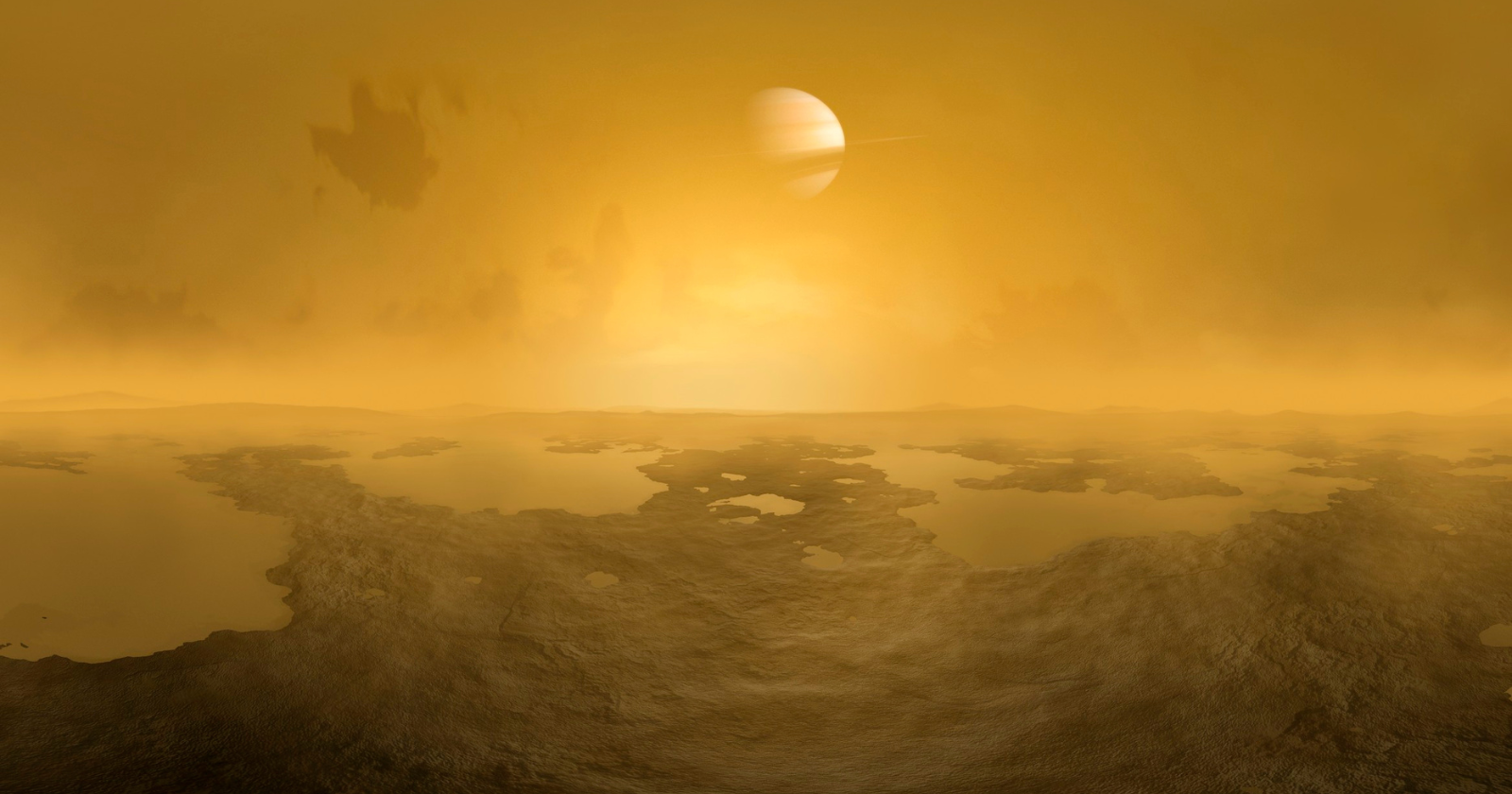
Designing hardware for Titan requires a fundamental departure from the standard blueprints used for Mars or Lunar missions. On Titan, the concept of “daytime” is a mathematical abstraction rather than a visual reality. The environment is defined by a thick, nitrogen-rich atmosphere that behaves as a massive light filter, scrubbing the solar spectrum before it ever reaches the surface.
The resulting environment is a monochrome orange gloom where the sun is reduced to a vague patch in the sky. This lack of directional light means that shadows are nearly non-existent, stripping away the primary visual cues that robotic systems typically use for depth perception and spatial orientation. For mission planners and the agencies that license nuclear-powered spacecraft, this is not just a poetic detail; it is the baseline design constraint that shapes everything from power policy to data-handling protocols.
The Atmospheric Filter and the Solar Gap
The scarcity of light on Titan is the result of two compounding factors: orbital distance and chemical composition. Located over a billion kilometers from the Sun, Titan receives only about one percent of the solar flux that reaches Earth. This baseline deficit is then exacerbated by the moon’s dense atmosphere.
The atmosphere is dominated by nitrogen and methane, which react under ultraviolet radiation to create tholins-complex organic particles that form a persistent, self-renewing smog. This signature orange haze, very similar to smog on Earth but far thicker, allows only about 10% of the already diminished sunlight to penetrate to the ground.
This unique chemistry creates an atmospheric anomaly where, in some wavelengths, twilight can be effectively brighter than the dayside due to the way the haze scatters light forward. For an autonomous vehicle, this means the environment does not follow the standard diurnal lighting cycles found on Earth, necessitating sensors that can operate in a constant state of low-contrast twilight. It also changes the way risk is modeled: engineers, insurers, and spacefaring governments must assume that standard Earth-tested optical systems will underperform, and that redundancy in non-visual sensing-LIDAR, radar, and inertial navigation-moves from desirable to mandatory.
Powering Autonomy in Low-Flux Environments
The most critical infrastructure decision for any surface mission on Titan is the power source. Solar arrays, which power the majority of planetary rovers, are non-viable in a world where noon is visually equivalent to ten minutes after sunset on Earth. To maintain operational integrity, NASA’s Dragonfly mission utilizes a nuclear power source, specifically a Multi-Mission Radioisotope Thermoelectric Generator (MMRTG), a technology whose development and launch are governed under the United States’ national policy for space nuclear power and propulsion.
The shift to nuclear power is not merely a preference but a survival requirement for the system’s architecture. It also pulls Titan exploration squarely into the realm of regulation and diplomacy, because every nuclear launch must pass environmental review, interagency oversight and, in practice, international scrutiny.
| System Requirement | Solar Constraint | Nuclear Solution (MMRTG) |
|---|---|---|
| Energy Density | Insufficient flux for sustained battery charging, especially during extended flights and science campaigns | Constant thermal-to-electric conversion independent of incident light |
| Thermal Management | Passive heating insufficient for -179°C ambient temperatures | Waste heat used to warm internal electronics and protect lubricants and batteries |
| Operational Window | Severely limited by light availability, atmospheric haze and surface deposition on panels | Near 24/7 power, opening multi-year flight and science schedules unconstrained by local time |
| Mission Longevity | Performance degrades with panel contamination and gradual cell damage | Predictable decay of Plutonium‑238 isotopes, enabling long-term planning and regulatory risk assessments |
For policymakers, this table is not just engineering detail. It encapsulates why agencies are increasingly committing to radioisotope power for deep-space exploration, and why stockpiles of suitable nuclear fuel have become a strategic asset. Decisions on how much plutonium‑238 to manufacture, how to prioritize it across missions, and which nations can access such technology all flow from the simple reality that sunlight at Saturn’s distance is not a usable baseline.
Visual Navigation and the Contrast Crisis
Beyond power, the lack of sharp light creates a significant failure risk for computer vision. Most autonomous navigation systems rely on contrast and edge detection to map terrain. On Titan, the atmospheric haze smears edges and eliminates hard shadows, creating a visual environment where noon and dusk collapse into the same dim orange.
To counter this, the imaging systems must be tuned for extreme low-light sensitivity and high dynamic range. The goal is to extract usable data from a landscape where the contrast is soft and the horizon is often indistinguishable from the sky. This engineering challenge was first highlighted by the 2005 Huygens probe, the only spacecraft to have successfully landed in the outer solar system, which provided the primary dataset for current light-level modeling and informed today’s autonomous flight standards for Dragonfly.
The reliance on advanced imaging sensors and autonomous flight algorithms is essential because real-time remote piloting from Earth is impossible due to the massive signal latency. The craft must be able to see and make decisions in a golden gloom that would leave a human observer straining for edges that the atmosphere refuses to provide. In governance terms, Titan is an early test case for a broader shift: high-stakes, AI-driven navigation in environments where human supervision is not merely limited but structurally impossible. The frameworks built for Titan-around fault tolerance, data transparency, and accountability when autonomy fails-are likely to echo back into how regulators think about robotics and AI much closer to home.
Worth a look
