
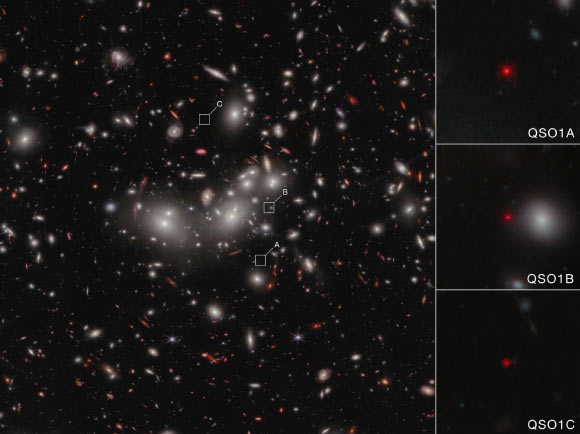

This Webb/NIRCam image shows the little red dot Abell2744-QSO1, magnified and triply imaged by galaxy cluster Abell 2744. Image credit: NASA / ESA / CSA / Lukas Furtak, Ben-Gurion University / Alyssa Pagan, STScI.
The discovery of Abell 2744-QSO1 (QSO1) is challenging the foundational understanding of how the earliest structures in the universe were assembled. Located just 700 million years after the Big Bang, this “little red dot” reveals a supermassive black hole that appears to have developed before its host galaxy, suggesting a reversal of the traditional sequence of cosmic evolution.
Historically, galactic models assumed that stars and gas formed first, eventually collapsing into smaller black holes that grew over eons through mergers and accretion. However, QSO1 presents a different reality: a massive gravitational engine that predates the stellar processes typically required to fuel such growth, at a time when the universe itself was less than 5% of its current age.
Precision Mapping via NIRSpec Infrastructure
The identification of QSO1 was made possible by the James Webb Space Telescope‘s advanced instrumentation, specifically the Near-Infrared Spectrograph (NIRSpec). By utilizing the Integral Field Unit (IFU), researchers were able to move beyond indirect estimations and map the actual kinetic behavior of the hydrogen gas surrounding the black hole, rather than inferring its presence solely from luminosity or emission line widths.
This technological capability allows for the simultaneous acquisition of spatial and spectral data, providing a three-dimensional view of gas velocity and enabling a direct dynamical mass measurement. Because QSO1 is gravitationally lensed by the Abell 2744 galaxy cluster-which acts as a natural magnifying glass-the telescope could resolve details that would otherwise remain invisible across a 13-billion-light-year void.
The work also underscores how space observatories are embedded in an increasingly formal governance system for space science. Missions such as Webb are selected, funded, and operated under the multi-agency framework set out in the United States’ NASA Science Plan, which defines long-term priorities for astrophysics and the public interest obligations that accompany them.
| Metric | Specification/Value |
|---|---|
| Object Designation | Abell 2744-QSO1 |
| Cosmic Age | 700 million years post-Big Bang |
| Black Hole Mass | ~50 million solar masses |
| Mass Distribution | ≥ 66% of total system mass concentrated in the black hole |
| Metallicity | < 0.5% of solar levels |
| Physical Diameter | 1,300 light-years |
Direct Mass Calculation and Keplerian Motion
The breakthrough in measuring QSO1 lies in the observation of Keplerian motion, a benchmark rarely accessible at such extreme distances. By plotting the rotation velocity of surrounding hydrogen gas relative to its distance from the center, the data showed a pattern identical to how planets orbit a star, with velocity decreasing at larger radii in a way that signals a dominant central mass.
“This is important because it tells us that most of the mass of QSO1 is concentrated in the black hole at the center,” said University of Cambridge graduate student Ignas Juodžbalis. “If the mass were more distributed, as it would be if there were a lot of stars, the gas would not have this perfect Keplerian rotation.”
This direct measurement eliminates the reliance on assumptions derived from the local universe, which may not apply to the high-redshift environment where early structure formation followed different rules. Dr. Francesco D’Eugenio noted, “Before now, all of the mass measurements of black holes in the early Universe have been indirect, based on assumptions from what we know about them in the local Universe. We didn’t know if those assumptions really apply to the distant Universe.”
Challenging Galactic Evolution Models
The chemical composition of QSO1 further complicates existing theories. The environment is nearly pristine, consisting almost entirely of hydrogen and helium with negligible amounts of oxygen or other heavy elements. In a typical galaxy, stellar death and supernova events seed the surrounding space with metals; the absence of these elements indicates that QSO1 lacked a significant stellar population and had not yet undergone multiple generations of star formation.
This extreme mass ratio-where the black hole comprises roughly two-thirds of the entire system’s mass-is thousands of times higher than what is observed in modern galaxies, where central black holes usually contain only a small fraction of the stellar mass. Dr. Roberto Maiolino described the find as a “paradigm shift, a total revisiting of the classical scenarios of how black holes form and grow.”
The evidence points toward two theoretical origins for such “born big” anomalies:
- Primordial black holes: Entities formed from high-density fluctuations within the first second after the Big Bang, potentially bypassing the need for any prior stars.
- Direct collapse black holes: The result of massive clouds of pristine gas collapsing directly into a black hole without first forming stars, creating a heavy seed that can grow rapidly.
“It seems that we have found a black hole that does not have a substantial host galaxy and that has predated stellar processes,” Juodžbalis said. “This is very exciting because it is evidence for primordial black holes or direct collapse black holes, which have been theorized but not confirmed.”
The implications suggest that the black hole may have served as the seed around which a galaxy eventually grew, rather than the other way around. For policymakers and research funders, that possibility feeds directly into decisions about how next-generation observatories and public investments in basic science are designed, particularly those aimed at probing the first billion years of cosmic history.
Dr. Cosimo Marconcini emphasized the significance of the data, stating, “This is a phenomenal result. It is the first direct measurement of a black hole mass within the first billion years after the Big Bang, and it is consistent with the previous measurements.”
Whether originating from the first second of existence or the collapse of a giant gas cloud, QSO1 stands as a primary example of the early universe’s capacity for rapid, massive structure formation. As international agencies refine their long-term astrophysics roadmaps under the umbrella of the Outer Space Treaty and related norms on the peaceful use of outer space, discoveries like this one are likely to shape which questions-about black holes, galaxy formation, and the origin of structure-are prioritized in the next generation of public, globally coordinated space missions.