
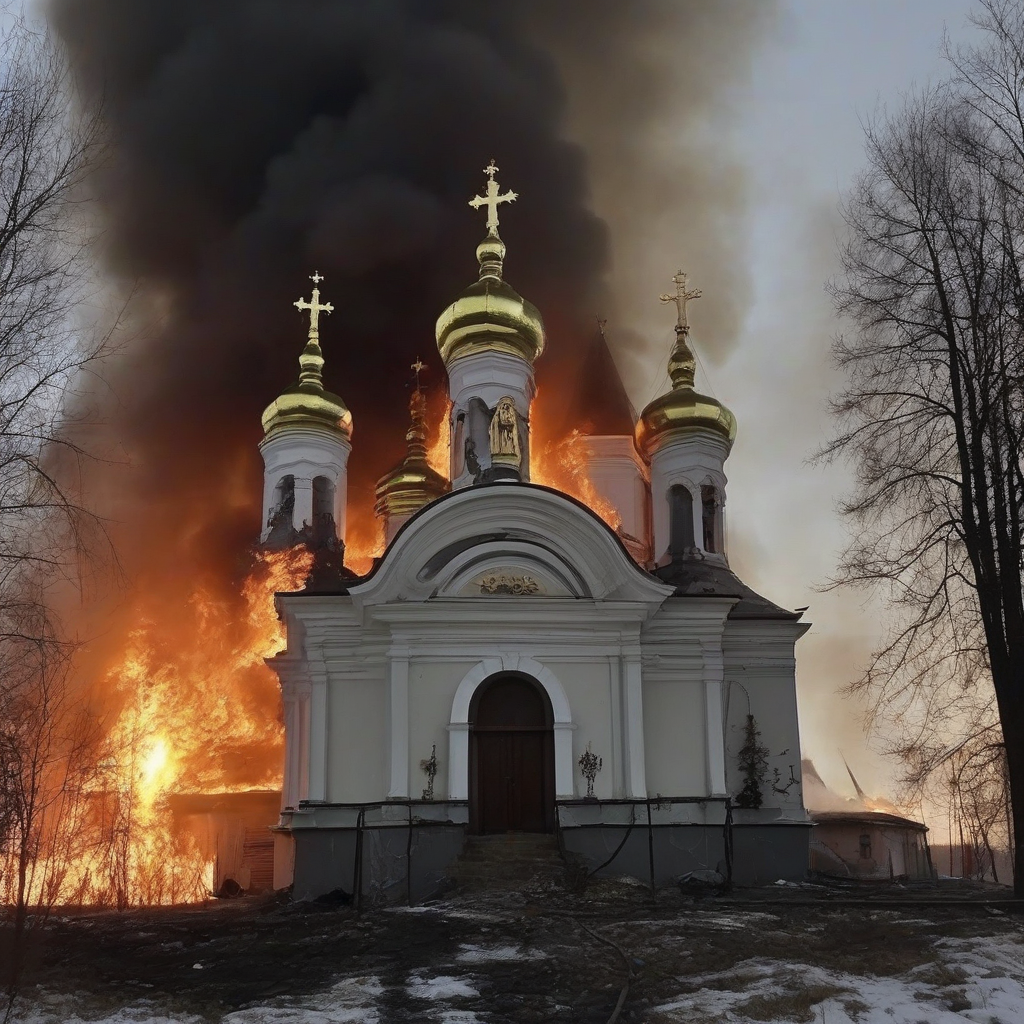
KYIV – Russia launched a massive wave of missile and drone strikes across Ukraine on June 15, 2026, killing at least five people and striking one of the nation’s most sacred religious sites in the capital.
The assault targeted residential buildings and the historic Dormition Cathedral within the Kyiv Pechersk Lavra, a UNESCO World Heritage site. The strikes coincided with high-level diplomatic communications between Ukrainian President Volodymyr Zelenskyy, Donald Trump, and Vladimir Putin regarding the end of the conflict.
Damage to Cultural and Religious Heritage
Footage from the Kyiv Pechersk Lavra, an 11th-century monastery complex and a center of Eastern Orthodox Christianity overlooking the Dnipro River, showed towering flames reaching the domes of the Dormition Cathedral. Six people were reported injured at the site.
The Lavra, sometimes referred to as the Monastery of the Caves, is one of the most prominent religious landmarks in Ukraine’s capital city of Kyiv and forms part of the city’s historic core.[2] Its destruction would represent not only a cultural loss for Ukraine but a blow to the broader Eastern Christian world.
Metropoliton Epiphanius, head of the Orthodox Church of Ukraine, wrote on X:
“[T]he roof of one of the holiest places in the Christian world – the Dormition Cathedral of the Kyiv Pechersk Lavra – is burning.”
Prime Minister Yulia Svyrydenko shared an image of the monastery in flames, describing the event as “a brutal assault on our people and our heritage.”
“This is the true face of Russia’s Orthodox values,” Svyrydenko wrote. “We ask for prayers for the salvation of the shrine from destruction. Another Russian crime against humanity, against history, against Christianity.”
The Lavra is protected under international cultural-heritage law, including the 1954 Hague Convention for the Protection of Cultural Property in the Event of Armed Conflict, which obliges parties to a conflict to refrain from targeting such sites.[1]
Casualties and Urban Impact
In the capital, damage was confirmed at 16 separate locations, including residential blocks and critical urban infrastructure. Residents reported explosions that shook windows in the city center, accompanied by the sound of interceptor launches as Ukrainian air defenses attempted to repel incoming missiles and drones.
Tymur Tkachenko, head of Kyiv’s military administration, reported that at least 10 people were injured in the city. He urged citizens to remain in shelters as new launches targeting the capital continued to be recorded and warned of possible further waves overnight.
Beyond Kyiv, the city of Kharkiv suffered severe casualties:
- At least five people killed.
- Strikes appeared to be a “double tap” attack, a tactic where a second strike targets emergency responders and civilians arriving at the scene of the first explosion.
Local officials in Kharkiv said the pattern of strikes hampered rescue operations and forced emergency services to pause evacuations amid fears of additional incoming fire.
Regional Security and Military Context
The Polish armed forces announced on June 15, 2026, that they had scrambled fighter jets in response to the escalation, citing the need to monitor missile trajectories near NATO airspace. Poland, a member of both the European Union and NATO, also placed ground-based air defense systems and radar reconnaissance on high alert along its eastern flank.
The wave of strikes followed a period of relative quiet in Kyiv, which officials suggest was a preparation phase for Moscow’s missile and drone forces. These attacks come after Vladimir Putin warned that Moscow would implement “systemic” strikes, occurring amid reports of mounting Russian battlefield setbacks and continued Western military assistance to Ukraine.
NATO allies have repeatedly framed large-scale missile barrages on Ukrainian cities as a test of the alliance’s deterrence posture on its eastern border, even when the strikes do not cross into allied territory.
Diplomatic Efforts and Global Parallel
The escalation follows a Sunday conversation between President Volodymyr Zelenskyy and Donald Trump, according to Ukrainian officials. The two discussed efforts to reach an end to the war ahead of a G7 meeting scheduled for this week in France, where leaders are expected to weigh additional security guarantees and long-term military support for Kyiv.
The Kremlin stated that Trump also spoke with Vladimir Putin on Sunday, telling the Russian president that ending the conflict in Ukraine was “vital” and that he was “ready to help.” Russian officials characterized the exchange as preliminary and offered no details on potential formats for negotiations.
While progress toward a peace agreement in Ukraine has remained slow, U.S. mediators have recently focused on Middle East diplomacy. On June 14, 2026, U.S. and Iranian officials announced an agreement on a peace framework to end their conflict, highlighting Washington’s effort to manage multiple flashpoints simultaneously.
The pact between the United States and Iran is expected to be officially signed on Friday in Switzerland. Diplomats say the outcome could shape how major powers approach future security architectures – including any eventual settlement in Ukraine – by testing whether complex, multi-party agreements can be implemented and verified under intense regional pressure.
Related reading
