
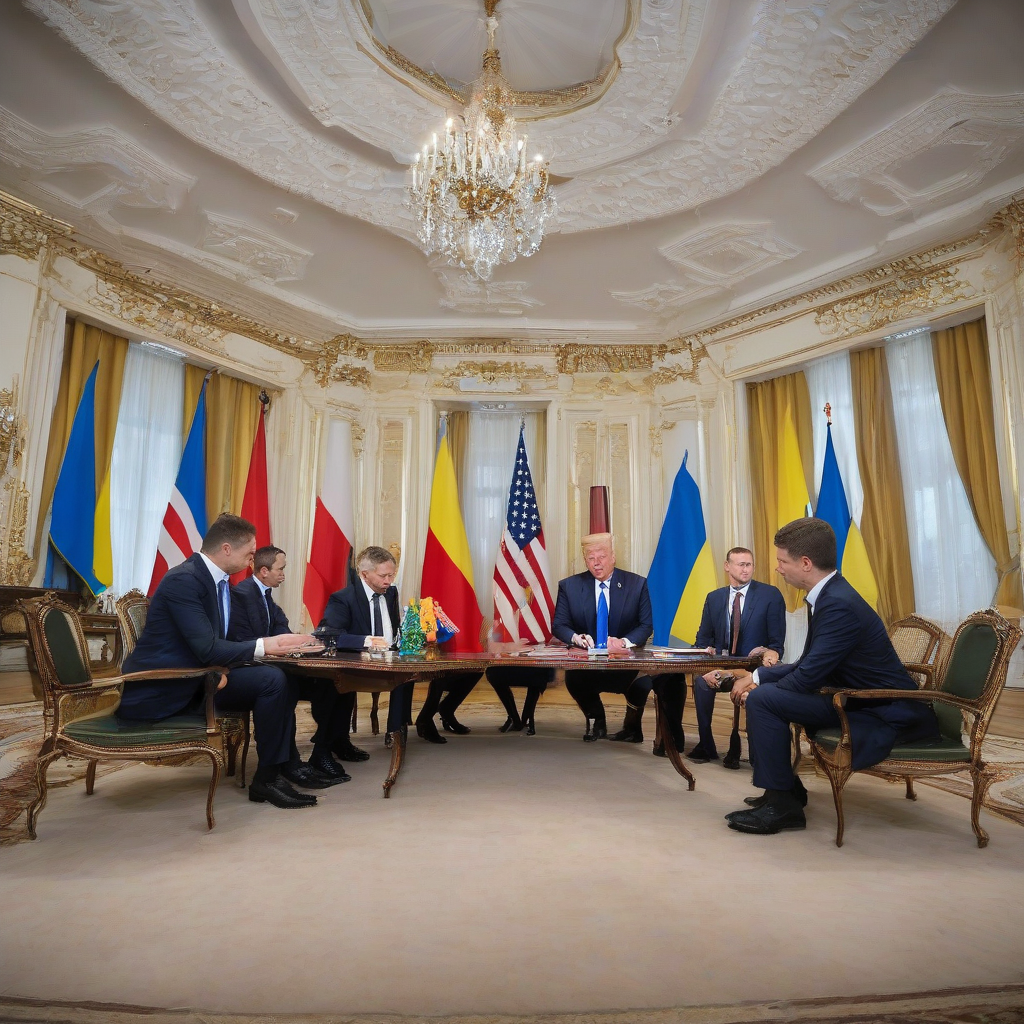
EVIAN – Donald Trump will participate in a G7 working session with Ukrainian President Volodymyr Zelenskyy in France on June 17, though the U.S. president will not hold a separate bilateral meeting with his Ukrainian counterpart, according to a senior administration official.
The engagement occurs as the U.S. administration signals a push for a rapid conclusion to the conflict, amid a series of Ukrainian long-range strikes on Russian energy infrastructure and critical stability efforts at Europe’s largest nuclear power plant.
The G7 summit, comprising the world’s leading industrialized democracies, is scheduled to take place from June 15 to June 17 in Evian, located in the Auvergne-Rhône-Alpes region of France. The gathering is expected to reiterate the group’s commitments to Ukraine and broader security, economic and sanctions policy coordination among members.
Diplomatic Schedule and Strategic Outlook
While the working session with Zelenskyy is confirmed, the U.S. president’s itinerary focuses heavily on other global partnerships and regional power brokers whose positions could influence the contours of any eventual settlement. A senior administration official confirmed that Trump is scheduled to hold bilateral meetings on the sidelines of the summit with:
- French President Emmanuel Macron
- The leader of India
- The leader of Qatar
- The leader of the United Arab Emirates
- The leader of Egypt
The lack of a one-on-one meeting with Zelenskyy follows assertions from the U.S. government regarding the current trajectory of the conflict and the durability of Ukrainian defensive lines. A senior U.S. official, speaking to reporters on condition of anonymity, stated that Russian gains have “more or less stopped.”
“We want the war to end as quickly as possible,” the official added, framing Washington’s objective as securing what they described as a “just and sustainable” peace rather than an open-ended military confrontation.
Any shift in U.S. posture at the summit will unfold under the umbrella of existing Western commitments, including NATO’s collective defense obligations under Article 5 of the North Atlantic Treaty, even as Ukraine remains a partner rather than a full member of the alliance. G7 leaders are also expected to weigh next steps on sanctions enforcement, export controls, and long-term security guarantees designed to deter renewed Russian aggression.
Ukrainian Kinetic Operations in Russia
The diplomatic maneuvering in France coincides with an intensified campaign by Kyiv to target Russian military and energy assets deep within Russian territory – a strategy Ukrainian officials argue is intended to undermine Moscow’s capacity to sustain its offensive. On June 14, local officials reported a Ukrainian drone attack in Russia’s southern Krasnodar region that killed one person and injured three.
Veniamin Kondratyev, the governor of Krasnodar, stated that debris from the drones sparked a fire at a sea terminal, highlighting the growing vulnerability of Russian energy logistics hubs far from the frontline.
While Ukraine’s general staff did not issue a specific comment on the Krasnodar strike, they confirmed overnight operations targeting the following locations:
- An oil preparation and pumping station in the Volgograd region of Russia
- Russian-occupied sectors within Ukraine’s Donetsk region
- Russian-occupied sectors within Ukraine’s Zaporizhzhia region
These actions follow previous statements from President Zelenskyy, who asserted that Ukrainian forces have successfully struck several infrastructure sites inside Russia, including a military factory used for the production of components for Russian missiles and drones. Western diplomats say such strikes are increasingly shaping discussions among G7 leaders about air-defense support, escalation risks and the rules governing the use of Western-supplied weapons.
Zaporizhzhia Nuclear Power Plant Stability
Amid the ongoing hostilities, the International Atomic Energy Agency (IAEA), the United Nations’ nuclear watchdog, announced that the Zaporizhzhia nuclear power plant has been reconnected to the electrical grid. The facility, occupied by Russian forces since early in the invasion, remains a central concern for European regulators because of the potential cross-border impact of any accident.
The restoration of power followed repairs conducted under a localized ceasefire brokered by the IAEA. The facility had lost off-site power late on June 11 after an attack on an electrical substation across the Dnipro River disconnected the Ferosplavna back-up power line.
The outage lasted nearly three days, representing one of the most prolonged power loss events since the start of the war. This incident marked the 19th time the plant has lost off-site power, forcing the facility to rely on emergency diesel generators to maintain the cooling systems for its six shutdown reactors – a scenario the IAEA has repeatedly warned is unsustainable if it were to recur frequently.
The IAEA continues to monitor the facility’s operational status and the integrity of its power supply lines under its mandate to uphold the global nuclear safety regime, which is anchored in instruments such as the Convention on Nuclear Safety. For G7 leaders meeting in Evian, the plant’s latest scare is likely to reinforce calls for stronger safeguards around critical infrastructure and for any future peace arrangement to include explicit provisions on nuclear security and civilian protection.
Worth a look
- Urban Infrastructure Resilience: How European and Asian Megacities Are Adapting to Extreme Climate Oscillations in 2026
- UN General Assembly 2026 Framework on Autonomous Systems: International Diplomacy Faces Algorithmic Governance
- Jay Clayton named White House AI czar by Trump to lead task force (globallypulse.com)
