

Managing the healthcare infrastructure for a global event requires a complex balancing act between routine operational capacity and the necessity for surge readiness. As Vancouver prepares for the FIFA World Cup 2026, regional health authorities are implementing a strategic framework to mitigate the systemic pressures associated with a sudden influx of over a million visitors into a system that is already operating near capacity.
Emergency Department Trends and Surge Readiness
World Cup planning is being layered onto a decade of experience with large events and a post-pandemic system still catching up on delayed care. Data analyzed by Health Emergency Management B.C., Vancouver Coastal Health, and Providence Health Care suggests that mass gatherings do not always result in a linear increase in hospital demand. An examination of previous events between 2010 and 2024 indicates a varied impact on emergency services.
| Analysis Component | Scope of Review (2010-2024) |
|---|---|
| Event Types | 4 major sporting events, 23 festivals |
| Duration | Two dozen events were multi-day |
| ED Arrival Trends | No consistent trend observed |
| Observation | “in some instances, ED arrivals were lower during the event period than in the pre-event period.” |
Despite the lack of a consistent upward trend, planners emphasize that systemic readiness is non-negotiable due to the volatility of high-density crowds. “Given the potential for occasional surges (e.g., the 2011 Stanley Cup Riot at St. Paul’s Hospital), maintaining operational readiness during major events is recommended to manage unexpected spikes in demand,” planners noted. For decision-makers, that translates into staffing, overtime, and contingency budgets that must be committed before anyone knows whether the worst-case scenarios will materialize.
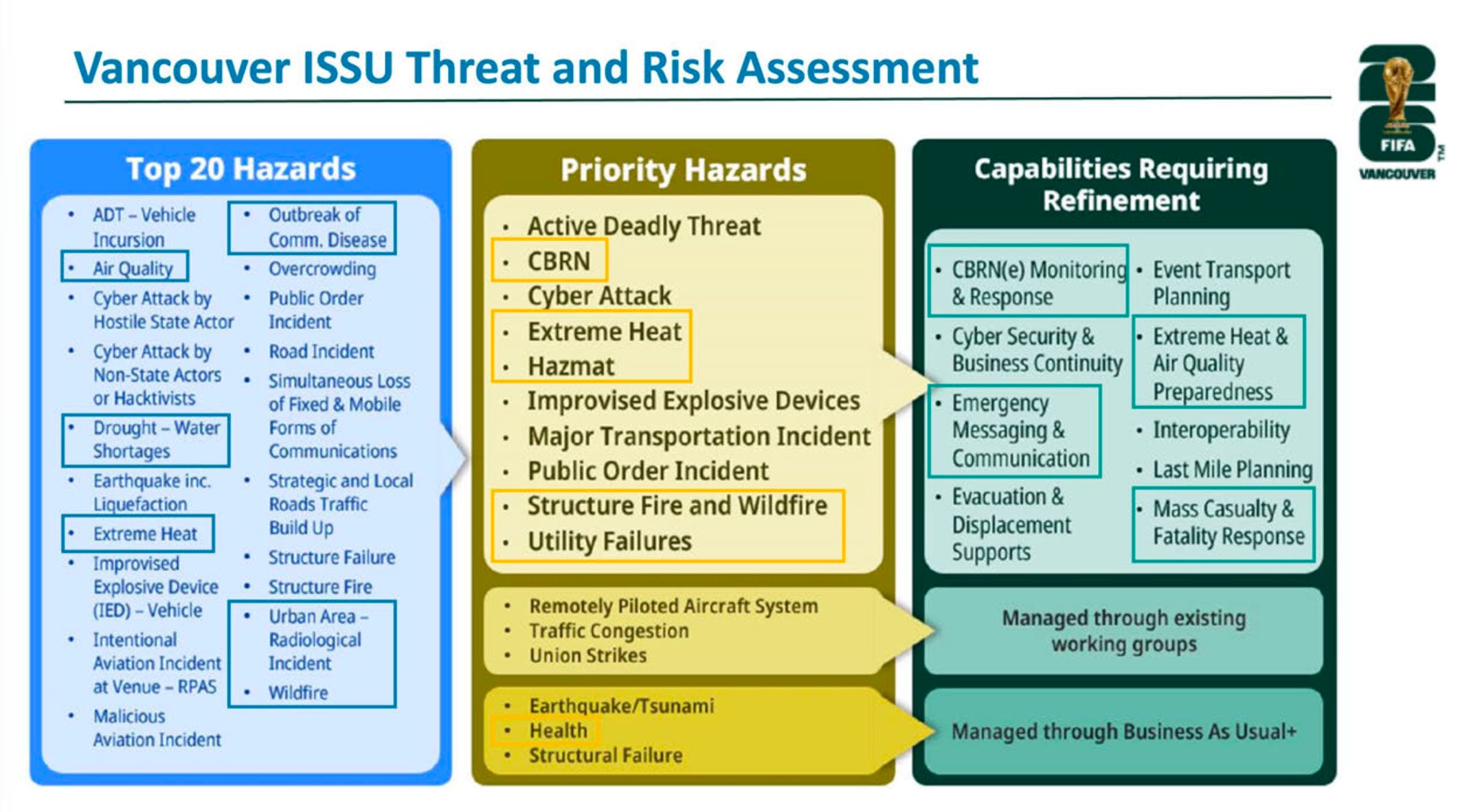
Population-Level Health Hazards
The scale of the tournament, involving seven matches at B.C. Place and a sustained Fan Festival at the PNE grounds, introduces specific public health variables. While planners describe the environment as “low-moderate risk for mass-casualty incidents, but will be highly visible internationally,” they are preparing for a significant spike in the regional population and a correspondingly higher baseline of risk.
Within the provincial public health risk framework, the Provincial Health Officer and the B.C. Centre for Disease Control have identified several primary health risks associated with the gathering of large, international crowds:
- Respiratory viral infections: High-density venues increase the transmission rate of seasonal and emergent respiratory pathogens, especially in enclosed or poorly ventilated spaces.
- Gastrointestinal illnesses: Large-scale food services and international travel increase the risk of foodborne and waterborne outbreaks if standards slip or supply chains are disrupted.
- Toxic drug overdoses: Urban centres already grappling with a declared public health emergency face heightened risks of substance-related emergencies during major festivities.
Health officials anticipate that while primary and acute care demands from tourists will remain modest compared with local demand, there will be a notable increase in medical visits originating from the downtown core and neighboring districts where fan zones, nightlife, and informal gatherings concentrate.
Regional Response and Resource Allocation
To manage an estimated 1.05 million tourists between June 13 and July 19, B.C. Emergency Health Services (BCEHS) is deploying a “multilayered, regional plan for duration of tournament.” That plan is being coordinated with municipal emergency operations and provincial oversight so that local hospitals are not left absorbing unplanned surges alone.
This strategy aims to divert non-emergency cases away from acute care centres to maintain hospital throughput and safeguard capacity for true emergencies. The operational response includes the expansion of the following resources:
- Personnel: Additional supervisors, dispatchers, and specialty paramedics positioned to flex between stadium, fan zones, and surrounding neighbourhoods.
- Fleet: Increased ambulance deployment across the region, with units pre-positioned to account for road closures, security perimeters, and congestion around B.C. Place.
- Diversionary care: Increased use of low-acuity response units and on-site treatment options to handle non-critical calls and reduce unnecessary transports to emergency departments.
Officials describe this as a “whole-of-region” posture: the goal is to prevent care for residents in outlying parts of Metro Vancouver from being crowded out by a month-long, downtown-centred tournament.
Specialized Care and Institutional Logistics
The medical infrastructure for the tournament is bifurcated between general public health and specialized services for FIFA personnel and athletes. Dr. Jim Bovard, the Vancouver Whitecaps’ team physician, serves as the FIFA venue medical lead at B.C. Place, overseeing private clinical services for VIP ticketholders, staff, and players. That parallel system is meant to absorb much of the high-expectation, high-security demand that might otherwise flow into already crowded urban hospitals.
On match days, the stadium’s medical footprint will consist of:
- Two BCEHS ambulances and dedicated paramedics.
- A specialized event medical team and the B.C. Place first aid team.
- Team physicians and the FIFA medical lead.
For high-priority medical needs, institutional protocols have designated Vancouver General Hospital as the primary facility for FIFA players and “individuals appropriate for the designated protected persons unit (e.g. internationally protected people).” This ensures that high-security patients are managed within a controlled environment to avoid disrupting general hospital flow and to meet Canada’s obligations to host state and VIP delegations under established diplomatic and security conventions.
The B.C. government has allocated $242 million toward the broader budget for safety and security, reflecting the intersection of public health preparedness, crowd management, and large-scale urban governance. How effectively that money is translated into front-line capacity – and whether it leaves a durable legacy for the provincial health system once the World Cup leaves town – will be a key test of the tournament’s public policy value for British Columbians.
Keep reading
- Global Antimicrobial Resistance Action: Surveillance Networks and Novel Bacteriophage Therapies in Late 2026
- Wearable Biosensors and Continuous Metabolic Monitoring: Preventive Healthcare’s Next Frontier
- Russian health watchdog denies plague after laboratory worker dies (archysport.com)
- How to Win “El Buen Fin” on Facebook & Instagram: The October Strategy (archyde.com)
