
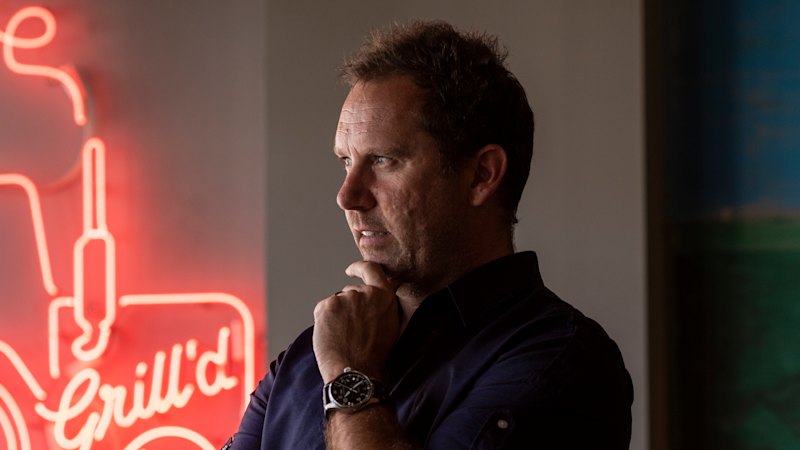
MELBOURNE – Grill’d CEO Simon Crowe is attempting to reconcile the company’s aggressive expansion strategy with a decade-long record of industrial unrest, regulatory sanctions, and high-profile class actions.
The burger chain’s operational model, which balances corporate ownership with a tiered manager-equity program, currently faces scrutiny as the company navigates a systemic conflict between its premium brand positioning and its history of wage disputes.
The tension between the company’s community-centric image and its labor practices has culminated in a new class action filed by Gordon Legal and the Shop, Distributive and Allied Employees’ Association (SDA). The suit alleges a systematic failure to provide workers with mandatory 10-minute paid breaks, with more than 1,700 employees having registered interest. The alleged underpayments relate to minimum standards set out in Australia’s national workplace relations system, overseen by the Fair Work Commission.
Crowe has stated the company will defend its position vigorously, noting that similar litigation has been pursued against other major quick-service restaurant (QSR) operators, including KFC and McDonald’s. For a brand that markets itself on higher-quality ingredients and a “better burger” ethos, the outcome of the case will be closely watched by investors, competing chains and policymakers scrutinising compliance in the low-paid service sector.
Industrial Relations and Regulatory History
The current legal challenge is the latest in a series of clashes with the Fair Work Commission and the Australian judicial system. The chain’s labor issues date back to 2015, when a lawsuit revealed the suppression of wages across 60 stores, leading the Commission to scrap a low-paying enterprise agreement and the Federal Court to order the reinstatement of a terminated employee.
Subsequent years saw the company face allegations regarding the use of government-subsidized traineeships to reduce labor costs and internal audits that uncovered food-safety failures. Those pressures placed Grill’d squarely in the broader national debate over insecure work, youth wages and the appropriate use of training schemes intended to upskill workers rather than displace standard employment.
The following timeline details the company’s primary regulatory and labor conflicts:
- 2015: Federal Court orders reinstatement of worker Kahlani Pyrah; Fair Work Commission scraps outdated pay agreements that had undercut award conditions.
- 2016: Settlement reached with co-founder Geoff Bainbridge following accusations of breached director duties and misappropriation of company resources.
- 2019: Allegations of traineeship exploitation and food-safety breaches lead to the appointment of a global food auditor and a renewed focus on compliance systems.
- 2024: Staff at the Flinders Lane store strike over a proposed enterprise pay deal, signalling organised employee resistance at a flagship CBD site.
- 2025: Fair Work Commission rejects proposed pay deals in April, citing a failure to transparently explain that workers would only be 77¢ a week better off; a revised deal requiring pay top-ups is approved in October after additional undertakings from Grill’d.
- 2026: Gordon Legal launches class action over denied paid breaks, escalating the dispute from the bargaining table to the courts.
Crowe has responded to mounting criticism by positioning Grill’d as a company in transition rather than one in breach, arguing that rapid growth has forced continual adjustments to systems and governance.
“I think we should always be held to a high standard and we should keep improving. We try and do the right thing on all occasions. I don’t think we’re ever perfect, but I think we contribute meaningfully to society and to our communities in a way that we’re really proud.”
The question now facing regulators and unions is whether those incremental improvements have kept pace with the company’s expansion and the expectations of Australia’s modern workplace relations framework.
Corporate Governance and Ownership Structure
The company’s governance has been marked by internal friction, specifically regarding the use of Grill’d resources to fund Koko Black, an artisan chocolate brand Crowe rescued from administration in 2016. While former co-founder Geoff Bainbridge previously alleged that this constituted a breach of director duties, Crowe confirms that Koko Black is now a standalone, profitable entity. The dispute underscored concerns about related-party transactions and the degree of board oversight inside a fast-growing private company.
To incentivize management and stabilize its workforce of 4,000 employees, Grill’d has implemented a tiered ownership program. While approximately 155 of the chain’s 180 stores are corporate-owned, 30 operate under a model allowing managers to acquire stakes of 5%, 15%, or 50% over periods of three to 10 years.
Under this structure, restaurant managers can earn an additional $400,000 over four years beyond their base salary. Supporters inside the company describe the scheme as a mechanism to align store-level decision-making with long-term profitability and brand standards. Critics in the union movement argue that equity incentives do not substitute for strict adherence to award wages, penalty rates and paid breaks mandated under Australian law.
The governance challenge for Grill’d is to demonstrate that its equity model and growth incentives are compatible with robust compliance, rather than creating pressure to trim labor costs at the margins of legality.
Market Positioning and Operational Pivot
Grill’d is currently repositioning itself within the fast-casual segment to compete with both traditional QSR brands and high-end dining. This involves a strategic refit of kitchen layouts and restaurant interiors designed to achieve the transaction speed of a fast-food chain while maintaining a “destinational appeal” for group and corporate bookings. In practice, that means higher average checks and longer dwell times, even as customers expect the convenience and price discipline of quick service.
The company continues to leverage its “Local Matters” program, donating over $1 million annually to charity and closing seven stores on the first Tuesday of every month for meal donations. Those initiatives are central to Grill’d marketing and community engagement, and are now being weighed by customers against the company’s record in paying and protecting its predominantly young workforce.
The company’s current growth trajectory remains aggressive, focusing on increasing its dine-in quotient to differentiate its value proposition from competitors such as GYG, Hungry Jack’s, and El Jannah. Management argues that a more experiential, dine-in model can support higher wages and better training, provided productivity gains from redesigned kitchens and technology investments are realised.
For now, Grill’d remains in a defensive legal posture regarding the ongoing paid-breaks class action while operating under the Fair Work Commission-approved pay agreement mandated in late 2025. The outcome of that case, and any subsequent enforcement action, will help determine whether the company is seen as a test bed for balancing premium branding with low-wage employment – or as a cautionary tale for regulators and boards across the fast-casual industry.
Related reading
