
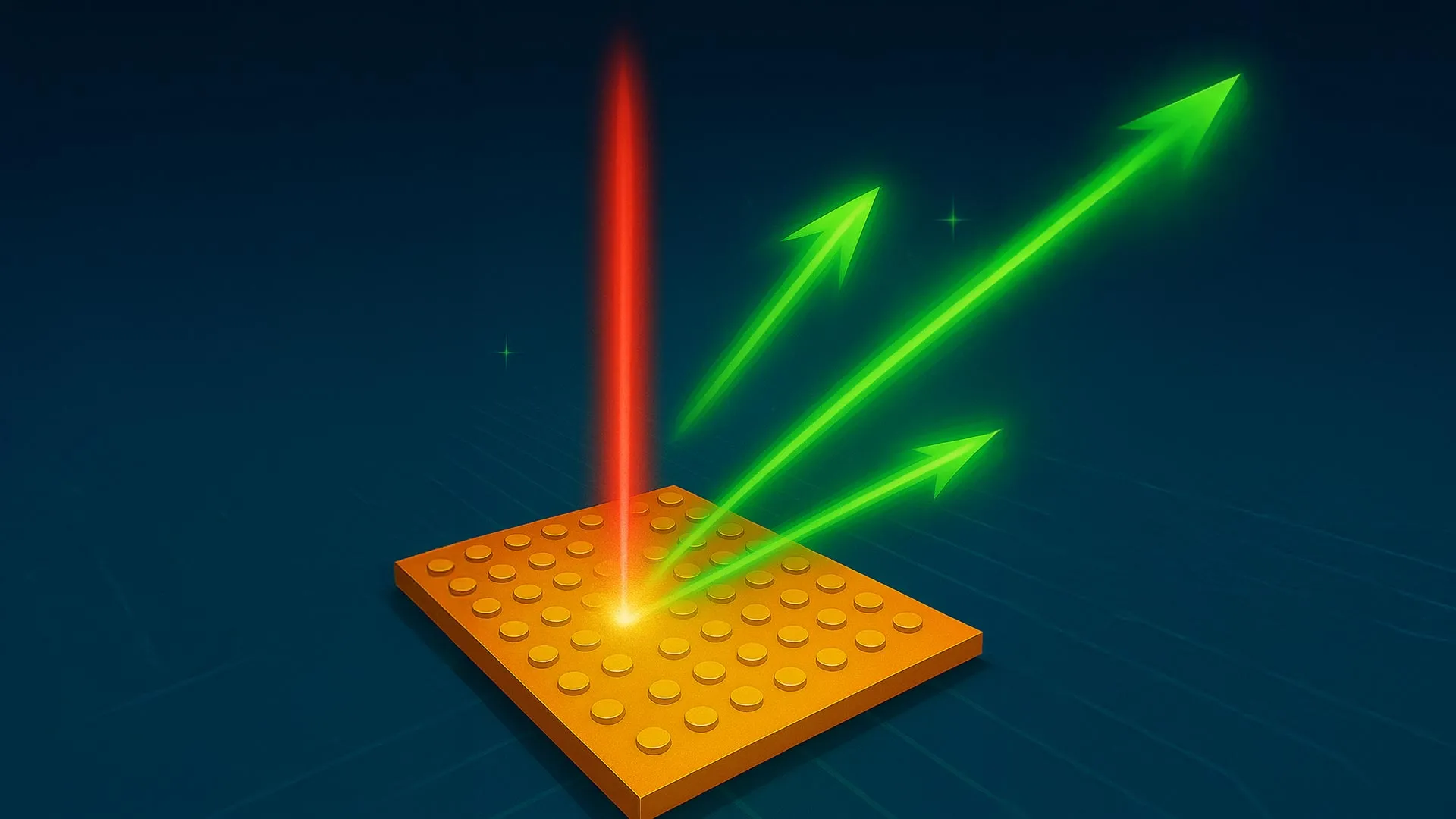
Researchers at the Advanced Science Research Center at the CUNY Graduate Center have built an ultra‑thin metasurface chip that converts invisible infrared light into visible green while steering the outgoing beam-no moving parts required. In lab demonstrations, the device shifted light from roughly 1530 nanometers to about 510 nanometers and directed the converted beam with polarization‑controlled precision. The work, described in the peer‑reviewed journal eLight, advances on‑chip nonlinear optics for sensing, communications, and compute and points toward fully solid‑state alternatives to today’s mechanically steered systems.
A flat, frequency‑converting spotlight that obeys polarization
The metasurface is patterned with subwavelength “meta‑atoms” whose collective resonance traps and intensifies the incoming infrared field, boosting nonlinear conversion to the third harmonic. A carefully designed rotation of each element imprints a spatially varying geometric phase, shaping and steering the emitted green beam in free space. Flipping the input polarization reverses the steering direction, enabling agile, solid‑state beam control that can be driven by compact polarization modulators rather than motors or moving mirrors.
“Think of it as a flat, microscopic spotlight that not only changes the color of light but also points the beam wherever you want, all on a single chip,” said Andrea Alù, founding director of the CUNY ASRC Photonics Initiative and Distinguished Professor at the CUNY Graduate Center. “By encoding the steering in geometry and polarization, we remove many of the knobs and bulk components that normally make optical systems fragile and hard to scale.”
Technical snapshot
| Input wavelength | ~1530 nm (telecom C‑band, widely used in long‑haul fiber networks) |
| Output wavelength | ~510 nm (green), frequency tripled via third‑harmonic generation |
| Nonlinear process | Third‑order (THG); output scales with the cube of input intensity |
| Resonant enhancement | Quasi bound‑state‑in‑the‑continuum (quasi‑BIC) to trap and intensify the pump |
| Beam control mechanism | Geometric (Pancharatnam-Berry) phase from rotated meta‑atoms; switching polarization flips steering |
| Reported efficiency gain | ~100× vs. comparable beam‑shaping metasurfaces lacking collective resonances |
| Actuation | All‑optical; no mechanical motion |
| Form factor | Planar metasurface suitable for chip‑level integration next to lasers, detectors, and control electronics |
Implications for communications, sensing, and compute infrastructure
Efficient, polarization‑addressable beam steering on a frequency‑converting surface intersects several infrastructure needs at once: routing light, monitoring signals, and directing illumination, all from a flat chip that could be fabricated in volume.
- Optical networking: Translating signals from the telecom band into visible wavelengths on chip can simplify optical performance monitoring and enable compact, frequency‑converted diagnostic links or probes within photonic packages, including in data centers where fiber links already operate near 1550 nm.
- Solid‑state LiDAR and 3D sensing: Steering without moving parts improves robustness under vibration and reduces size and calibration complexity relative to mechanical scanners. A chip‑scale, steerable source could help automakers and robotics firms meet long‑term reliability targets while shrinking sensor modules embedded in vehicles or industrial equipment.
- Quantum and scientific instrumentation: Bright, chip‑scale harmonic light can seed or probe quantum emitters and enable compact sources for nonlinear microscopy and precision metrology, potentially migrating capabilities now confined to table‑top optical benches into deployable instruments.
- Edge compute and smart sensors: Integrated light sources that can steer and wavelength‑shift enable spatially selective illumination for depth mapping, gesture recognition, and machine‑vision modules in constrained form factors such as smartphones, drones, and autonomous robots.
How it differs from today’s steering options
Most commercial beam‑steering architectures force a trade‑off between compactness, efficiency, speed, and wavelength flexibility. The CUNY metasurface aims to compress several of those attributes into one patterned film.
- Optical phased arrays (OPAs): Provide electronic beam steering in waveguides with mature silicon processes, but often contend with side‑lobes, thermal tuning overhead, and limited wavelength agility because they are optimized for specific telecom bands.
- MEMS mirrors: Offer wide field of regard and market maturity in consumer LiDAR and projection systems, yet moving parts introduce wear, shock sensitivity, and packaging constraints that complicate qualification for harsh environments and long lifetimes.
- Acousto‑/electro‑optic deflectors: Deliver fast and precise deflection in lab settings but are typically bulkier, power‑hungry, and harder to integrate monolithically with CMOS electronics and waveguides.
- Frequency‑converting metasurface: A passive nanophotonic pattern delivers both color conversion and free‑space steering in a single layer. Polarization controls the direction of the converted beam, offering fast, solid‑state control using compact modulators and avoiding mechanical actuation altogether.
Integration realities: what will determine adoption
For technology buyers and policymakers focused on resilient infrastructure, the key question is what it will take to move this platform from lab prototypes into manufacturable, standards‑compliant components.
- Pump requirements: Third‑harmonic generation is intensity‑hungry; resonant enhancement lowers thresholds but still demands careful laser selection, coupling strategies, and power management to stay within safety and reliability margins.
- Thermal stability: High optical fields can heat subwavelength features; materials and heat‑spreading layers must maintain resonance alignment over the temperature swings seen in automotive, aerospace, and outdoor telecom deployments.
- Bandwidth and tolerance: Quasi‑BIC resonances are narrow; fabrication variability and temperature drift must be managed to keep the pump on resonance, likely through tighter process control or active stabilization.
- Wafer‑scale manufacturability: Transitioning from electron‑beam patterning to deep‑UV or nanoimprint lithography will be key for volume and cost, and will influence which semiconductor foundries can support the required feature sizes.
- Packaging: Efficient in‑ and out‑coupling between fibers, waveguides, and free space requires co‑designed micro‑optics and alignment features that fit within existing photonic‑integrated‑circuit packaging standards.
- Material platform choices: The geometric concept is material‑agnostic, but compatibility with back‑end processes, refractive‑index control, and reliability qualifications will shape which industrial ecosystems-silicon photonics, III-V, or emerging dielectrics-can host it.
Regulatory and safety layers that will shape commercialization
Any move from laboratory experiment to deployed hardware will run through a thicket of laser safety and sector‑specific rules that influence procurement and certification decisions.
- Laser eye safety: System designs must meet the United States occupational laser safety requirements, which reference international laser‑classification schemes, for both near‑infrared pumps and visible outputs. How much power designers can safely send through the metasurface will determine its role in automotive, industrial, and consumer products.
- Automotive pathways: LiDAR deployments face ISO 26262 functional‑safety processes, electromagnetic‑compatibility testing, and automotive‑grade component requirements. A solid‑state, chip‑scale steering element could simplify functional‑safety cases by reducing moving parts but will still need to demonstrate predictable failure modes and long‑term stability.
- Telecom environments: Operation in fiber‑optic bands brings interoperability expectations for wavelength control, noise, and reliability within photonic modules governed by carrier and standards‑body specifications. Integrators will look for evidence that metasurface‑based devices can be qualified alongside conventional lasers, modulators, and detectors.
Signals for the roadmap
The metasurface combines collective resonance for efficiency with per‑element phase engineering for control, bridging a trade‑off that has long limited nonlinear beam‑shaping devices. The team points to stackable or cascaded metasurfaces optimized across different bands to widen spectral coverage and extend steering range in future iterations, including potential operation in the ultraviolet and other visible colors.
Funding for the project came from the U.S. Department of Defense, the Simons Foundation, and the European Research Council, underscoring the strategic interest major public institutions now place on compact, controllable light sources for sensing and secure communications. “This platform opens a path to ultra‑compact light sources and beam‑steering elements for technologies like LiDAR, quantum light generation, and optical signal processing, all integrated directly on a chip,” said lead author Michele Cotrufo, a former postdoctoral fellow at CUNY and now an assistant professor at the University of Rochester. “Because the concept is driven by geometry, not by one specific material, it can be applied to many other nonlinear materials and across different colors of light, including the ultraviolet.”
Keep reading
